Home Cheesemaking: A Beginner’s Guide to Fresh Cheese

Home cheesemaking starts with one decision: how you make the milk proteins clump together. Fresh cheeses use either acid, rennet, or live culture to drop pH and set a curd — and for the easiest ones you can have warm ricotta on toast about 40 minutes after the pot hits the stove. That single coagulation choice, plus a thermometer and a kitchen scale, is most of what separates a clean batch from a grainy mess.
I came to cheese sideways. I keep kraut and kimchi crocks going, brew kombucha and vinegar, and run koji and miso on a heat mat — all of it the same family of organisms dropping pH in a controlled way. Fresh cheese is that exact reflex pointed at milk: measure the dial, hit the number, and the curd behaves. This guide is the map for the whole cluster — the fresh, simple cheeses you can make in an afternoon. For the aged, cave-conditioned varieties, that is a different room entirely, and I send you to the curing chamber for those.
What “fresh cheese” actually means
Fresh cheese is any cheese you eat within days of making it, with no aging, no rind, and no mold ripening. Ricotta, paneer, mozzarella, queso fresco, chèvre-style soft cheese, and simple pressed farmhouse rounds all live here. Moisture stays high, pH stays in a friendly range, and the flavor is milky and clean rather than sharp or funky.
The reason fresh cheese is the right starting point is risk and feedback. You are not holding a product at cellar temperature for months hoping the right organisms win. You set the curd, you drain it, you salt it, you eat it. The failure modes are visible the same day — too acidic, too rubbery, too wet — and the next batch fixes them. In my kitchen the fresh cheeses behave like a quick lacto-pickle: short cycle, fast lesson, low stakes. Aging is the long miso of the cheese world, and I treat it as a separate discipline.
The three ways milk becomes curd
Every cheese in this cluster sets through one of three mechanisms, and knowing which one you are using tells you what milk to buy, what temperature to hold, and what can go wrong.
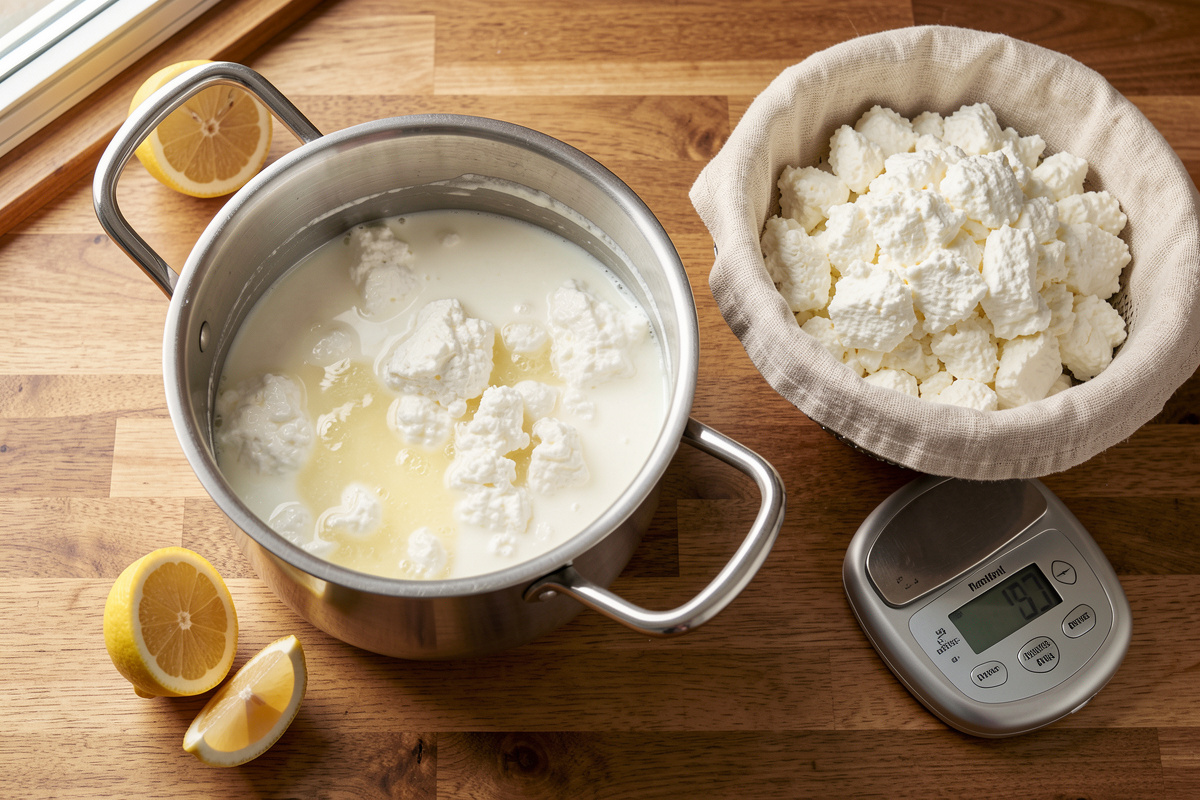
Acid coagulation is the simplest. You heat milk close to a near-simmer — usually 185–195°F (85–90°C) — and add an acid like lemon juice, white vinegar, or citric acid. The drop in pH (toward roughly 5.3 and below) destabilizes the casein proteins and they flocculate into soft curds. Ricotta and paneer work this way. No special culture, no rennet, no waiting. This is the acid-set route I cover in the ricotta guide.
Rennet coagulation uses an enzyme (chymosin) that snips a specific bond on the casein, letting the proteins knit into a firm, sliceable gel at much lower temperatures — often 85–105°F (29–40°C). Rennet curds are cleaner, springier, and the base for anything you want to stretch or press. Mozzarella and simple pressed cheeses rely on it. The whole subject of which rennet to buy and how to dose it is its own topic in the cultures and rennet guide.
Culture (lactic) coagulation lets live bacteria — the same Lactobacillus and Lactococcus families I run in my vegetable crocks — slowly ferment lactose into lactic acid, dropping pH over hours and setting a soft curd. Soft lactic cheeses and the acidification step before stretching mozzarella both use this. Most real cheeses combine culture and rennet: the culture sets the flavor and pH, the rennet sets the structure.
The measurement lens: why I weigh and meter everything
Most cheese writing online is folklore — “until it looks right,” “a good splash of vinegar,” “a pinch of salt.” That vagueness is exactly why beginners get grainy ricotta and rubbery paneer. Cheese is a controlled process, and there are only a few dials.
Temperature decides whether your proteins set gently or seize. I keep a probe thermometer in the pot for every batch — acid-set cheeses want that near-simmer band, rennet cheeses want body temperature. A 10-degree miss is the difference between tender ricotta and tight rubbery pellets.
pH is the dial that turns cheese rules into risk management, exactly like it does in my kraut crocks and kombucha. Pathogens cannot establish below about pH 4.6, and most fresh cheeses finish well under that or are eaten so fresh and cold that it is moot. For stretching mozzarella, pH is not optional: the curd will only stretch in a narrow window around 5.2–5.3. I check it on the same calibrated pH meter I use for vinegar, with paper strips as a backup cross-check.
Salt by weight is the last dial. I salt everything by weight on a 0.1 g scale — a fresh cheese is typically salted at roughly 1–2% of the drained curd weight, and a brine for mozzarella or pressed cheese runs in the 5–8% salt-by-weight range. Eyeballing salt is how you get a bland round one week and an inedible one the next. The equipment guide covers the scale and meter that make this possible.
The milk problem nobody warns beginners about
The single most common reason a first rennet cheese fails is the milk. Ultra-pasteurized (UHT) milk — the kind with a months-long shelf life — has been heated so hard that the whey proteins denature and bind to the casein, and the calcium balance shifts. Rennet then cannot form a clean, knittable curd; you get a weak, soupy set or none at all. This is not your technique. It is the carton.
For rennet cheeses, buy the lowest-temperature pasteurized whole milk you can find — ideally just “pasteurized,” not “ultra-pasteurized.” If your only option is standard store milk, a small dose of calcium chloride restores enough of the calcium balance to get a usable curd; it is the standard fix and I treat it as a default for store milk. Acid-set cheeses like ricotta and paneer are far more forgiving — they will set even from ultra-pasteurized milk, because you are bludgeoning the proteins with heat and acid rather than coaxing them with an enzyme.
Raw milk makes excellent cheese and is what traditional recipes assume, but its legality and safety vary by jurisdiction and it carries a genuine pathogen risk that pasteurization removes. I am not going to adjudicate that for your area — if you use it, you are taking on that risk knowingly. For everything in this cluster, good pasteurized whole milk is the reliable default.
The fresh cheeses, ranked by difficulty
Here is how the cluster lays out, easiest first. Each row is a full guide of its own. If you have never made cheese, start with ricotta, make paneer next, then attempt mozzarella once you trust your thermometer.
| Cheese | How it sets | Difficulty | Hands-on time | Approx. yield (per 4 L / 1 gal milk) |
|---|---|---|---|---|
| Ricotta | Acid + heat | Easiest | ~40 min | About 450–550 g |
| Paneer | Acid + heat, pressed | Easy | ~30 min + press | About 350–450 g |
| Mozzarella | Citric acid + rennet, stretched | Moderate | ~1 hour | About 350–450 g |
| Simple pressed cheese | Culture + rennet, pressed | Moderate | ~2 hours + press | About 450 g |
The numbers above are working figures from whole pasteurized milk; richer milk gives higher yield, and skim gives less. Yield is the cheapest feedback you get — if a batch comes in dramatically low, you either lost curd to over-acidification or your milk was thin.
Ricotta — the gateway cheese
Acid-set, no rennet, no culture, done in under an hour. Heat milk (or a milk-and-cream blend) to the near-simmer band, add acid, watch the curds break from the whey, scoop and drain. It is the cheese I tell every beginner to make first because it teaches the look and feel of a clean break with almost no risk. Full method in the ricotta guide.
Paneer — pressed, firm, and unmeltable
Paneer is acid-set like ricotta but then pressed under weight until it is firm enough to cube and fry. Because it is acid-set rather than rennet-set, it does not melt — that is a feature, not a flaw, and the reason it holds its shape in a curry. The paneer guide covers the press, the salting, and getting the texture firm without it turning dry.
Mozzarella — the one that teaches pH
Fresh mozzarella is where the measurement lens earns its keep. You acidify milk with citric acid, set it with rennet, then heat the curd and stretch it like taffy — but the stretch only works in a tight pH window around 5.2–5.3. Hit it and you get glossy, elastic mozzarella; miss it and you get a crumbly or stringy mess. The mozzarella guide walks the whole pasta filata process step by step.
Simple pressed cheese — the bridge to aging
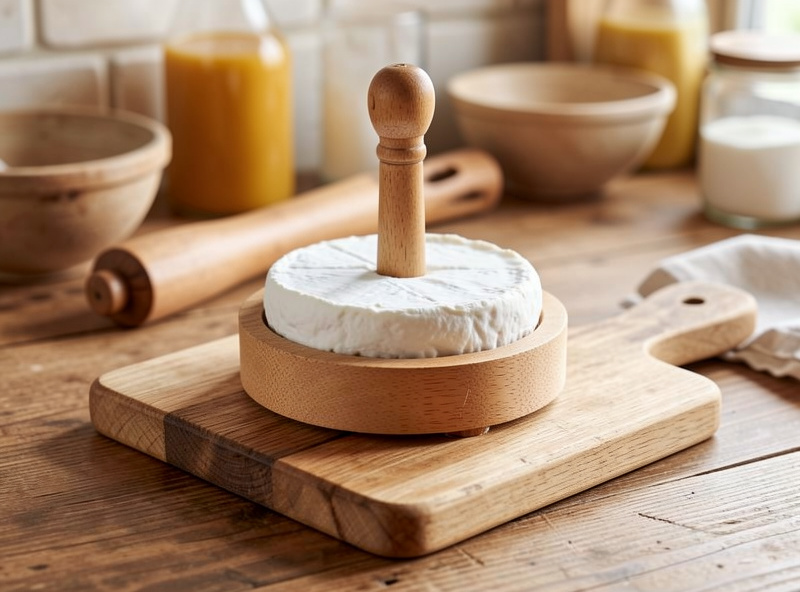
A basic pressed cheese uses a mesophilic culture for flavor and acidity, rennet for a clean curd, then a press to expel whey and knit a sliceable round. It is the natural next step once fresh cheeses feel routine, and it is the doorway to aged cheese. My pressed cheese for beginners guide keeps it to an unaged or briefly-aged round so you learn pressing and salting before you commit to weeks of patience.
Cultures, rennet, and the two ingredients that confuse everyone
Once you move past pure acid-set cheeses, two ingredients enter the picture and they are where most beginners stall. Cultures are the bacteria that ferment lactose into lactic acid — mesophilic strains that work at room-to-warm temperatures (roughly 70–90°F) and thermophilic strains that want it hot (110–130°F). They are the same lactic workhorses I keep alive in my vegetable crocks, just selected and packaged for dairy. Rennet is the coagulating enzyme, and it comes as animal, microbial, or fermentation-produced (FPC) types, in liquid or tablet form, each with its own dosing.
Getting the dose right matters: too much rennet gives a bitter, over-firm curd, too little gives a weak set. I do not eyeball either one. The full breakdown — which culture for which cheese, how to store them, how to measure rennet, and why calcium chloride belongs in your kit — lives in the cultures and rennet guide. If you only read one supporting article before buying ingredients, read that one.
The equipment you actually need
You do not need a creamery. For fresh cheese, the real kit is short: a large non-reactive (stainless) pot, an accurate thermometer, a long knife or spatula to cut the curd, a colander, and butter muslin or fine cloth for draining. Add a kitchen scale for salt, and a pH meter once you start caring about mozzarella and pressed cheese. A simple press — even a homemade one made from a tin and a weight — covers paneer and pressed rounds.
What I would not skip: the thermometer and the scale. Those two tools convert cheesemaking from luck into a repeatable process. I run the same probe thermometers and 0.1 g scale across my whole fermentation bench, and they earn their place on every batch. The full kit, with what to buy first and what to skip, is in the cheesemaking equipment guide. There is real overlap with my general fermentation equipment toolkit, so if you already ferment, you own half of it.
Food safety: where the real risk lives
Fresh cheese is low-risk compared with aged cheese or charcuterie, but the risk is not zero, and being calm about it means knowing exactly where it sits. Three things keep fresh cheese safe.
First, start from pasteurized milk unless you are knowingly accepting raw-milk risk. Pasteurization removes the pathogens that soft, high-moisture cheese would otherwise let grow — soft fresh cheeses are a classic Listeria vector when made from contaminated raw milk. Second, keep it cold and eat it fresh. These cheeses have no preservative rind and high moisture; treat them like fresh dairy, refrigerate immediately, and eat within a week (a few days for the softest). Third, salt and acidity are your preservatives — a properly salted, properly acidified cheese is far more stable than a bland, high-pH one, which is one more reason to weigh your salt and check your pH rather than guess.
What you do not need to fear: clean fresh curd, a little whey weeping, or the milky smell of a young cheese. What you should respect: any fuzzy, colored, raised mold on a cheese that was supposed to be eaten fresh (toss it), milk that smells off before you start, and equipment that was not clean. I cover cleaning and when sterilizing actually matters in the equipment sterilizing guide.
How fresh cheese connects to the rest of the bench
The thing that makes cheese click is realizing it is not a separate hobby. The sauerkraut crock and the cheese pot are running the same chemistry — Lactobacillus and its relatives dropping pH — at different scales and substrates. The same patience that watches a sourdough starter rise and a vinegar mother build acidity watches a cheese curd firm up. Fresh cheese is genuinely one of the fastest, most rewarding entries into the whole world of cultured food, and the dials you learn here — temperature, pH, salt by weight — transfer to every other ferment on the bench. When you are ready to take a pressed round and actually age it into something with a rind and weeks of character, that is the moment to step over to the curing chamber.
Your first batch, start to finish
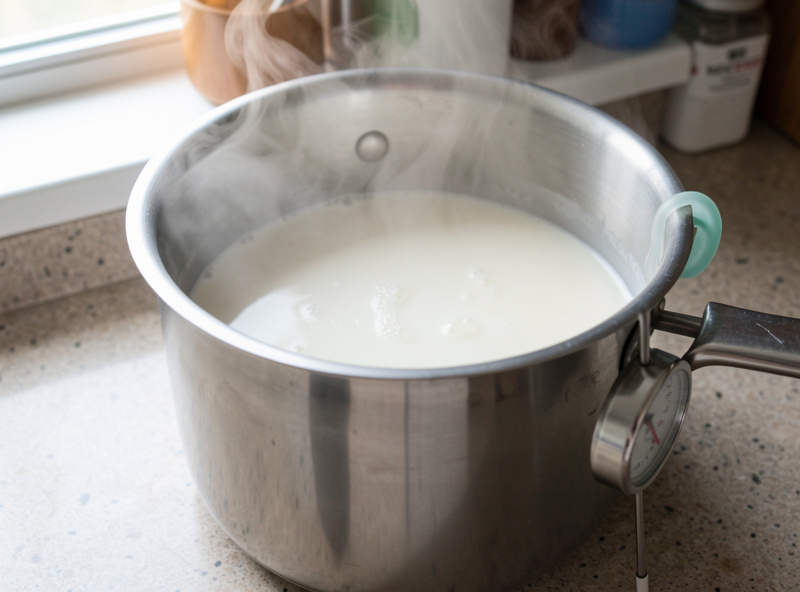
If you have read this far and want a concrete first run, here is the shape of a ricotta batch — the cheese I push everyone toward first. Pour a gallon of whole pasteurized milk into a large stainless pot. Clip in your thermometer and heat slowly over medium, stirring now and then so the bottom does not scorch. As it climbs past 175°F the milk will start to steam and foam at the edges; ease off the heat as you approach 190–195°F. You are looking for hot-but-not-boiling — a rolling boil tears the curd apart.
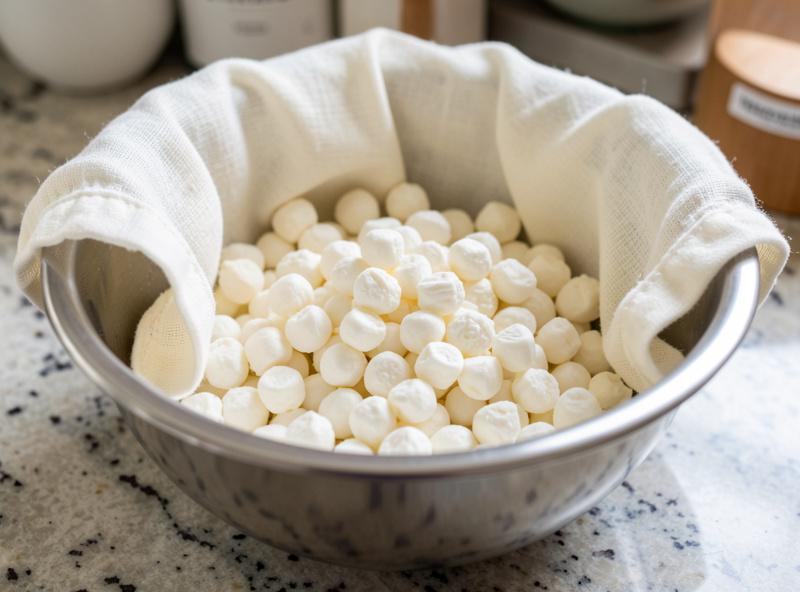
Off the heat, stir in your acid: roughly a third of a cup of lemon juice or white vinegar per gallon, added a splash at a time. Within a minute you will see the milk separate — soft white curds rising through clear, faintly green whey. That separation is “the break,” and learning to recognize a clean break is the whole skill. Let it sit undisturbed for ten minutes, then ladle the curds into a colander lined with butter muslin. Drain to the texture you want — a few minutes for spoonable, longer for firm. Salt by weight at about 1% of the drained curd, and you are done. That is cheese, made with confidence, in under an hour.
Five mistakes that ruin a first cheese
Almost every failed first batch traces to one of these, and all five are easy to avoid once you know them.
Boiling instead of heating. A hard boil makes acid-set curds tough and grainy. Hold the near-simmer band and pull off the heat before it rolls. Using ultra-pasteurized milk for a rennet cheese. As covered above, UHT milk fights the enzyme — switch milk or add calcium chloride. Eyeballing the salt. Salt is flavor and preservation; weigh it every time so the result is repeatable. Over-draining. Walk away from a draining ricotta for an hour and you get a dry crumble instead of a creamy spread; check it. Dirty or soapy equipment. Cheese is a clean-milk product. Residual soap film flavors the curd and stray bacteria can sour it; rinse well and, when it matters, follow the cleaning notes in the equipment guides.
None of these are skill problems. They are setup problems, and a thermometer, a scale, and clean gear remove four of the five before you start.
What to do with all that whey
Every gallon of milk leaves you with most of its volume as whey, and throwing it out feels wrong because it is. Sweet whey from a rennet cheese still holds milk sugar and a little protein — it makes a genuinely good bread liquid (it feeds a sourdough beautifully), a braising liquid, or the base for a second cheese. In fact, traditional ricotta — the name means “recooked” — was originally made from the leftover whey of other cheeses, reheated until the last proteins flocculate. Acid whey from ricotta or paneer is more sour and best used in baking or compost. I treat whey like the brine left over from a pickle crock: not waste, just the next ingredient.
Frequently Asked Questions
What is the easiest cheese to make at home?
Ricotta is the easiest. It is acid-set, needs no rennet or culture, and is done in about 40 minutes: heat milk to roughly 190 degrees Fahrenheit, add lemon juice or vinegar, drain the curds. It is the cheese to make first because the risk is minimal and the technique transfers to paneer.
Why won’t my milk set into curd with rennet?
Almost always the milk. Ultra-pasteurized (UHT) milk is heated so hard that rennet cannot form a clean curd. Use low-temperature pasteurized whole milk, or add a small dose of calcium chloride to standard store milk to restore the calcium balance rennet needs.
Do I need a pH meter to make cheese?
Not for acid-set cheeses like ricotta and paneer. But for mozzarella, pH is essential because the curd only stretches in a narrow window around 5.2 to 5.3. A calibrated pH meter, with paper strips as a backup, turns mozzarella from guesswork into a repeatable result.
Is homemade fresh cheese safe to eat?
Yes, when you start from pasteurized milk, keep the cheese refrigerated, and eat it within a few days to a week. Fresh cheese has high moisture and no protective rind, so treat it like fresh dairy. Raw-milk soft cheese carries a real pathogen risk and depends on local law.
How much milk do I need for a batch of cheese?
One gallon (about 4 liters) of whole milk yields roughly 350 to 550 grams of fresh cheese depending on the type and the milk fat. Richer milk gives more cheese; skim gives less. A gallon is the standard home batch size for ricotta, paneer, and mozzarella.
What is the difference between a culture and rennet?
A culture is live bacteria that ferment lactose into lactic acid, building flavor and dropping pH. Rennet is an enzyme that coagulates milk proteins into a firm, sliceable curd. Many cheeses use both: the culture sets flavor and acidity, the rennet sets structure.
Related Guides
- How to Make Ricotta at Home
- Homemade Paneer: The Complete Guide
- Fresh Mozzarella Making: A Step-by-Step Guide
- Simple Pressed Cheese for Beginners
- Cheesemaking Cultures and Rennet Guide
- Cheesemaking Equipment for Beginners

About Kenny Nyhus Fadil
A home fermenter documenting brines, bubbles, and the occasional moldy tragedy.