Controlling Sugar and Carbonation in Natural Sodas

You control carbonation in a fermented soda by controlling one thing: how much fermentable sugar is left in the bottle when you seal it. More residual sugar means more gas and higher pressure; less means a gentler fizz. As a working figure, about 17 grams of sugar per liter fully fermented yields roughly 1% alcohol and a proportional slug of CO2 — so sugar is the single dial that sets both fizz and sweetness.
This is the article where the measurement lens earns its keep. Most soda content treats carbonation as luck — “bottle it and hope.” It isn’t luck. With a scale and a way to read sugar, fizz becomes a number you set on purpose, the same way I set a brine by weight or confirm a kombucha’s pH on my meter. Once you can measure the sugar going in, you can dial a soda from a soft, sweet spritz to a bone-dry, hard-hissing pop and hit it repeatably.
The catch is that sweetness and fizz pull against each other, because the culture has to eat the sugar to make the gas. Understanding that trade-off — and how to cheat it — is the whole game. This piece sits inside the broader method in the complete fermented soda guide; here we go deep on the numbers.
How Does Sugar Control Carbonation?
Sugar controls carbonation because CO2 is a direct byproduct of the culture eating sugar — every gram fermented in the sealed bottle produces a fixed amount of gas. The microbes convert simple sugars into roughly equal parts CO2 and alcohol; trap that CO2 in a sealed bottle and it dissolves into the liquid as fizz. So the amount of unfermented sugar present at bottling sets the ceiling on how much gas you can build.
This is why the timing of bottling matters as much as the recipe. During the open first fermentation (F1), the culture is steadily eating the sugar you started with. Bottle early and lots of sugar remains, so the sealed second fermentation (F2) generates plenty of gas — and plenty of pressure. Bottle late, after the culture has eaten most of it, and there’s little left to carbonate the bottle. The soda’s fizz is decided at the moment you seal it, by how much fuel you leave inside. Home brewers formalize this with priming-sugar math — the American Homebrewers Association publishes priming-sugar tables for exactly this — where roughly 3.5–4 grams of sugar per liter produces about one “volume” of CO2, and a well-carbonated soda sits around 3–4 volumes.
How Much Sugar Does a Soda Need?
A fermented soda base typically starts around 5–10% sugar by weight (50–100 g/L) and is bottled while roughly 1–2% (10–20 g/L) of fermentable sugar remains, which carbonates the bottle without over-pressurizing it. Fruit juices bring their own sugar into this range; sugar-water and herbal-tea bases need sugar added to reach it. The exact number depends on how sweet you want the finished soda and how much fizz you’re chasing.
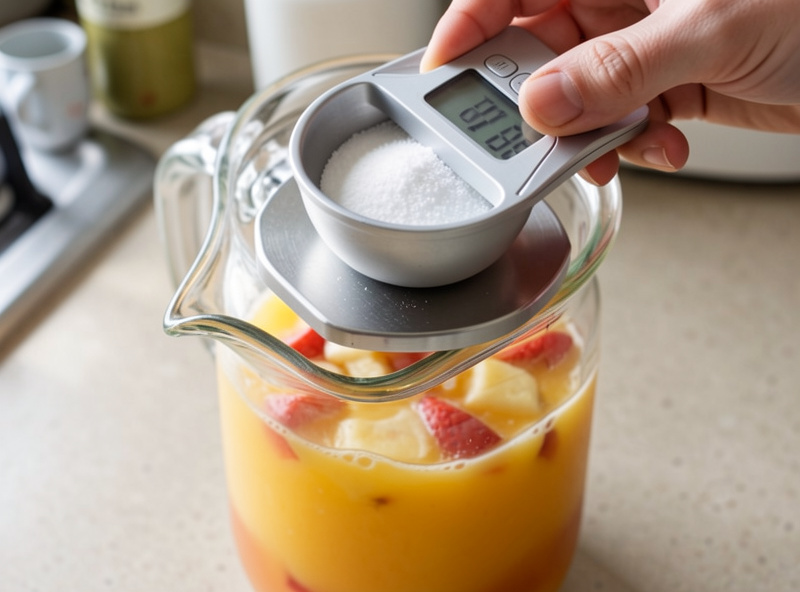
In practice I don’t try to hit a perfect residual number — I leave a safe surplus and let the plastic gauge bottle and the fridge control the endpoint. A reliable default for a quart of soda is a base at roughly 8–10% sugar, fermented in F1 for a day or two until it’s still clearly sweet but has visibly started working, then bottled. That leaves comfortably more than enough sugar to carbonate, and I stop the process by cold-crashing the moment the gauge firms up rather than by trying to time the sugar to zero. If you want a stronger fizz, add a measured teaspoon of sugar per bottle at sealing (about 4–8 g) as dedicated priming sugar — a trick borrowed straight from bottle-conditioned beer.
Measuring Sugar: Brix, Refractometer, and the Scale
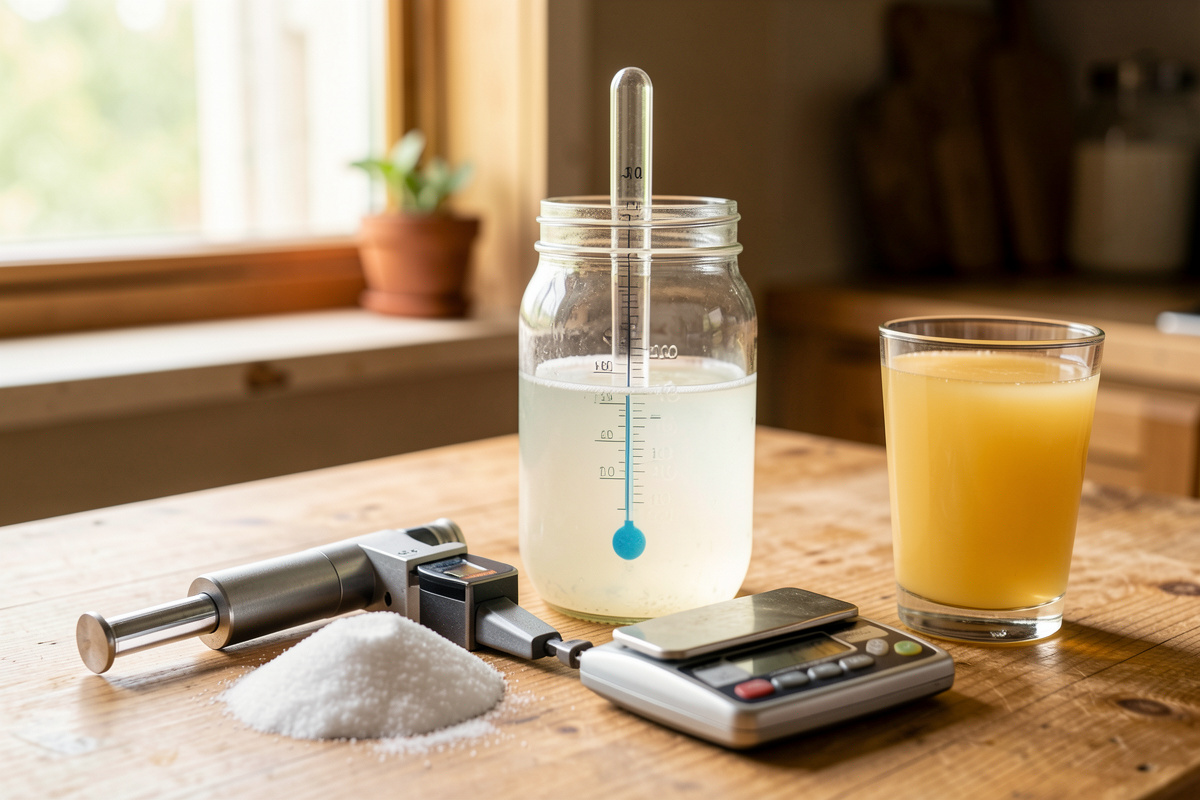
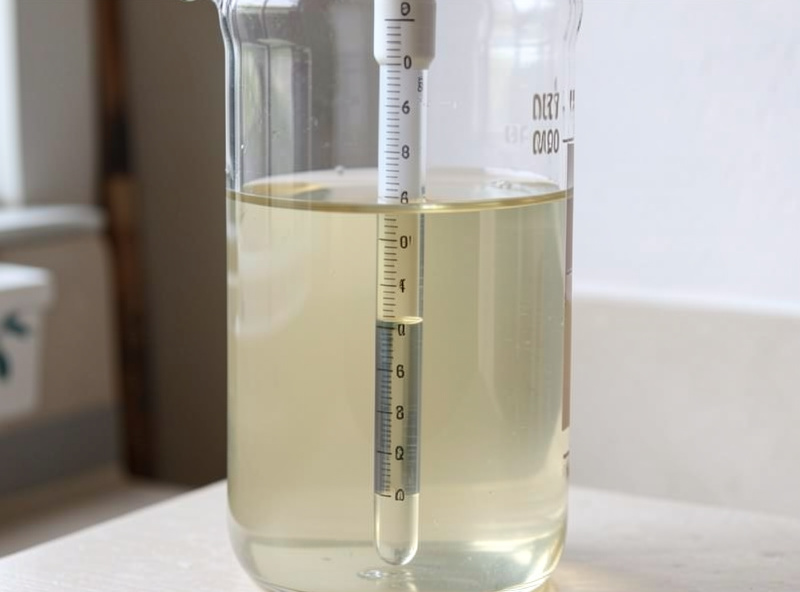
The two tools that turn guesswork into control are a 0.1 g kitchen scale for adding sugar by weight and a refractometer or hydrometer for reading how much sugar is in the liquid. The scale sets your starting sugar precisely; the refractometer or hydrometer tells you how far the culture has eaten it, so you know when to bottle. Neither is essential to make soda, but together they make it repeatable.
A refractometer reads sugar in degrees Brix — °Brix is defined as dissolved solids by mass, so on a fruit juice full of glucose, fructose, and acids rather than pure sucrose it reads as a close approximation rather than an exact sugar figure — where 1 °Brix is roughly 1% sugar by weight (about 10 g/L). I take a starting Brix on the fresh base — a fruit soda might read 9–11 °Brix — and I know it’s time to bottle once it has dropped a couple of points but still tastes sweet, which means fermentable sugar remains for the bottle. A hydrometer does the same job by measuring specific gravity in a test jar; it needs more liquid but doubles as an alcohol estimate. On my bench I weigh every sugar addition on a 0.1 g scale rather than using volume, because a “cup” of sugar varies enough between pours to swing a batch from flat to over-carbonated. I learned that the expensive way: early on I primed a batch of berry soda by eye, a heaped spoon per bottle, and three of them gushed halfway up the kitchen wall the moment I cracked the seals — every sugar addition has gone on the scale since. Precision in, predictability out.
Sugar, Sweetness, and Fizz: A Reference
Here’s how I map residual sugar at bottling to the finished soda, at a typical room temperature around 70°F (21°C). Treat it as a starting guide and adjust to your culture and taste; the gauge bottle is still the final authority on when to chill.
| Residual sugar at bottling | Approx. Brix | Finished sweetness | Carbonation | Notes |
|---|---|---|---|---|
| Under 0.5% (under 5 g/L) | Under 1 | Dry | Weak, may stall | Too little fuel; add priming sugar |
| ~1% (~10 g/L) | ~1 | Off-dry | Light spritz | Good for a subtle, adult soda |
| ~1.5% (~15 g/L) | ~1.5 | Lightly sweet | Solid fizz | My everyday target |
| ~2% (~20 g/L) | ~2 | Sweet | Strong, watch pressure | Cold-crash promptly |
| Over 3% (over 30 g/L) | Over 3 | Very sweet | Risk of over-carbonation | Bottle-bomb territory if left warm |
How Do You Control the Carbonation Level?
You set the carbonation level by choosing how much fermentable sugar remains at bottling and how long you let F2 run before chilling. For a light spritz, bottle with less residual sugar or refrigerate sooner; for a hard, sharp fizz, bottle sweeter or let the sealed bottle build pressure longer before cold-crashing. The plastic gauge bottle tells you where you are along that curve.
Temperature is the second lever, and it works on speed rather than ceiling. A warm room drives F2 fast, so a sweet batch can over-carbonate in under a day — which is why I cold-crash promptly in summer and cover the mechanics in bottle-conditioning fermented soda safely. If a batch comes out flat despite decent sugar, the culprit is usually cold or a weak starter rather than the recipe, and the fixes live in why my fermented soda is flat and how to get fizz. Between sugar at bottling, F2 time, and chill timing, you can place a soda anywhere from barely-tingling to Champagne-sharp on purpose.
How Do You Get Fizzy but Not-Too-Sweet Soda?
The way to get a soda that’s both fizzy and low in sweetness is to ferment it drier for the gas, then back-sweeten to taste right before drinking and refrigerate immediately. Because fizz requires the culture to eat sugar, you can’t have maximum fizz and maximum sweetness at once in a shelf-stable bottle — but you can separate the two by adding sweetness back after the carbonation is done and cold has stopped the culture.
In practice: let the bottles carbonate fully, cold-crash them, and then stir a little sugar, honey, or fruit juice into the glass — or into a bottle you’ll drink that day and keep refrigerated. The cold keeps the culture too sluggish to ferment the new sugar into more pressure, so the sweetness stays put and the bottle stays safe. What you must not do is add sugar to a sealed bottle you then leave warm; that’s how you turn a nicely carbonated soda into a bottle bomb, because you’ve just handed a live culture fresh fuel in a closed container. Ferment for fizz, sweeten for taste, and keep it cold once you’ve done both — that’s how you beat the trade-off honestly.
Does More Fizz Mean More Alcohol?
Yes, to a degree — because the culture produces CO2 and alcohol together, so the sugar that becomes fizz also becomes a small amount of ethanol. Wild fermented sodas typically finish between 0.5% and 2% ABV, and the more sugar you ferment in the bottle, the higher both the carbonation and the alcohol climb. For most people at soda strength this is trivial, but it’s worth understanding if children will be drinking it or if you’re avoiding alcohol entirely.
The same 17-grams-per-liter rule of thumb frames it: every liter of sugar the culture fully ferments adds roughly 1% ABV. Since a soda is bottled with only a small residual sugar load and chilled before it all ferments, the alcohol stays low — but a soda left warm for a week, over-carbonating, is also quietly climbing past 2%. The levers that keep alcohol down are the same ones that keep pressure down: ferment cooler, bottle with modest residual sugar, and cold-crash promptly rather than chasing maximum fizz. If you want a genuinely near-zero-alcohol soda, ferment it very briefly for just a light spritz and refrigerate early, or lean on the back-sweetening method so you’re not fermenting a big sugar load in the first place. Fizz and alcohol ride the same curve, and the fridge is the brake on both.
The Takeaway: Fizz Is a Number You Set
Control comes down to measuring the sugar in and stopping the ferment at the right point out. Weigh your sugar, read the Brix if you have a refractometer, bottle while sweetness remains, keep a plastic gauge, and cold-crash on cue. Do that and carbonation stops being a mystery and becomes a setting — light, medium, or sharp, hit on purpose batch after batch.
That repeatability is the whole reason I bring the same scale and refractometer to soda that I bring to brines and kombucha. Fermentation isn’t folklore when you put numbers on it; it’s a controlled process with a couple of dials and some safe ranges. Learn the sugar dial and you can make exactly the soda you want, every time, instead of the one the batch happened to give you.
Keep Building
- Fermented Sodas: The Complete Guide to Wild Fizz
- How to Make and Maintain a Ginger Bug Starter
- Bottle-Conditioning Fermented Soda Without Exploding Bottles
- Why My Fermented Soda Is Flat and How to Get Fizz
How do I control how fizzy my fermented soda is?
Fizz is set by how much fermentable sugar is left when you seal the bottle and how long you let it build pressure before chilling. Bottle with more residual sugar or let it run longer for a sharper fizz, or bottle drier and refrigerate sooner for a light spritz. Use a plastic gauge bottle to judge where you are.
How much sugar does fermented soda need to carbonate?
A soda base usually starts around 5 to 10 percent sugar and is bottled while roughly 1 to 2 percent, about 10 to 20 grams per liter, still remains. That residual sugar carbonates the bottle. As a rule of thumb, around 17 grams of sugar per liter fully fermented yields about 1 percent alcohol and a proportional amount of gas.
Can I make a fermented soda that is fizzy but not sweet?
Yes, by separating the two. Ferment the soda drier so the culture makes plenty of gas, then back-sweeten to taste right before drinking and refrigerate immediately. Do not add sugar to a sealed bottle left warm, because that gives the live culture fresh fuel and can create a bottle bomb.
Do I need a refractometer or hydrometer to make soda?
No, but they make results repeatable. A refractometer reads sugar in degrees Brix and a hydrometer reads specific gravity, so either tells you how far the culture has eaten the sugar and when to bottle. A 0.1 gram scale to add sugar by weight is the more important tool for consistency.
Why does my soda get too sweet or not sweet enough?
Sweetness and fizz compete because the culture eats sugar to make gas. If you want it sweeter you have to bottle earlier and accept less fizz, or cold-crash sooner. If it is too sweet and over-carbonated, you bottled with too much sugar; next time bottle drier or chill earlier.

About Kenny Nyhus Fadil
A home fermenter documenting brines, bubbles, and the occasional moldy tragedy.