How to Make and Maintain a Ginger Bug Starter

To make a ginger bug starter, stir 1 tablespoon of grated fresh ginger and 1 tablespoon of sugar into 1 cup of dechlorinated water in a jar, then feed it the same amounts daily. In 5–7 days at room temperature it turns cloudy, fizzy, and yeasty-sharp — that’s a live culture of wild yeast and Lactobacillus ready to carbonate soda.
The ginger bug is the cheapest, most forgiving culture on my bench, and it’s the one I recommend anyone start with. I keep a jar of it going year-round in my Swedish kitchen alongside the sourdough starter and the kombucha SCOBY hotel, and unlike those two it costs almost nothing to rebuild if it dies — a knob of ginger and a spoon of sugar. Once it’s alive it will carbonate fruit soda, root beer, and lemonade indefinitely.
Most first attempts fail for exactly one of two reasons, and both are avoidable: chlorinated tap water that stuns the microbes, or too little sugar to feed them. I’ve killed a bug each way. Get the water and the sugar right and this is nearly foolproof.
What Is a Ginger Bug?
A ginger bug is a wild fermentation starter — a living culture of yeast and lactic-acid bacteria captured from the skin of fresh ginger and fed on sugar. It’s the botanical equivalent of a sourdough starter: a self-sustaining population you keep alive by feeding, and then use to inoculate other things. In this case it inoculates sweet liquids and turns them fizzy.
The microbes come pre-installed. Fresh, unpeeled ginger root carries a community of wild Saccharomyces yeast and Lactobacillus on its skin, the same way grapes carry the yeast that ferments wine. When you submerge grated ginger in sugar water and keep feeding it, you’re not adding anything magic — you’re just giving that native community food and time to outcompete everything else. The yeast makes CO2 and a little alcohol; the Lactobacillus drops the pH and keeps spoilage organisms out. On my pH meter an established bug sits comfortably under 4.0.
People confuse the ginger bug with water kefir, and they’re genuinely different tools. Water kefir uses fixed grains — a stable, purchased culture that behaves the same every batch. A ginger bug is wild-caught and a little more variable, but it’s free to make and it lends a clean gingery note the grains don’t. I run both, and I cover the grain route in the water kefir guide for beginners; for the wider map of which culture suits which soda, see the complete fermented soda guide.
How Do You Make a Ginger Bug From Scratch?
You build a ginger bug over about a week by starting a jar and feeding it daily until it comes alive. The whole process needs three ingredients — fresh ginger, sugar, and dechlorinated water — plus a jar, a cloth cover, and a rubber band. No special equipment, no purchased culture.
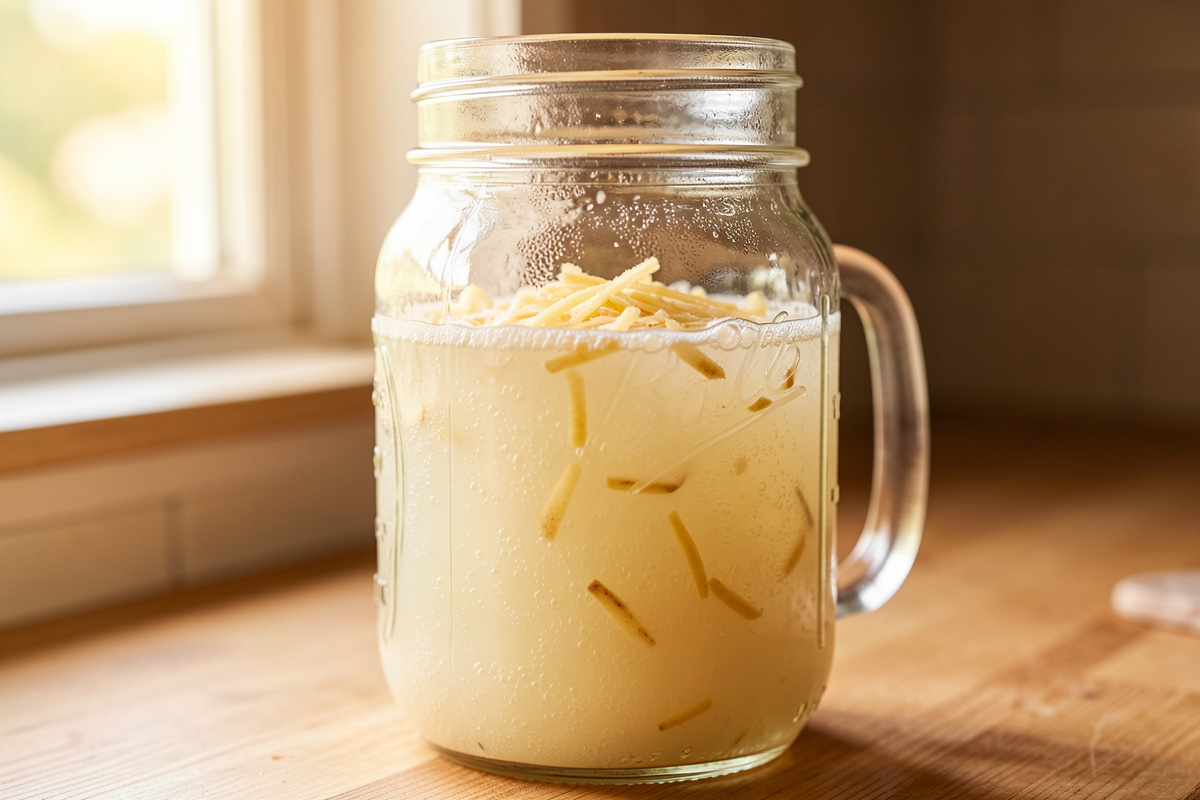
Here’s the exact routine I use. Day 1: into a clean pint jar, add 1 tablespoon grated unpeeled ginger, 1 tablespoon white sugar, and 1 cup of dechlorinated water (see below on water). Stir hard to dissolve, cover with a breathable cloth secured with a band, and leave it on the counter out of direct sun. Days 2–6: every day, stir in another tablespoon of grated ginger and a tablespoon of sugar, and give it a good stir to introduce oxygen — the yeast needs air to build population early on. Somewhere around day 4 or 5 you’ll see fine bubbles rising when you stir, and it’ll smell yeasty and sharp rather than raw-vegetal. That fizz is the finish line.
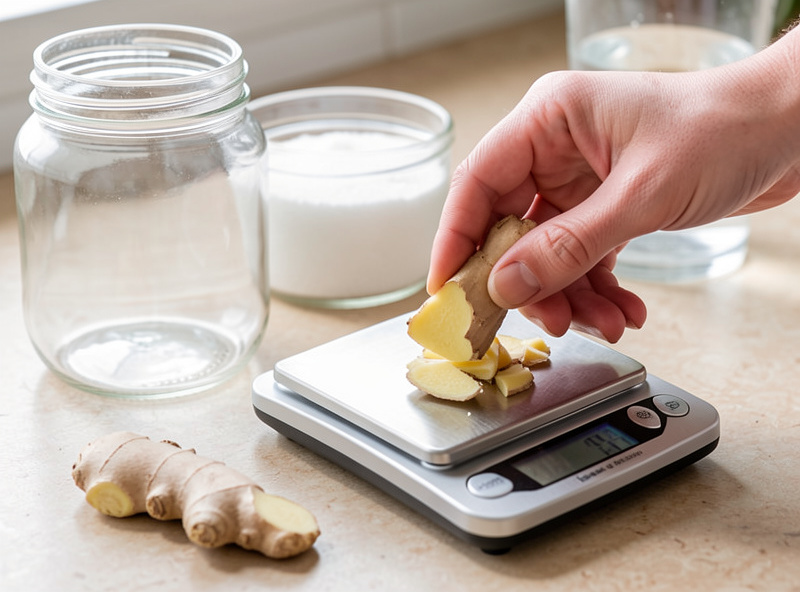
A few specifics that matter. I grate ginger unpeeled and I weigh nothing here — a tablespoon is close enough at this stage, roughly 8–10 grams. Use a wide-mouth jar so stirring is easy and gas escapes. Keep it between about 68 and 75°F (20–24°C); colder and it drags, hotter and it can go off. And use white cane sugar to start — it’s the most neutral, predictable food. Honey will partly inhibit the bacteria and raw sugars muddy the early signal, so save those for later once the bug is strong.
Do You Have to Use Organic Ginger?
You don’t strictly need organic ginger, but it noticeably improves your odds, because the wild yeast lives on the skin and some conventional ginger is irradiated or treated in ways that reduce that surface population. Given the whole point is harvesting skin microbes, I buy the freshest, unwaxed, organic ginger I can and I never peel it for a bug.
The failure mode here is subtle: a bug made from treated ginger doesn’t die dramatically, it just sits there sluggish and refuses to fizz, and beginners assume they did something wrong with the method. The first bug I ever tried to build did exactly that — flat for eight days on plain supermarket ginger — and a switch to knobbly organic root from the same recipe was bubbling in five. If organic isn’t available, buy the freshest conventional ginger you can find, scrub it lightly rather than scouring it, and never peel it. The skin is the inoculant.
Water is the other input people get wrong. Municipal tap water is chlorinated or chloraminated specifically to kill microbes, which is exactly the wrong thing for a culture you’re trying to grow. Let tap water sit out uncovered overnight to let chlorine gas off, or run it through a carbon filter; chloramine is more stubborn and won’t off-gas, so filtered or spring water is safer if your utility uses it. This is the same reason chlorinated water stalls a sauerkraut crock — the chemistry doesn’t care which ferment it’s sabotaging.
How Do You Know Your Ginger Bug Is Ready?
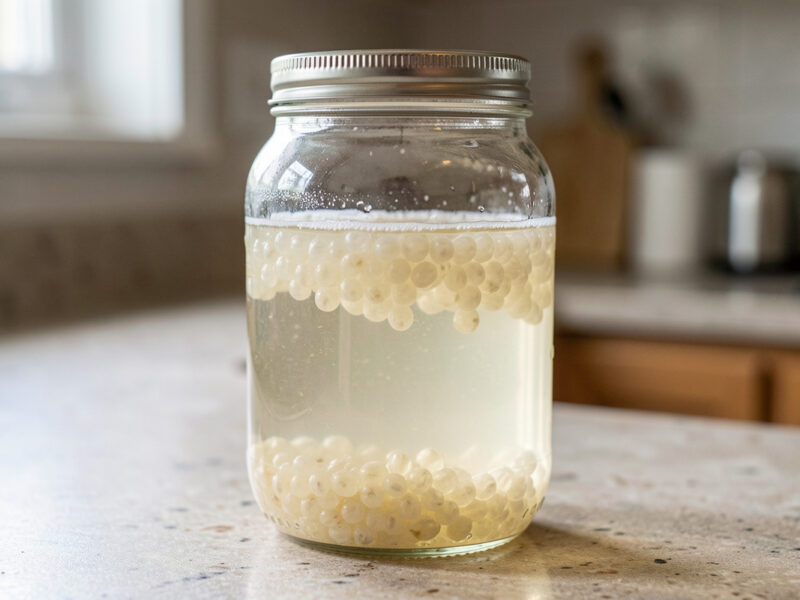
A ginger bug is ready when it fizzes actively within a few hours of feeding, smells yeasty and pleasantly sharp, and shows bubbles rising through the liquid on their own. That usually lands on day 5 to 7. If you stir it and hear a faint hiss or see a rush of bubbles, it’s alive and strong enough to carbonate a soda.
Use your senses, not the calendar. The three ready signals I trust: sight — the ginger sinks and floats as gas lifts it, and the liquid goes cloudy; sound — a soft effervescent hiss when you stir or feed; and smell — bright, yeasty, faintly boozy and gingery, never rotten, never like nail polish. A whiff of solvent or rotten egg means something went wrong and you should start over. A ready bug also settles into a rhythm: it responds to each feeding with a burst of activity within hours rather than days.
One reassurance about looks. It’s normal for the liquid to be cloudy, for a little sediment to collect, and for the ginger to discolor slightly. What’s not normal is fuzzy or colored growth on the surface — that’s mold, and it means toss and restart. A flat, thin, wrinkly film is more likely kahm yeast, which is harmless, but on a young bug I don’t take chances: if I’m unsure, I rebuild. Ginger and sugar are cheap; a stomachache isn’t worth the gamble.
How Do You Maintain and Store a Ginger Bug?
Once alive, you keep a ginger bug going by feeding it — daily if it lives on the counter, weekly if you park it in the fridge. It’s a pet that eats sugar and ginger, and it’ll outlast most of your other kitchen projects if you keep it fed. I run mine the same way I run my sourdough: fast cycles warm, slow cycles cold.
For active use, keep it on the counter and feed a tablespoon each of ginger and sugar daily. When you use some to make soda, just top the jar back up with fresh water, ginger, and sugar to replace what you took — that’s back-slopping, and the bug rebounds within a day. For storage between soda projects, cover it with a proper lid and move it to the fridge, where the cold slows the culture to a crawl; feed it about once a week with a spoon of ginger and sugar so it doesn’t starve. To wake a fridge-stored bug, bring it to room temperature and feed it daily for two or three days until it’s fizzing hard again before you trust it with a batch.
| Situation | Location | Feeding rhythm | Notes |
|---|---|---|---|
| Building from scratch | Counter, 68–75°F | Daily, ginger + sugar | Ready in 5–7 days |
| Active soda-making | Counter | Daily, plus top-up after use | Keep it bubbling |
| Storage between batches | Fridge | About once a week | Cold stalls it safely |
| Waking from the fridge | Counter | Daily for 2–3 days | Fizz before you brew |
Strain out old, fibrous ginger occasionally if the jar gets crowded — I do it every couple of weeks — and if the liquid ever gets too syrupy or funky, pour off half and refresh with new water, ginger, and sugar. A healthy bug is remarkably resilient. Mine has survived a two-week holiday in the fridge with no feeding and bounced back after three days of counter feeding.
Why Isn’t My Ginger Bug Bubbling?
A ginger bug that won’t bubble is almost always suffering from one of three things: chlorinated water, cold temperature, or treated ginger with too few wild microbes. Fix the input and most “dead” bugs turn out to be merely stalled. In years of running one I’ve thrown out far fewer than I’ve rescued.
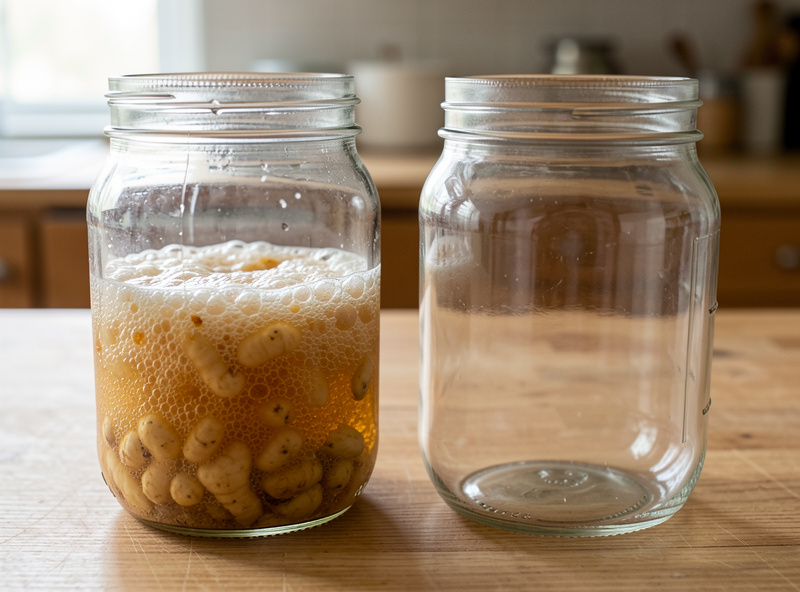
Work through it in order. First, water — if you used straight tap water, that’s the likeliest culprit; switch to filtered or dechlorinated water going forward. Second, temperature — below about 65°F the yeast barely works, so move the jar somewhere warmer, near the top of the fridge or a low seedling heat mat, and give it two warm days before you judge it. Third, ginger — if it’s been a week of daily feeding with warm dechlorinated water and still nothing, your ginger probably lacked live yeast; start over with fresh organic root. And feed consistently: a bug that’s fed erratically starves and sulks. The same cold-and-weak-culture logic explains most flat sodas downstream, which I lay out in the guide to fermented drinks beyond kombucha.
What Can You Make With a Ginger Bug?
A finished ginger bug carbonates almost anything sweet: ginger beer, fruit sodas, root beers, herbal tonics, and lemonades. You use it by straining off some of the liquid — roughly a quarter cup per quart of soda base — and stirring it into your sweetened juice or tea, then bottling to trap the fizz. The bug is the yeast engine; the base is the flavor.
The classic first project is ginger beer, from bug to bottle — a strong ginger tea, sugar, and a shot of bug, carbonated in a couple of days. From there the bug pushes into fruit sodas, spiced root beers, and old-world tonics. Even something as simple as tepache — usually made with just pineapple’s own wild yeast — carbonates faster and more reliably with a splash of active ginger bug added. Keep the bug alive and you’ve got the front end of an entire home soda program.
As an Amazon Associate I earn from qualifying purchases. I build my bugs in plain wide-mouth quart mason jars, which make daily stirring and straining easy.
Related Reading
- Fermented Sodas: The Complete Guide to Wild Fizz
- Ginger Beer Fermentation Guide: Ginger Bug to Bottle
- Water Kefir Guide for Beginners
- Tepache: Fermented Pineapple in Four Days
How long does it take to make a ginger bug?
About 5 to 7 days at room temperature. You feed it a tablespoon each of grated ginger and sugar daily until it turns cloudy, fizzes when stirred, and smells yeasty and sharp. Cold kitchens take longer, sometimes up to 10 days.
Do I need to peel the ginger for a ginger bug?
No, and you should not. The wild yeast and bacteria that power the culture live on the skin of the ginger, so peeling removes the very microbes you are trying to capture. Just scrub it lightly and grate it unpeeled.
Why is my ginger bug not bubbling?
The three usual causes are chlorinated tap water, a kitchen colder than 65 degrees Fahrenheit, or treated ginger with too few wild microbes. Switch to dechlorinated water, move it somewhere warm, and if it still fails after a week of daily feeding, restart with fresh organic ginger.
Can I store a ginger bug in the fridge?
Yes. Cover it with a lid and refrigerate it between soda projects, feeding it a spoon of ginger and sugar about once a week so it does not starve. To use it again, bring it to room temperature and feed it daily for two or three days until it is fizzing strongly.
How much ginger bug do I use to make soda?
Roughly a quarter cup of strained ginger bug liquid per quart of sweetened juice or tea. Stir it in, bottle in pressure-rated bottles to trap the carbonation, and let it build fizz for one to three days before refrigerating.

About Kenny Nyhus Fadil
A home fermenter documenting brines, bubbles, and the occasional moldy tragedy.