Fermented Hot Sauce Mold: Is It Safe? Kahm vs Toss

A flat white film on fermenting hot sauce mash is kahm yeast — safe, just skim and continue. Fuzzy raised growth in any color means mold contamination, and confirmed mold means the entire batch gets tossed, no matter how small the spot; pink or red mold especially, immediately and without exception.
Mold safety is one decision in a longer hot-sauce process; pepper selection, salt math, mash-vs-brine, fermentation timing, and aging all live in my fermented hot sauce guide.
I ferment roughly 15 pounds of peppers each summer for hot sauce, and I’ve seen mold exactly three times across five growing seasons. Each time the cause was peppers floating above the brine — fix that and mold becomes a once-in-several-years event. For a complete mash fermentation guide, see How to Make Fermented Hot Sauce at Home.
Why Fermented Hot Sauce Is Less Mold-Prone
Fermented hot sauce drops pH faster than most other fermented vegetables. A typical pepper mash at 2 to 3% salt reaches pH 4.0 within 4 to 7 days at room temperature, while sauerkraut takes 10 to 14 days and kimchi takes 3 to 5 days. The fast pH drop creates an environment hostile to most mold species.
Capsaicin, the heat compound in peppers, has mild antifungal properties — not enough to prevent mold entirely but enough to slow establishment compared to salt-only ferments. Hotter peppers (Carolina Reaper, ghost pepper, Scotch bonnet) have more capsaicin and stronger antifungal effect than mild peppers (jalapeño, cayenne, Anaheim).
The combination of fast pH drop and capsaicin antifungal activity means home-fermented hot sauce mold incidents are noticeably rarer, in my experience, than the kahm and mold issues that show up in a sauerkraut crock. When mold does appear on hot sauce, it’s almost always because peppers were sticking up above the brine surface.
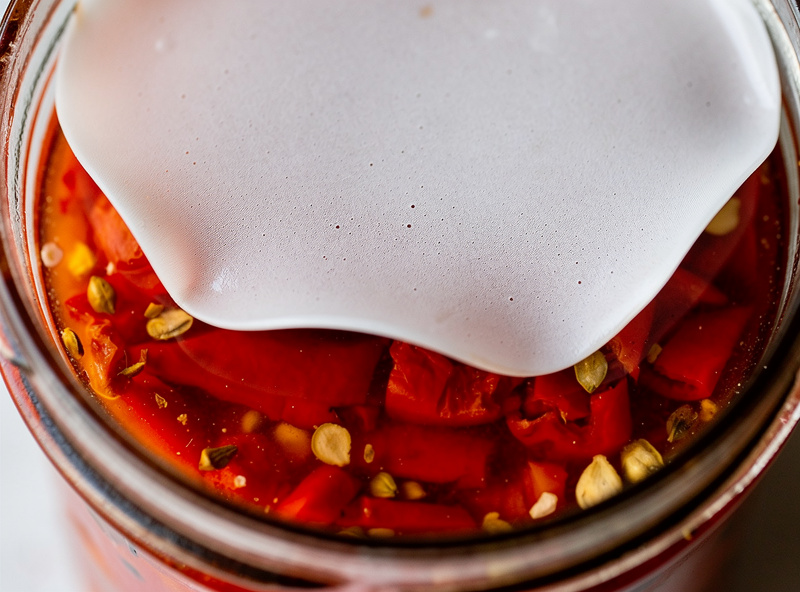
Safe White Film: Kahm Yeast on Hot Sauce
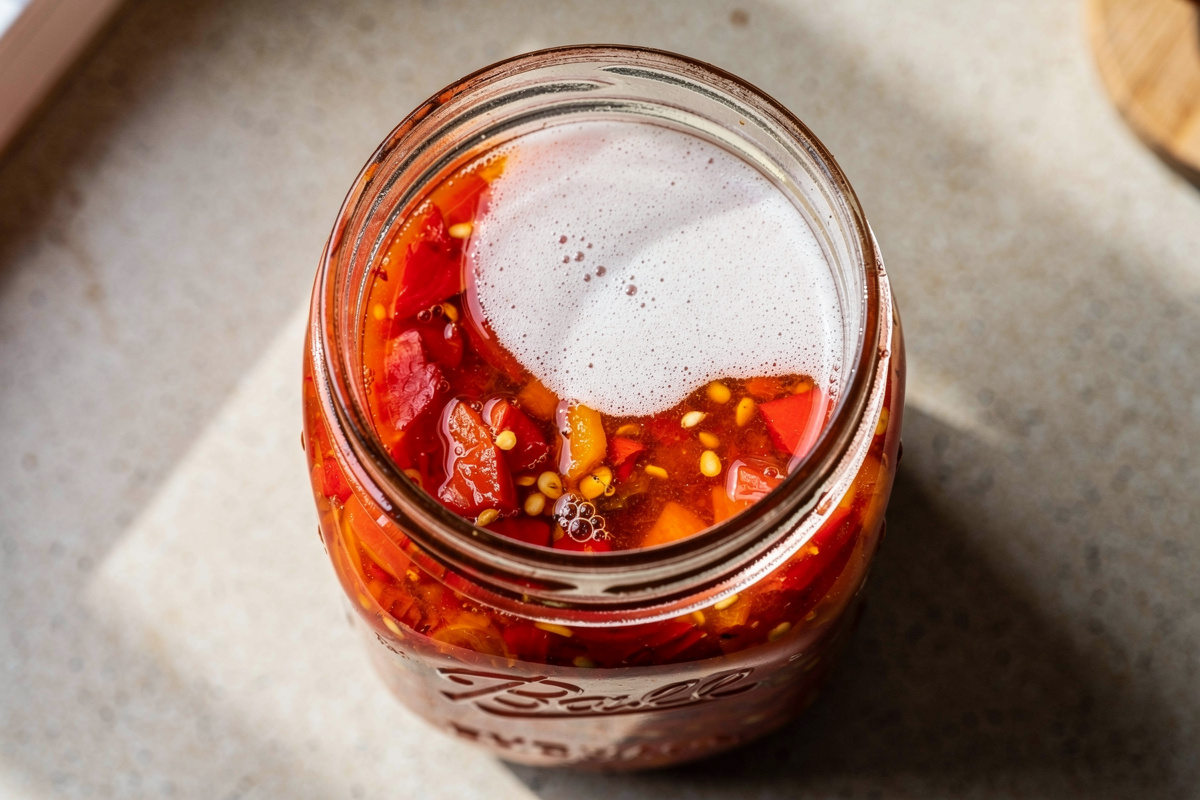
What it looks like: thin white-to-cream film on the brine surface of the pepper mash, often appearing day 3 to 5 of fermentation. Texture is flat and slightly wrinkled. Color is uniformly white-to-pale-cream rather than colored.
What causes it: pepper pieces sticking up above the brine surface, salt percentage too low (under 2%), or fermentation happening too warm (above 78°F). The same kahm yeast (Pichia, Candida species) that affects sauerkraut and kimchi also colonizes hot sauce mash brine surfaces.
What it tastes like in finished hot sauce: faint musty or yeasty note, sometimes described as “off” though not unpleasant. Skim the kahm off within 48 hours and the off-flavor doesn’t transfer noticeably. Leave it for 5+ days and the finished hot sauce has a perceptible musty undertone.
What it isn’t: dangerous, contamination, or a sign your hot sauce failed. Skim it off, press the peppers back down below the brine, and continue fermenting normally. The hot sauce will still be safe and tasty.
Dangerous Mold: Fuzzy and Colored
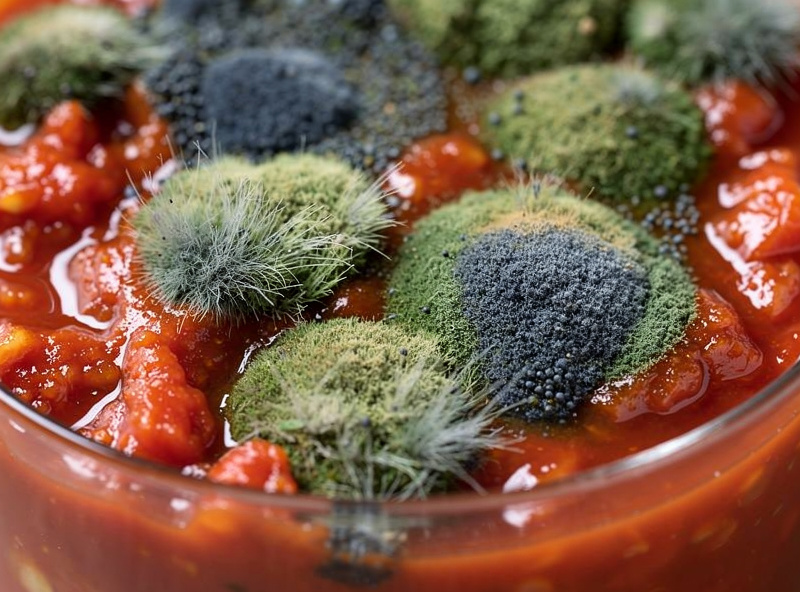
Fuzzy raised growth in any color (green, blue, black, pink, or fuzzy white that’s clearly raised) is mold and means the ferment is contaminated. Color identification:
Green or blue-green (Penicillium expansum, Aspergillus species): the most common contamination type, often appearing as small raised spots on pepper pieces above the brine. Toss the batch regardless of size — a small, early spot doesn’t change the guidance.
Black (Aspergillus niger): rare in hot sauce because pH drops too fast for it to establish. If you see black mold, the brine pH probably never dropped below 5 (something failed in the early ferment) — toss and start over.
Pink, red, or orange (Fusarium): toss immediately regardless of coverage. Fusarium produces serious mycotoxins that migrate through the brine and contaminate peppers that look fine. Don’t try to rescue any hot sauce with pink/red contamination.
White fuzzy raised colonies (white mold, possibly Geotrichum): still indicates contamination even without color — toss the batch. Don’t confuse it with the flat white kahm film, which is safe and unrelated.
Kahm-or-Mold Decision Tree
I lost a habanero batch to blue-green Penicillium a few years back, coming home from a trip to find dime-sized green spots on three peppers. I’ll admit the first instinct is always to reach for a spoon and scrape it off — the batch smelled fine everywhere else, and it felt wasteful to dump a full jar of habaneros over three small spots. I didn’t, and I don’t anymore. The UC Davis fermentation troubleshooting guide is blunt about it: confirmed mold on any part of a ferment means immediate discard, and a visible edge doesn’t tell you how far the mycelium has actually spread through the brine below it.
| What You See | Identification | Action |
|---|---|---|
| Thin flat white film | Kahm yeast (safe) | Skim, continue ferment |
| Fuzzy white spots, raised | White mold (contamination) | Toss the batch, any amount |
| Green or blue-green spots | Penicillium mold | Toss the batch, any amount |
| Black spots | Aspergillus niger | Toss; suggests pH drop failed |
| Pink, red, orange | Fusarium (toxic) | Toss immediately, no exceptions |
| Bubbles around the brine | Active fermentation (good!) | None — this is correct |
The Skim-and-Continue Rescue (Kahm Yeast Only)
Step 1: With a clean spoon, skim the flat white kahm film off the brine surface. Try to lift it in one or two pieces. Discard the skimmed material — don’t return it to the jar.
Step 2: Inspect the top layer of peppers for any kahm clinging to them. Wipe or rinse it off; the peppers below should smell like fresh fermenting mash, not musty.
Step 3: Top up the brine if needed to fully cover all remaining peppers. Use a 2% saltwater solution (20 g salt in 1 liter water) — never plain water. The brine should sit at least 5 mm above all pepper pieces.
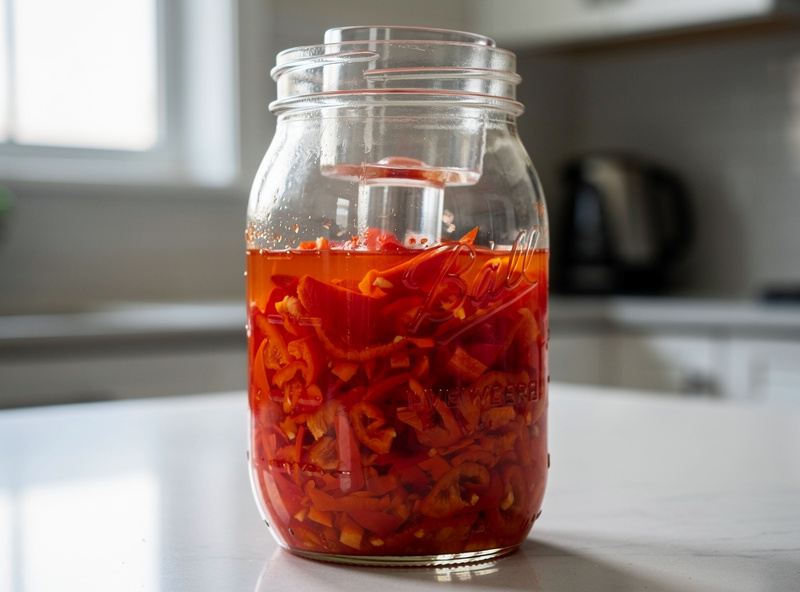
Step 4: Place a fermentation weight (glass disc, ceramic weight, or zip-bag of brine) on top to keep all peppers submerged. Re-seal the jar with the airlock lid or loose cap.
Step 5: Continue fermenting normally, checking daily for a few days to confirm kahm doesn’t return. This rescue is for kahm yeast only — flat, white, uniform. Anything fuzzy or raised, in any color, isn’t a rescue candidate; it’s a toss.
The Toss Decision (Confirmed Mold)
Toss the entire batch the moment you confirm fuzzy, raised, colored growth — regardless of coverage, regardless of how recently it appeared. There’s no small-spot exception. Off-smells (rotten, sweet-rotten, ammonia) accompanying any surface growth are also an automatic toss, even if the growth itself looks ambiguous.
For pink/red mold specifically, toss immediately and don’t even taste the hot sauce. Fusarium mycotoxins (trichothecenes) are stable and toxic at low concentrations, and they migrate through the brine to peppers that look fine. The cost of a few dollars in peppers isn’t worth the food poisoning risk.
After tossing a contaminated batch, deep-clean the jar and equipment with 1:10 bleach solution, rinse thoroughly, dry completely, then start fresh. Spores from the previous batch can survive on container surfaces and contaminate the next batch if cleaning is inadequate.
Why Bottled Hot Sauce Doesn’t Mold
Once fermented hot sauce reaches pH below 4.0 (typically day 5 to 7 of fermentation) and is blended into a sauce consistency for bottling, mold becomes essentially impossible. The acidic environment is hostile to fungi, and the smooth blended texture has no surface micro-niches for spore establishment.
Properly bottled fermented hot sauce keeps in the refrigerator for 6 to 12 months without spoiling. The pH stays acidic (the LAB don’t continue dropping it once oxygen is excluded), capsaicin remains stable, and the smooth texture prevents surface contamination.
For shelf-stable bottling (room-temperature storage), additional steps are needed: pH verification with a meter (target under 3.5), water bath canning at 200°F for 10 minutes, and use of pH-tested recipes from preserves authorities (Ball Corporation, USDA). The fermented hot sauce cluster covers safe bottling protocols.
Preventing Mold From Establishing
Submersion is the single most important prevention. Use a fermentation weight to hold all pepper pieces below the brine surface. Pepper chunks floating above the brine line are the consistent failure mode for hot sauce ferments — they create a surface niche where mold can establish.
Salt at 2 to 3% by total weight of peppers + water — the same window university extension guidance and the standard 3% shredded-vegetable brine figure used across home fermentation both fall into. This range provides enough LAB activity to drop pH rapidly while inhibiting spoilage organisms. Lower salt risks slow LAB activity and gives mold time to establish before pH drops. Higher salt slows fermentation excessively and produces over-salty hot sauce.
Temperature 65 to 75°F for the first 5 to 7 days. Above 78°F mold establishes more readily; below 60°F LAB activity slows so much that pH drop takes 10+ days, giving mold a longer window to colonize. Most home kitchens at 68 to 72°F are in the sweet spot.
Use an airlock-style lid for room-temperature fermentation. Standard mason jar lids let oxygen exchange happen. Simple, inexpensive silicone waterless-airlock lids limit oxygen ingress while letting CO2 escape during active fermentation. The fermentation equipment cluster covers airlock options.
What “Pellicle” Means in Hot Sauce Context
Some fermented hot sauce recipes (especially those using whole-pepper ferments rather than mash) develop a thin yeast film called a “pellicle” — similar to kahm but specific to certain fermentation conditions. The pellicle is safe to skim off and indicates active surface yeast colonization rather than dangerous mold. A pocket pH meter, like the Hanna Instruments pHep line I use, confirms whether the brine is acidic enough (below 4.0) to suppress fungi, which helps distinguish harmless pellicle from a stalled ferment that mold could colonize.
Pellicle vs kahm vs mold: pellicle is a thin, slightly thicker, sometimes smooth-glossy film that can develop in late-stage hot sauce ferments. Kahm is thinner and more powdery-flat. Mold is fuzzy and raised. All three are visually distinguishable with a few minutes of practice.
Don’t confuse the pellicle from a vinegar mother (used in ACV brewing) with mold either — the pellicle on vinegar fermentation is desired and indicates the acetic acid bacteria are working. Different ferment, different rules. The vinegar brewing cluster covers pellicle development across ferment types.
Frequently Asked Questions
After fermenting peppers across five growing seasons, my hot-sauce advice is: salt at 3% and use an airlock. Those two choices eliminate the great majority of mold problems before they start. What’s left comes down to submerging every pepper piece — a glass fermentation weight costs just a few dollars and prevents losing a much more expensive batch of peppers.
Is white film on fermented hot sauce dangerous?
No — flat white film is almost always kahm yeast, completely safe. Skim it off with a clean spoon and continue fermenting. The ferment will be fine. Real mold is fuzzy, raised, and colored (green, blue, black, pink) — that means the ferment is contaminated and may need to be tossed.
What does dangerous mold on hot sauce look like?
Fuzzy raised growth in colors: green or blue-green (Penicillium), black (Aspergillus niger), or pink/red (Fusarium). Any confirmed mold, any color or amount, means toss the entire batch immediately — there is no small-spot exception. Pink/red is especially dangerous due to trichothecene mycotoxins.
Can I scrape mold off fermented hot sauce and keep it?
No — university extension food-safety guidance is conservative here: any confirmed mold, regardless of how small the spot is, means the batch should be discarded immediately. Mold’s visible edge doesn’t reliably show how far it has spread through the brine. This is different from kahm yeast, a flat white film that’s always safe to skim and continue.
Why does my fermented hot sauce keep getting mold?
Three causes: pepper pieces sticking up above the brine surface (most common), salt percentage below 2 percent, or fermentation temperature above 78 degrees F. Use a fermentation weight to keep peppers submerged, raise salt to 2.5 to 3 percent, and ferment at 65 to 75 degrees F.
Can bottled fermented hot sauce mold in the fridge?
Almost never — once fermented hot sauce is below pH 4.0 and blended into a smooth sauce, the acidic environment is hostile to fungi. Properly bottled hot sauce keeps 6 to 12 months in the refrigerator. If mold appears, the original ferment failed to drop pH adequately.
What if pink mold appears on my hot sauce ferment?
Toss immediately, no rescue. Pink mold is Fusarium which produces mycotoxins (trichothecenes) that migrate through the brine and contaminate peppers that look fine. Deep-clean equipment with bleach before starting a fresh batch — Fusarium spores survive on container surfaces.
Related Articles
- How to Make Fermented Hot Sauce at Home
- Kahm Yeast: What It Is, How to Prevent It
- Sauerkraut Mold vs Kahm Yeast: Visual ID
- Fermentation Weights Compared: Glass vs Ceramic
- Garden to Jar: Fermenting What You Grow

About Kenny Nyhus Fadil
A home fermenter documenting brines, bubbles, and the occasional moldy tragedy.