Mak Kimchi vs Pogi Kimchi: Which to Make and When

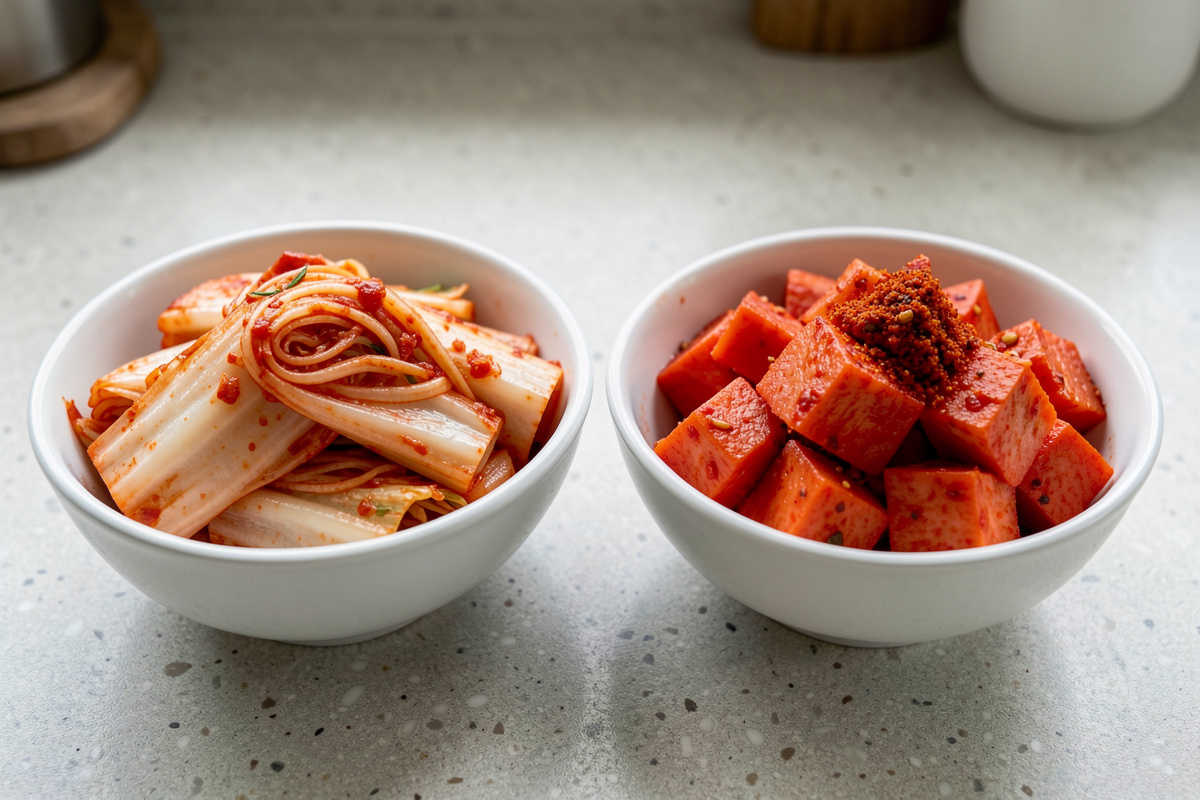
When people picture kimchi they usually picture pogi kimchi — whole quartered cabbages packed with red paste and lined up in a crock. But most of the kimchi actually eaten in Korean homes day to day is mak kimchi: the same flavour, but with the cabbage cut into bite-size pieces before salting and pasting, so it is faster to make and ready to eat straight from the jar. After years of making both in my kitchen rotation, I make far more mak kimchi than pogi, and this is the honest comparison of when each one is worth the work.
The two are not different recipes — same napa, same gochugaru paste, same fermentation. The only real difference is whether you keep the cabbage in whole quarters (pogi) or cut it into pieces (mak), and that one choice changes the prep time, the presentation, and how you serve it. Understanding the trade-off lets you pick the right one for the occasion instead of always defaulting to the fiddly version.
Pogi vs Mak: The Core Difference
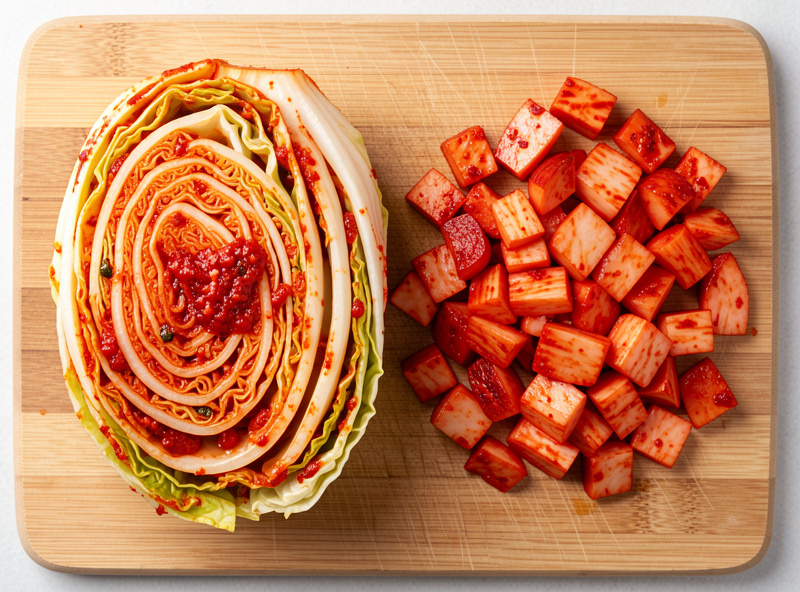
Pogi kimchi (포기김치) keeps the napa cabbage in whole quarters. You salt the quarters, then paste the gochugaru mixture between each individual leaf layer, and ferment the quarters whole. To serve, you lift out a quarter and cut it into bite-size pieces at the table or just before eating. It is the traditional, presentation-forward form — the one made in large quantity during kimjang (the communal autumn kimchi-making) and stored to last the winter.
Mak kimchi (막김치) — “mak” loosely means “carelessly” or “roughly” — cuts the napa into bite-size pieces first, then salts and pastes the pieces all at once, tossed together like a salad rather than leaf-by-leaf. It ferments the same way and tastes the same, but it is dramatically faster to make and is ready to eat directly from the jar with no cutting needed. It is the everyday, no-fuss kimchi.
| Feature | Pogi kimchi (whole) | Mak kimchi (cut) |
|---|---|---|
| Cabbage form | Whole quarters, kept intact | Cut into bite-size pieces first |
| Pasting | Paste between every leaf layer | Toss all pieces with paste at once |
| Prep time | Longer, more careful | Much faster |
| Serving | Cut a quarter before eating | Eat straight from the jar |
| Presentation | Elegant, traditional | Casual, everyday |
| Best for | Kimjang, gifts, special meals, long storage | Weekly home kimchi, fast batches |
| Flavour and fermentation | Identical | Identical |
The key thing to understand is that the flavour and the fermentation are the same. Anyone who tells you pogi tastes better is describing the ritual and the presentation, not the kimchi. The lactobacillus does not care whether the cabbage is whole or cut. Choose based on time and occasion, not on some imagined flavour gap.
When Pogi Is Worth the Extra Work
Pogi kimchi earns its longer prep in a few situations. For long storage — the traditional winter stash — whole quarters keep their texture better over many months than cut pieces, which soften faster because more surface area is exposed to the brine. If you are making a big autumn batch meant to last until spring, pogi is the right call. It is also the form to make when presentation matters: a neatly cut quarter fanned on a plate looks far more impressive than a heap of mak kimchi, so for guests, gifts, or a special table, pogi is worth the time.
The leaf-by-leaf pasting also gives slightly more even seasoning deep into the cabbage, which some cooks prefer for the most carefully made batches. But this is a marginal difference, not a transformation. Unless you are storing for many months or plating for company, the extra effort of pogi is mostly tradition rather than necessity.
When Mak Is the Smarter Choice
Mak kimchi is what I make for everyday eating, and for most home cooks it should be the default. It takes a fraction of the time — no careful leaf-pasting, just salt the pieces, toss with paste, and jar — and it is ready to eat with no cutting. For a household that goes through kimchi steadily and remakes it every couple of weeks, that time saving is the difference between making your own kimchi consistently and giving up because it feels like too much work.
Mak kimchi is also more forgiving for beginners. Because you are tossing pieces rather than threading paste between delicate leaves, there is less technique to get wrong, and uneven salting is easier to correct by simply mixing more thoroughly. If your first napa kimchi attempt felt fiddly, switching to mak kimchi for the next batch usually fixes the frustration. Both forms make excellent aged kimchi for jjigae too, so neither limits how you can use the kimchi later.
How to Make Mak Kimchi Step by Step
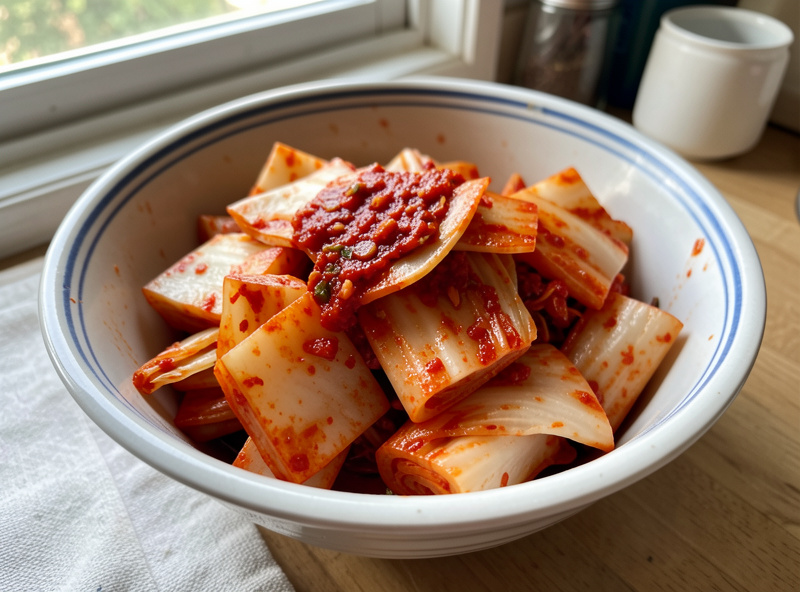
Because mak kimchi is the version most people should default to, it is worth walking through. Cut a head of napa lengthways into halves or quarters, then chop crossways into roughly bite-size pieces — about three to four centimetres. Toss the pieces with salt (the same overall salt logic as whole-cabbage kimchi, around 60 grams of unrefined sea salt per kilogram of cabbage) in a large bowl and let them sit for one and a half to two hours, mixing once or twice. Because the pieces are cut, they wilt faster than whole quarters and need less salting time. Rinse the salted pieces a couple of times under cold water and drain well in a colander.
Meanwhile make the standard paste — cooled glutinous rice porridge, gochugaru bloomed in it for half an hour, then garlic, ginger, fish sauce, a little sugar, and julienned radish and scallion. Add the drained cabbage pieces straight into the bowl of paste and toss everything together by hand (wear a glove) until every piece is evenly coated. Pack into jars, press down to remove air and bring the liquid up over the surface, leave a little headspace, and ferment on the counter one to three days before refrigerating. That is the entire process — no leaf-by-leaf threading, which is exactly why it is the everyday choice.
Texture and Storage Differences
There is one genuine, non-cosmetic difference between the two beyond prep time: how they age. Cut mak kimchi has more surface area exposed to the brine, so it ferments a touch faster and softens sooner than whole pogi quarters. For kimchi you will eat within a couple of months that is a non-issue — many people actually prefer how quickly mak kimchi comes into its flavour. But for a batch intended to hold its crunch through six months or more of cold storage, whole pogi quarters keep their structure better, which is the practical reason the traditional long-keeping winter kimjang batches are made pogi-style.
This connects to the wider point that all kimchi shifts from crunchy-and-bright to soft-and-sour as it ages, covered in my guide to how long kimchi lasts. Mak kimchi simply travels that arc slightly faster. If you find your mak kimchi softening sooner than you would like, keep it colder (toward 2 C) and eat the crunchy young jars first while letting a pogi batch hold in reserve for later. In practice, matching the cut to how soon you will eat the kimchi is the whole skill: cut for fast eating, whole for long keeping.
My Default Choice
In practice my kitchen runs roughly eighty percent mak kimchi and twenty percent pogi. Mak is the workhorse — fast batches every two weeks that keep the fridge stocked. Pogi comes out for the occasional larger batch I want to age longer, or when I am making kimchi as a gift and want it to look the part. Both come from the same cabbage, the same paste, and the same fermentation logic, so learning one teaches you the other.
If you are deciding which to make right now: if you want kimchi with the least fuss and the fastest path to eating, make mak. If you are making a big batch to store for months or to present to someone, make pogi. There is no wrong answer, only the right one for the occasion in front of you.
Where the Other Kimchi Forms Fit
Mak and pogi are the two cabbage formats, but it helps to see them in the context of the wider kimchi family, because the same logic of cut-versus-whole shows up across other vegetables too. Kkakdugi (cubed radish kimchi) is essentially the radish equivalent of mak — everything is cut into pieces and tossed with paste, fast and casual. Chonggak kimchi, made from whole young radishes with their stems left on, is closer in spirit to pogi: the vegetable is kept intact for presentation and texture. Baek kimchi (white kimchi) is usually made pogi-style with whole stuffed quarters, because its delicate brine and elegant serving suit the whole form.
Once you internalise that “cut for speed and fast eating, whole for texture and presentation” rule, you can apply it to almost any kimchi you make rather than memorising separate recipes. The paste, the salt math, and the two-stage fermentation stay constant across all of them; the format is just a choice about effort and occasion. That single insight is what turns kimchi from a set of intimidating individual recipes into one flexible skill you can adapt to whatever cabbage, radish, or schedule is in front of you. It is also why I tell beginners to start with mak: master the flavour and the fermentation first with the least fiddly format, and the more elaborate whole-vegetable forms become trivial extensions rather than new things to learn.
Related Guides on FermentFoundry
- Homemade Kimchi: The Complete Guide from Cabbage to Stew
- Easy Napa Cabbage Kimchi Recipe for Beginners
- Baek Kimchi: White Kimchi Recipe With No Chili Heat
- Kkakdugi: Crunchy Korean Cubed Radish Kimchi Recipe
- Kimchi Jjigae: Authentic Sour-Kimchi Stew Recipe

About Kenny Nyhus Fadil
A home fermenter documenting brines, bubbles, and the occasional moldy tragedy.
Keep Bubbling
How Long Does Kimchi Last? Safe Sour vs Actually Spoiled
Kimchi Pancake (Kimchijeon): The Best Use for Sour Kimchi