Bottling Hot Sauce for Sale: Laws, pH, and Process

Bottling hot sauce for sale is a different job from bottling it for your own fridge: it adds a regulatory layer, a documented safety process, and labelling rules on top of the sauce itself. The short version is that fermented and acidified hot sauces are usually classed as “acidified foods” and fall outside most home cottage-food laws, so selling legally almost always means a licensed kitchen and a verified process — not a home stovetop.
I make hot sauce for my own kitchen and to give away, not for sale, so I treat the commercial side the way the trade actually treats it: as a food-safety and compliance question with answers that vary by country and region. This guide lays out what bottling for sale involves so you know what to research before you start, and it builds on the safety foundation in my complete fermented hot sauce guide. Treat it as an orientation, not legal advice — your local food-safety authority has the final word.
Disclosure: FermentFoundry is reader-supported. As an Amazon Associate I earn from qualifying purchases made through links in this article, at no extra cost to you. I only point to gear I actually use in my own kitchen.
Why Hot Sauce Is an “Acidified Food”
Most regulators classify a pH-controlled hot sauce as an acidified or fermented food, and that classification carries stricter rules than baked goods or jams. In the United States, acidified foods fall under FDA 21 CFR Part 114, which is exactly why hot sauce is excluded from most state cottage-food laws — those laws cover low-risk shelf-stable items, and a pH-dependent product is not considered low-risk.
The reason is the one constant across every jurisdiction: the danger in an improperly acidified, anaerobic product is Clostridium botulinum. A bottled hot sauce that has not reliably reached a safe pH is the kind of low-acid-risk product food law is built to control. That is why commercial producers cannot simply self-certify — they must demonstrate the process keeps every bottle below the safety threshold. The underlying pH science is the same one I cover for home bottling in my hot sauce pH guide; selling just adds the obligation to prove it.
The Compliance Steps the Trade Follows
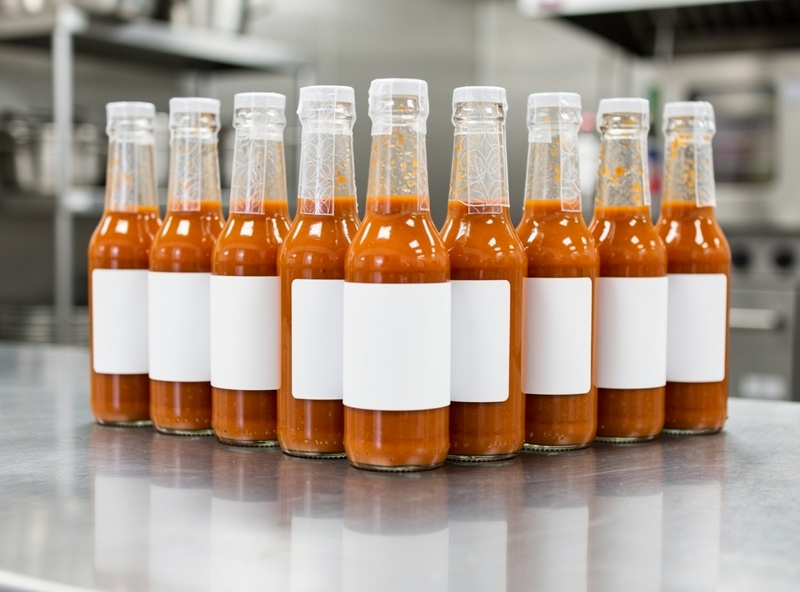
Commercial hot sauce producers generally work through a consistent set of requirements, even though the details differ by region. Understanding the shape of it tells you what to expect before you invest. The common steps are a licensed kitchen, a reviewed recipe and process, lab verification, and compliant labelling — each one a checkpoint a home bottler does not have to clear.
In many jurisdictions, producers have their recipe and acidification process reviewed by what is called a “process authority” — typically a food-science department or an extension service — who confirms the sauce reliably reaches a safe equilibrium pH. Producers also commonly complete a food-safety course (in the US, often a Better Process Control School for acidified foods) and register their facility. None of this is meant to discourage you; it is simply the real checklist, and knowing it up front saves a lot of wasted effort. Always confirm the specifics with your own regulator, because the trade does it differently from country to country.
Proving Your pH: The Non-Negotiable Step
For a sauce sold to the public, a home pH meter reading is a starting point, not proof. Commercial acidified foods are generally documented to a verified equilibrium pH — the stable pH the whole product settles at, measured under controlled conditions, often confirmed by an accredited lab. The widely used target is well under the 4.6 botulism line, and producers build in margin by aiming lower, commonly pH 3.4 or below.
Practically, that means acidifying before bottling and documenting it. Even a well-fermented sauce is usually brought down with vinegar or citric acid to a confident, repeatable target rather than relying on fermentation alone, because every batch must clear the line, not just the average. A calibrated digital pH meter is essential for your own process control, but for sale you pair it with the documented, often lab-confirmed verification your regulator requires. This is the single point where home practice and commercial practice genuinely diverge.
The Physical Bottling Process
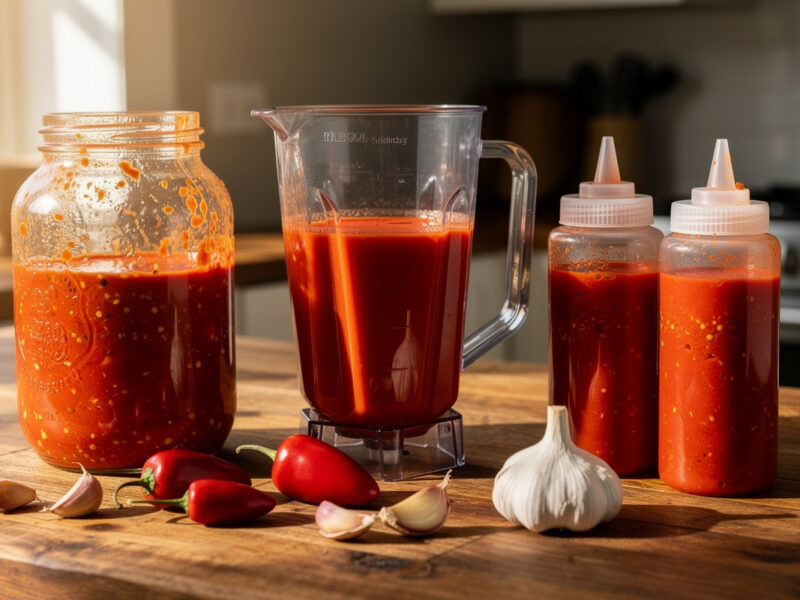
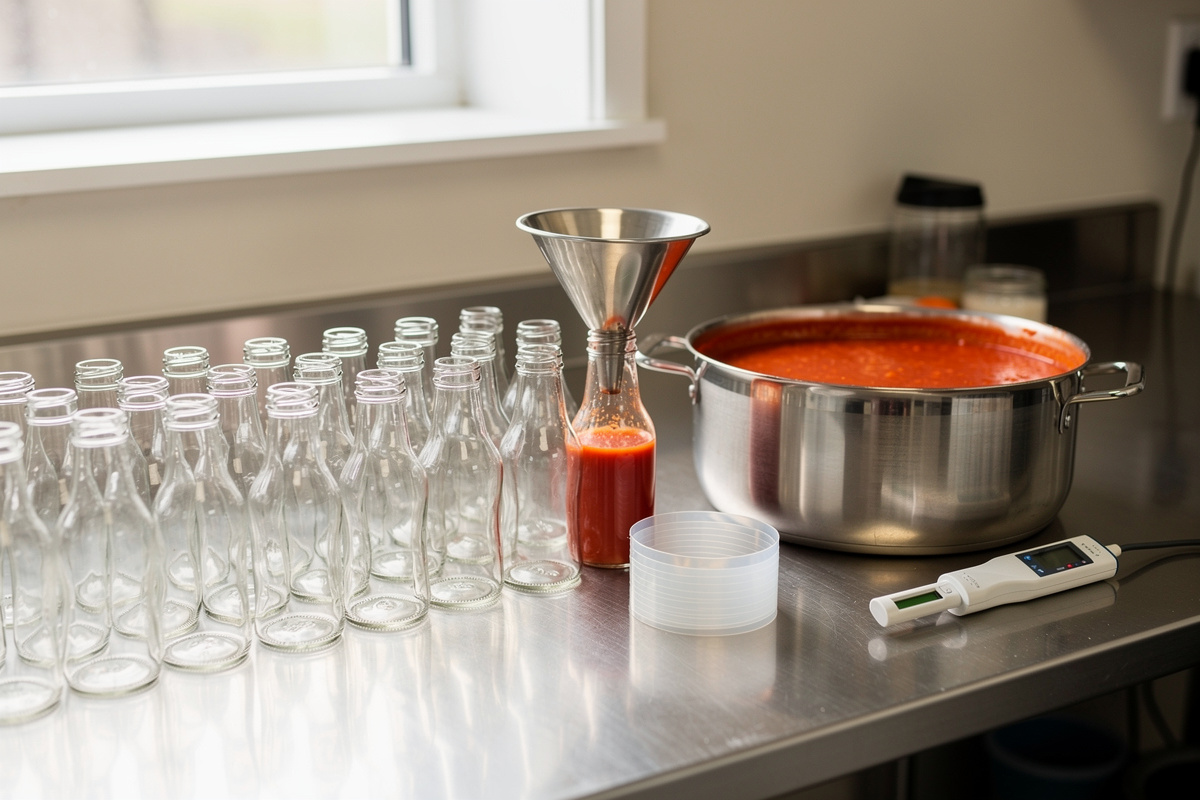
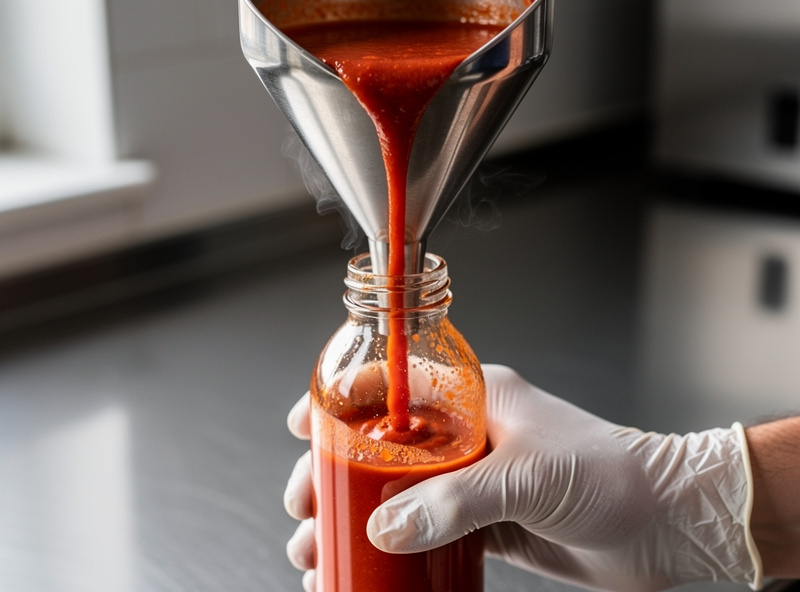
The bottling mechanics are the same whether for sale or for gifting, just done to a higher standard of sanitation and consistency. Sanitise the bottles, hot-fill the sauce while it is hot (commercial lines fill at around 180 °F / 82 °C) to drive out air and create a vacuum seal as it cools, leave consistent headspace, cap immediately, and apply a tamper-evident band.
Glass woozy bottles with an orifice reducer are the standard hot sauce format, finished with a shrink band for tamper evidence. Note that hot-filling lightly cooks the sauce, which trades a little fermentation brightness for a more reliable shelf-stable seal — a deliberate choice most commercial fermented sauces make. If you keep a sauce raw and live for sale, it generally must be sold refrigerated, which changes its regulatory category again. Consistency is everything here: every bottle should be filled, sealed, and labelled identically.
Labelling Requirements
A sauce sold to the public carries mandatory label information, and the specifics are set by your food authority. The near-universal elements are the product name, a full ingredient list in descending order by weight, allergen declarations, net weight or volume, and the name and address of the producer. Many regions also require a batch or lot code and a best-by date.
Getting the label right is part of the legal product, not decoration. Allergen rules in particular are strict — if your sauce contains common allergens, they must be declared clearly. The ingredient list must be honest and complete, including any acid you added to control pH. Because these requirements vary so much by jurisdiction, the labelling rules are one of the first things to confirm with your regulator, alongside the process review. Below is a high-level comparison of how bottling for personal use differs from bottling for sale.
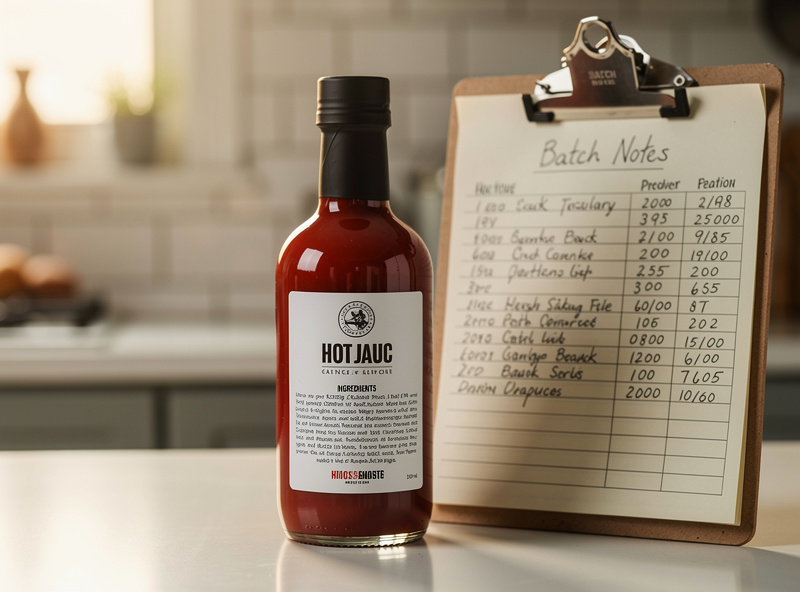
A useful habit even for home bottling is to draft a full label as if it were for sale — listing every ingredient, the acid you added, and the batch date. It forces you to track exactly what went into each batch, which is the same record-keeping discipline the commercial path demands and a good rehearsal if you ever pursue it.
Bottling for Yourself vs for Sale
| Requirement | Personal / Gifting | For Sale |
|---|---|---|
| Kitchen | Home kitchen fine | Licensed/inspected kitchen usually required |
| pH verification | Calibrated home meter | Documented equilibrium pH, often lab-confirmed |
| Process review | None | Process authority review common |
| Training | None | Food-safety / acidified-foods course often required |
| Labelling | Date and pH for your own tracking | Full regulated label (ingredients, allergens, producer) |
| Cottage-food law | Not applicable | Usually excludes acidified hot sauce |
Where to Actually Start
If you are serious about selling, the first call is to your local or state food-safety authority — not a bottle supplier. Ask specifically how acidified and fermented foods are regulated where you live, whether hot sauce is excluded from any cottage-food provision, and what process review and facility requirements apply. That one conversation reshapes everything downstream, from your recipe to your kitchen.
Get the compliance path clear before you scale the recipe or buy packaging, because the regulatory category determines the rest. A consistent, well-acidified, properly bottled sauce is the achievable part; the documentation and licensing is the part people underestimate. Master the sauce itself first — dial in your peppers, your pH, and your texture using the rest of this cluster, including keeping a sauce stable and uniform with the methods in my hot sauce separation guide — and treat selling as a separate, deliberate project with its own homework.
Frequently Asked Questions
Can I sell hot sauce made in my home kitchen?
Usually not without meeting acidified-food rules. Hot sauce is typically classed as an acidified food and excluded from most cottage-food laws, so selling legally generally requires a licensed kitchen and a verified process. Always confirm with your local food-safety authority first.
Why is hot sauce not allowed under cottage food laws?
Cottage-food laws cover low-risk shelf-stable items like baked goods and jams. A pH-controlled hot sauce is an acidified food, where improper acidification carries a botulism risk, so regulators class it as higher-risk and exclude it from those simpler home-sale provisions.
What pH does hot sauce need to be sold commercially?
It must reliably stay well below the 4.6 botulism threshold, and producers typically target pH 3.4 or lower for margin. For sale, this is documented as a verified equilibrium pH, often confirmed by an accredited lab rather than a single home-meter reading.
What is a process authority for hot sauce?
A process authority is a qualified food scientist or extension service that reviews your recipe and acidification process and confirms it reliably produces a safe pH. Many jurisdictions require this review before an acidified food like hot sauce can be sold to the public.
What has to be on a hot sauce label for sale?
Typically the product name, full ingredient list by weight, allergen declarations, net weight or volume, and the producer’s name and address. Many regions also require a batch code and best-by date. Exact requirements are set by your local food authority.
Do I have to cook a fermented hot sauce to sell it?
Often, yes. Hot-filling at around 180°F creates a shelf-stable seal but lightly cooks the sauce. A raw, live fermented sauce generally must be sold refrigerated, which places it in a different regulatory category. Confirm the path for your product with your regulator.
Related Guides on FermentFoundry
- Fermented Hot Sauce: The Complete Home Brewer Guide
- Fermented Hot Sauce pH: Safe Shelf-Stable Levels
- Hot Sauce Separation: Why It Happens and How to Prevent It
- How to Thicken Hot Sauce: 3 Proven Methods
- How to Make Fermented Hot Sauce (Beginner Pepper Mash)

About Kenny Nyhus Fadil
A home fermenter documenting brines, bubbles, and the occasional moldy tragedy.