Tempeh and Koji: Where Fermentation Meets Mushroom Cultivation

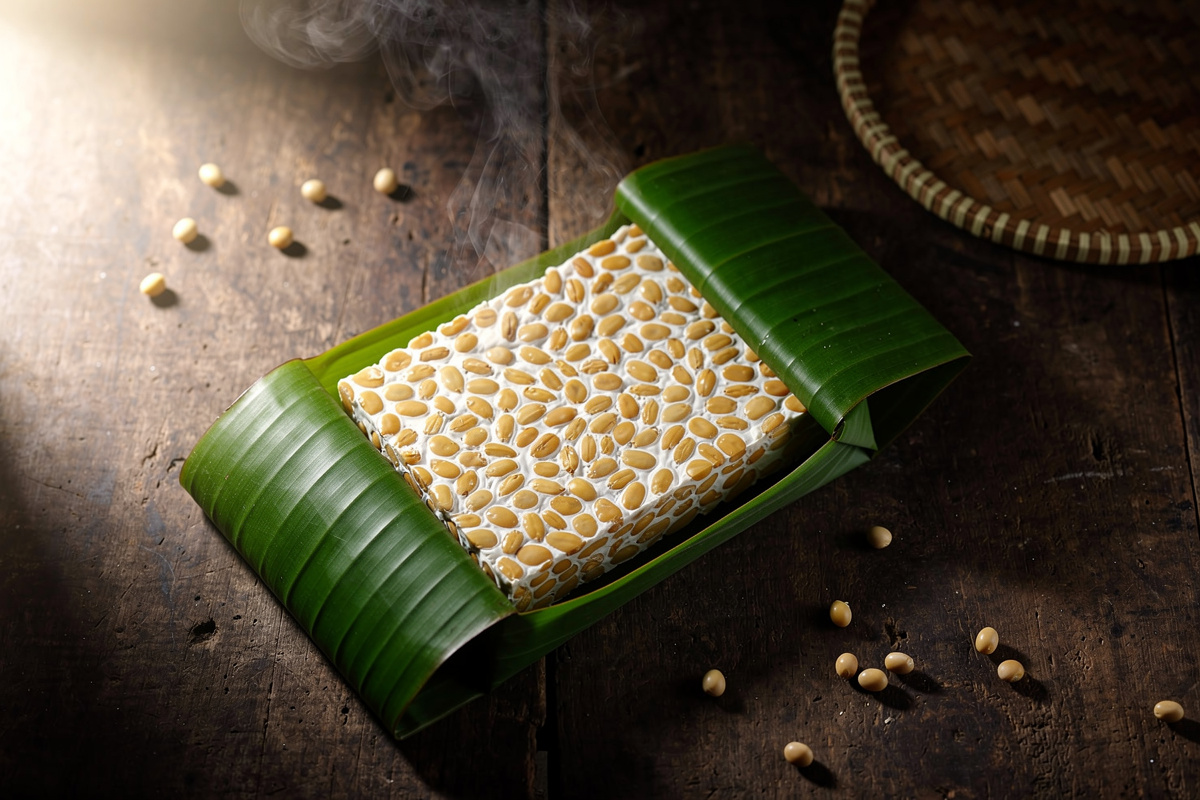
Tempeh and koji sit at the intersection of fermentation and mushroom cultivation — both rely on filamentous fungi to bind, transform, and preserve substrates that would otherwise be perishable. Tempeh uses Rhizopus oligosporus to knit cooked soybeans into a firm cake in 24-48 hours at 86-88°F, while koji uses Aspergillus oryzae on steamed rice to produce the enzymes that drive miso, sake, and soy sauce.
Tempeh and koji use specialised climate-controlled hardware; the broader fermentation-kit tiers and what to buy first are in my fermentation equipment guide.
I started making tempeh after a failed attempt at growing oyster mushrooms — I had the incubator, the sterile technique, and the contamination-paranoia already dialed in from mycology work, and the jump from mushroom spawn to tempeh starter felt like the same craft with a different ending. The first batch that came out of my Govee-controlled incubator at 86°F with fluffy white mycelium binding every soybean convinced me these two crafts are one skill set.
This guide walks through what makes these two fermentations behave like mushroom growing instead of like sauerkraut, the temperature and humidity controls they share with home mushroom cultivation, the specific equipment overlap that lets a single setup serve both crafts, and the safety considerations that matter when culturing pure fungal monocultures at home.
As an Amazon Associate I earn from qualifying purchases.
Why Tempeh and Koji Are Mycology, Not Just Fermentation
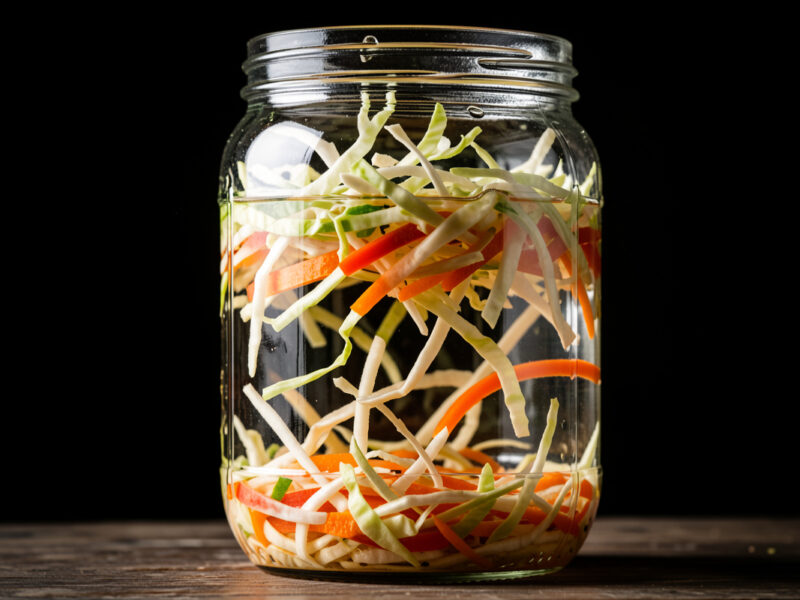
Lactic acid fermentation (sauerkraut, kimchi, pickles) is a microbial competition where you create conditions that favor lactobacilli and let them out-compete everything else. The bacteria are everywhere — on the cabbage, in the air, on your hands — and you set the conditions. There is no inoculation, no clean transfer, no dedicated culture.
Tempeh and koji are fundamentally different. Both require:
- Pure starter culture (spore inoculation). You can’t rely on ambient organisms — you specifically introduce Rhizopus spores or Aspergillus oryzae spores from a known commercial source.
- Sterile or sanitized substrate. Cooked, cooled, drained substrate that doesn’t carry competing molds or bacteria.
- Controlled temperature and humidity over 24-72 hours. Same incubation requirements as growing oyster mushroom mycelium.
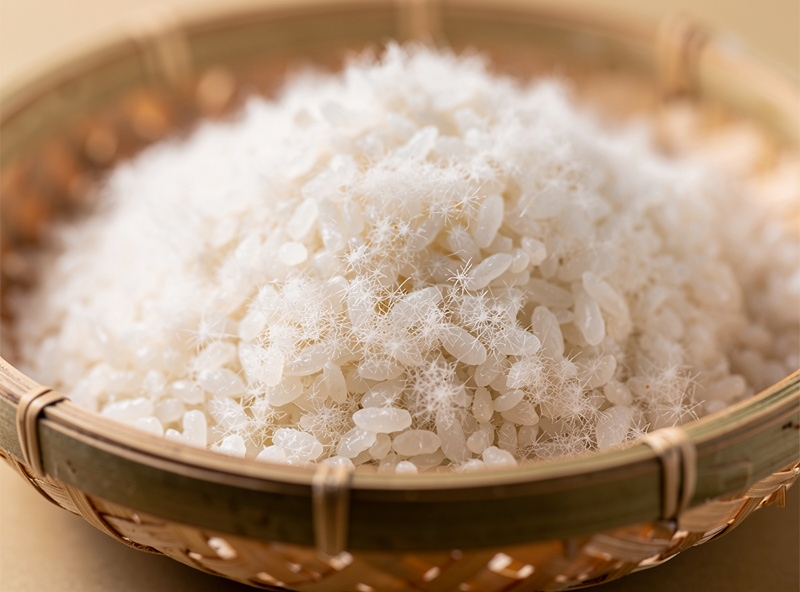
- Visual identification of correct vs contaminating growth. White fluffy Rhizopus good; black sporulation = past peak. White-yellow A. oryzae good; green sporulation = contamination.
That entire skill set — sterile transfer, spore inoculation, incubation control, contamination identification — is exactly what mushroom cultivators learn. The cross-niche overlap is not a theoretical curiosity; it’s how Japanese sake breweries and Indonesian tempeh producers have always trained workers. Both crafts treat the fungus as the primary worker, with humans providing only conditions.
Tempeh in Detail: The Rhizopus Workflow
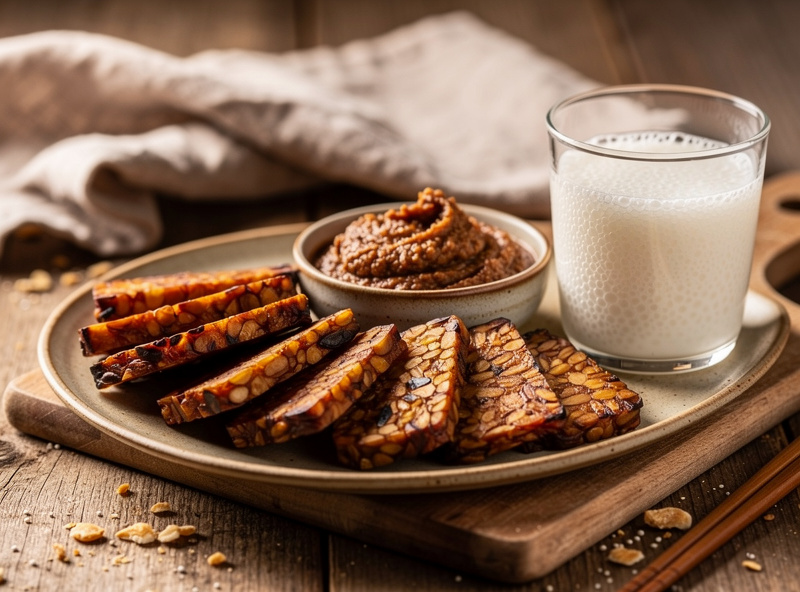
Tempeh production at home is a 36-hour project, with most of the time being passive incubation. The core steps:
- Soak dry soybeans 8-12 hours. Use whole or split beans; both work. Hull removal speeds incubation but is not strictly required.
- Cook beans until al dente, about 30-40 minutes simmering. Drain, cool to body temperature.
- Acidify with vinegar. Add 1 tablespoon white vinegar per pound of cooked beans. Lowers pH enough to suppress competing bacteria.
- Inoculate with Rhizopus tempeh starter. Roughly 1 teaspoon spore powder per 1 kg cooked beans. Toss to distribute evenly.
- Pack into perforated containers. Plastic bags pierced every 2 cm, or perforated trays. Aim for 1-1.5 inches of bean depth.
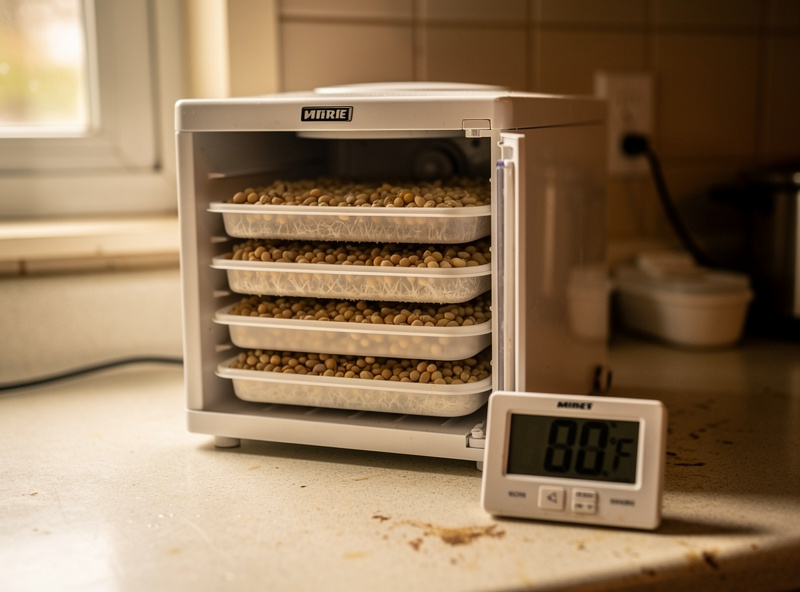
- Incubate at 86-88°F (30-31°C) for 24-48 hours. A dehydrator with the fan disabled, an Instant Pot on yogurt setting, or a dedicated incubator (same as the mushroom cultivator’s chamber) all work.
- Stop fermentation when white mycelium fully covers the cake and the beans are firmly bound. Refrigerate to halt fermentation — sporulation begins after about 56 hours and produces an unwanted bitter flavor.
Koji in Detail: The Aspergillus oryzae Workflow
Koji production is the foundation of Japanese miso, sake, soy sauce, and amazake. The 48-hour project:
- Steam short-grain rice 45-60 minutes. Bamboo steamer or pot-on-trivet method. Rice should be firm but cooked — al dente, never mushy.
- Cool to 90-95°F (32-35°C). Spread the rice in a thin layer on a clean tray to release steam.
- Inoculate with A. oryzae koji spores at 1 g spore powder per kg of dry rice. Toss thoroughly.
- Wrap in damp cotton cloth and place in incubator at 86-90°F (30-32°C).
- Hour 18-22: Rice begins to clump as mycelium grows. Stir gently to redistribute oxygen and break clumps.
- Hour 30-36: White fluffy mycelium covers the rice. This is “peak koji” — harvest now for amazake or miso. For sake brewing, continue 6-12 more hours for fuller enzyme development.
- Hour 48+: Yellow-green sporulation begins; flavor turns bitter. Refrigerate immediately to use within a week, or freeze for long-term storage.
Equipment Overlap: One Setup, Both Crafts
If you already have mushroom cultivation equipment, you have everything you need for tempeh and koji. The reverse is also true:
| Equipment | Mushroom use | Tempeh use | Koji use |
|---|---|---|---|
| Incubator (Excalibur dehydrator, Instant Pot, Govee chamber) | Spawn incubation 75-78°F | Tempeh incubation 86-88°F | Koji incubation 86-90°F |
| Hygrometer (Govee H5179, Inkbird IBS-TH2) | Monitor fruiting humidity | Monitor cake humidity | Monitor rice humidity |
| Pressure cooker (10-15 PSI) | Sterilize substrate | Cook soybeans | Steam rice |
| HEPA filter / SAB | Sterile spawn transfer | Reduce contamination during inoculation | Reduce green-mold contamination risk |
| Spore syringe storage (refrigerator) | Mushroom culture stock | Tempeh starter storage | Koji-kin storage |
| Perforated bags (mushroom growing bags) | Spawn-to-fruit bags | Tempeh fermentation bags | Koji wrapping (substitute) |
| pH meter | Substrate prep | Pre-acidification check | Final amazake pH check |
For the mushroom-cultivation side that pairs with this fermentation work, our partner site has the mushroom growing mistakes for beginners guide, which covers the contamination identification and sterile-transfer skills that translate directly to tempeh and koji workflows. The CVG substrate recipe walkthrough demonstrates the same substrate-preparation discipline used for koji rice steaming.
Contamination: What It Looks Like and What to Do
Three contamination patterns matter for tempeh and koji:
- Black or dark green spotting: Aspergillus niger or related dark-spore species. Discard the entire batch. Common cause: temperature too high (over 95°F) or substrate too wet.
- Pink, red, or orange film: Neurospora or Geotrichum. Discard. Common cause: improperly sanitized incubator surfaces.
- White cottony growth that turns slimy or sour-smelling: Bacterial contamination, often Bacillus. Discard. Common cause: substrate too wet or insufficient acidification.
My first tempeh batch grew black spore instead of white mycelium because my incubation temperature hit 92°F overnight — a Govee H5179 Bluetooth thermometer would have caught the temperature drift with a phone alert. I now run all tempeh and koji incubations with a temperature controller that shuts off at 90°F and restarts at 85°F, and I have not lost a batch since. Rhizopus oligosporus has a long history of safe food use and FDA-recognized GRAS status for tempeh production — but “GRAS fungus” doesn’t mean risk-free technique regardless of source: a 2012 outbreak of Salmonella Paratyphi B in North Carolina was traced to unpasteurized tempeh made with a contaminated Rhizopus starter culture (Gastroenteritis Outbreak Associated with Unpasteurized Tempeh, North Carolina, USA, content-verified case report) — the failure was a contaminated starter and inadequate fermentation, not the fungus itself. Buy starter from a reputable supplier and cook substrate fully; that’s what actually prevents this.
Healthy Rhizopus on tempeh is white, fluffy, and odor-neutral or slightly mushroomy — never sour, ammonia-like, or sharp. Healthy A. oryzae on koji is white-to-yellow, fluffy, and produces a sweet apple or chestnut aroma. Any other smell or color is contamination. For surface-film identification across fermentation types — a skill that transfers between fungal and lacto-fermentation projects — see our kahm yeast identification guide.
What to Make First This Weekend
- Saturday morning: Soak 1 lb of dry soybeans for tempeh and 2 cups of short-grain rice for koji.
- Saturday afternoon: Cook both. Cool, inoculate with their respective starters. Place in incubator at 86-88°F.
- Sunday evening: Tempeh should be cake-firm with full white mycelium coverage (about 30 hours). Refrigerate.
- Monday morning: Koji should show full white-yellow mycelium coverage (40-48 hours). Refrigerate or freeze.
- Monday-Tuesday: Use tempeh in stir-fries, sandwiches, or curries. Mix half the koji into a 1:1:1 (cooked-soybean : koji : salt) miso project. Keep the other half for amazake (rice cooked with koji at 140°F for 6 hours).
For other fermentation projects that build on the same skill set, see our garden to jar fermentation guide, the fermented hot sauce walkthrough, and the fermentation weights comparison guide for the brine-submersion gear that keeps any wet fermentation safe from surface contamination. The fermenting hydroponic greens guide covers the input-supply-side overlap that connects garden, hydro, and ferment workflows.
If I were starting with tempeh tomorrow, I would buy a 1-lb bag of soybeans, a $10 tempeh starter from Cultures for Health, and set my Instant Pot to yogurt mode at 87°F. The entire project costs under $25 and produces 1 lb of fresh tempeh — roughly equivalent to $8-10 of store-bought blocks. The real payoff is the transferable skill: the same incubator, sterile technique, and contamination-reading eye that makes tempeh work also makes koji, mushroom spawn, and a dozen other fungal ferments successful.
For deeper background on the regulatory side of GRAS status for fermentation microorganisms, the FDA’s Generally Recognized as Safe (GRAS) page is the primary source — I check it whenever I consider adding a new culture to the rotation.
Frequently Asked Questions
Is tempeh actually a mushroom or a fermented food?
Both, technically. Tempeh is created by Rhizopus oligosporus, a filamentous fungus closely related to bread mold. The white binding that holds the soybeans together is mycelium — the same vegetative form mushroom cultivators work with. The classification overlap is why tempeh-making fits naturally alongside mushroom cultivation.
What temperature do tempeh and koji incubate at?
Tempeh incubates at 86-88°F (30-31°C) for 24-48 hours. Koji incubates at 86-90°F (30-32°C) for 36-48 hours. Both temperatures are easily maintained with a dehydrator (fan disabled), an Instant Pot on yogurt setting, or a dedicated incubator. Mushroom growers already own this equipment for spawn incubation.
Where do I buy tempeh and koji starter cultures?
Cultures for Health, GEM Cultures, and Northwest Ferments all sell tempeh starter (Rhizopus oligosporus) and koji-kin (Aspergillus oryzae). Both store frozen for years. Cost is roughly $10-15 per culture pack, enough for many batches. Mushroom cultivation suppliers (Out-Grow, North Spore) also carry koji-kin alongside their oyster and shiitake spawn.
Why does my tempeh smell like ammonia?
Ammonia smell means bacterial contamination, often from substrate that was too wet, insufficient acidification with vinegar, or temperature drifted too low (under 80°F) so bacteria out-competed the Rhizopus. Discard the batch and rebuild — never eat suspect tempeh. Reduce moisture, increase acidification, and verify your incubator holds temperature.
Can I make miso from store-bought koji?
Yes — store-bought koji rice (sold at Japanese groceries or online from suppliers like Cold Mountain) ferments into miso identically to home-made. Mix 1 part koji with 1 part cooked soybeans (mashed) and 0.6 parts salt by weight, pack into a crock, and ferment at room temperature for 6-18 months depending on style.
Are these fungi safe to grow at home?
Yes — both Rhizopus oligosporus and Aspergillus oryzae are GRAS (Generally Recognized As Safe) by the FDA and have a long history of safe food use. A. oryzae is closely related to the aflatoxin-producing mold Aspergillus flavus and carries the same ancestral gene cluster, but centuries of food-fermentation domestication have inactivated those genes by mutation, so it does not produce aflatoxins. Buy starter cultures from reputable suppliers to ensure you are working with the safe species, since contaminated or misidentified starter is the real risk, not the organism itself.
What overlaps most between mushroom growing and koji making?
Sterile substrate preparation, controlled-temperature incubation, contamination identification, and pure-culture inoculation discipline. A mushroom cultivator already knows how to pressure-sterilize substrate, work in front of a flow hood or in a SAB (still air box), and identify good vs contaminated mycelium by sight. All of those skills transfer directly to koji and tempeh work.
Related Articles
- Garden to Jar Fermentation Guide
- How to Make Fermented Hot Sauce
- Sourdough Bread Troubleshooting
- Fermenting Hydroponic Greens
- How to Lacto-Ferment Garlic

About Kenny Nyhus Fadil
A home fermenter documenting brines, bubbles, and the occasional moldy tragedy.
Keep Bubbling
Chloramine vs Chlorine: Why Boiling Is Not Enough
How to Sterilize Fermentation Equipment (and When Not To)