Salt-Preserved Produce: The Complete Guide

Salt-preserved produce is the oldest preservation trick in my kitchen and the one I reach for when I don’t want to babysit a ferment: pack fruit or vegetables in enough salt — usually 15% to 20% of their weight for a dry cure, or a fully saturated brine — and you pull enough water out of the cells that spoilage organisms simply can’t grow. No airlock, no daily burping, no pH meter required. Preserved lemons are the gateway, but the same method runs across garlic, herbs, whole limes, and half the citrus shelf.
I’ve kept a jar of preserved lemons going more or less continuously for years, refilling it as I use them, and it sits on the same shelf as my kraut crock and my SCOBY hotel. What surprises people is that this isn’t fermentation in the way sauerkraut is — there’s no *Lactobacillus* driving the pH down through anaerobic acid production. Salt curing works on a different dial entirely: osmosis and water activity. Get that distinction wrong and you’ll either under-salt something and grow real mold, or you’ll fear a perfectly safe cloudy brine and toss a jar that was fine. This guide is the map of the whole method family, and it links out to every deep-dive I’ve written on the individual pieces.
What Does “Salt-Preserved Produce” Actually Mean?
Salt-preserved produce means fruit or vegetables held safe by salt concentration alone, not by acidity. You either dry-cure the produce in a heavy salt pack (15–20% of the food’s weight) or submerge it in a saturated or near-saturated brine, and the salt lowers water activity until bacteria, yeast, and mold can’t establish. It is preservation by dehydration from the inside out.
The mechanism is osmosis. Salt outside the cell wall is at a far higher concentration than the water inside the produce, so water migrates out to try to balance the two sides. Within a day or two of packing lemons in salt, the jar fills with a cloudy, salty juice — that’s the water the fruit gave up. What’s left behind is a food environment with a water activity low enough that pathogens including *Clostridium botulinum* have nothing to work with. The FDA Food Code treats foods with a water activity at or below 0.85 as not requiring time-and-temperature control for safety, and a proper salt cure drives well below that line.
This is fundamentally different from what my kraut crock does, and I think the confusion between the two paths is the single biggest source of bad advice online. If you want the full breakdown of where the two methods diverge — and why one needs to stay anaerobic while the other doesn’t care — I wrote a whole piece on salt-cured versus lacto-fermented preservation that sits at the center of this cluster.
How Much Salt Do You Need to Preserve Produce Safely?
For a dry salt cure you want salt at 15–20% of the produce weight; for a covering brine you want a fully saturated or near-saturated solution, roughly 20–25% salt by weight of water. These numbers are non-negotiable for a shelf-stable cure — they are far higher than the 2–2.5% you’d use for sauerkraut, because salt is doing all the preservation work here instead of sharing the job with acid.
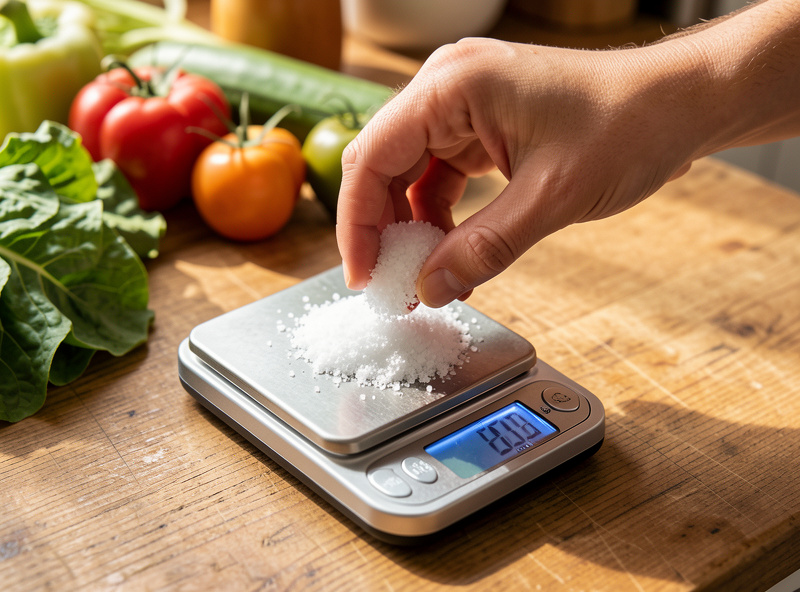
This is the part I refuse to hedge on. Under-salting a ferment that also acidifies is recoverable; under-salting a salt cure that relies on salt alone is how you grow something dangerous. On my 0.1 gram scale I weigh both the produce and the salt every single time — for a batch of preserved lemons I’ll put whole lemons on the scale, note the weight, and measure out salt at close to a fifth of that. I never eyeball it. Table salt, kosher salt, and coarse sea salt all weigh differently by volume, so a “quarter cup” means nothing; grams mean everything.
| Produce | Method | Salt level | Ready in | Keeps |
| Lemons (whole, quartered) | Dry salt pack + own juice | 15–20% by fruit weight | 3–4 weeks | 6–12 months |
| Limes | Dry salt pack + own juice | 18–20% by fruit weight | 4–6 weeks | 6–12 months |
| Garlic cloves | Salt pack or saturated brine | 20% pack / saturated brine | 2–3 weeks | 6+ months |
| Soft herbs (parsley, cilantro) | Layered salt cure | 25% by herb weight | 1 week | 6+ months |
| Whole chilies | Saturated brine | ~20% brine | 2–4 weeks | 6+ months |
Notice the pattern: the wetter and more delicate the produce, the higher the salt fraction, because there’s more cell water to overcome. Herbs get the heaviest cure of all. If you want to see exactly how I run each of these, the citrus work lives in the preserved lemons walkthrough and the alliums-and-herbs work lives in the salt-preserved garlic and herbs guide.
Which Produce Takes Well to Salt Curing?
The best candidates for salt curing are firm, acidic, or aromatic produce: citrus of every kind, garlic, ginger, chilies, and hardy herbs. These hold their structure through weeks in a salt-heavy environment and actually improve — the salt breaks down bitter pith and concentrates flavor. Watery, sweet produce like tomatoes or berries does poorly and is better lacto-fermented or canned.
Citrus is the star because the rind is where all the aromatic oil lives, and salt curing transforms that rind from something you’d normally discard into the whole point of the ingredient. Preserved lemon peel, finely minced, goes into everything I cook from tagines to salad dressings to a spoonful stirred through roast vegetables. Limes take the cure beautifully and turn almost black and jammy over months — I cover that transformation, plus oranges, bergamot, and mixed-citrus jars, in preserved limes, oranges, and other citrus variations.
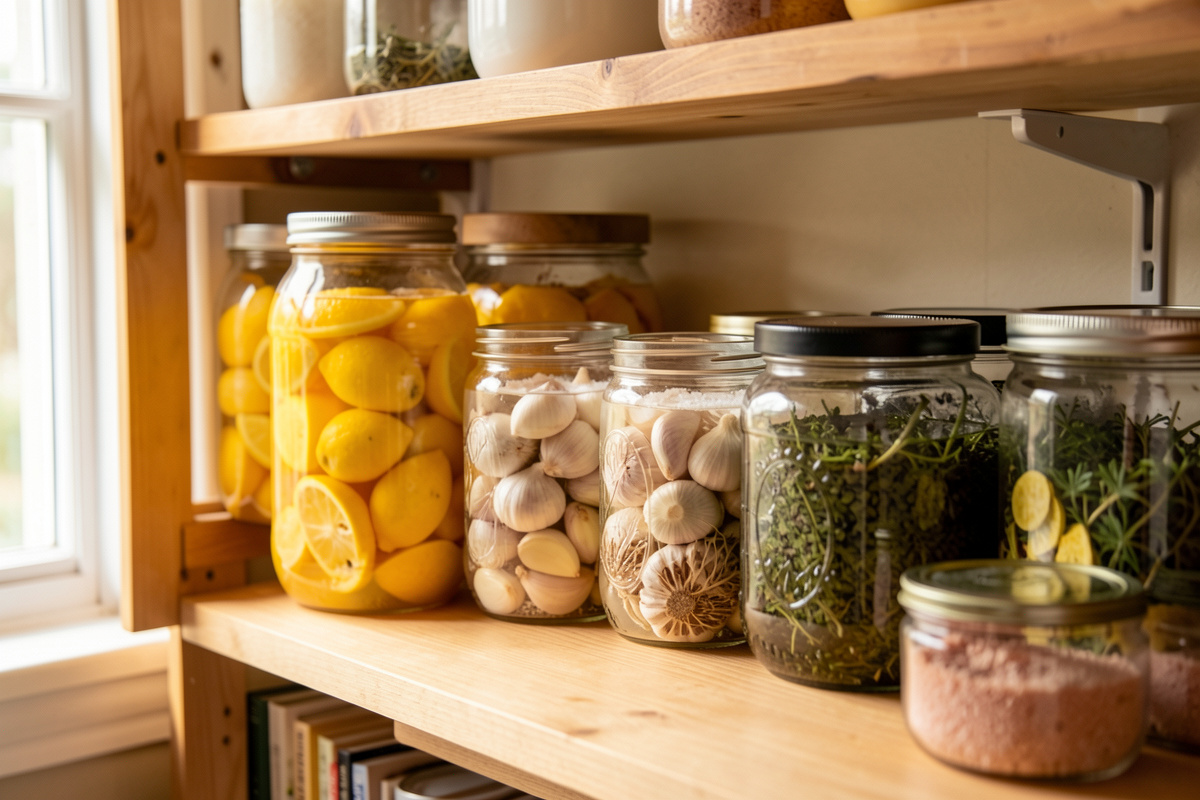
Garlic and herbs are the pantry workhorses. A jar of salt-cured garlic means I always have aromatics that won’t sprout or go soft, and salt-packed parsley or rosemary keeps a hit of green flavor available in February when the garden is under snow. The full method for both — including why I brine garlic rather than dry-pack it if I want to keep the cloves usable whole — is in the garlic and herbs guide.
Salt-Curing vs Lacto-Fermentation: Where’s the Line?
The line is acid. Lacto-fermentation uses a low salt level (2–3%) that permits *Lactobacillus* to grow and ferment sugars into lactic acid, dropping the pH below 4.6 and preserving through acidity. Salt curing uses a high salt level (15–25%) that suppresses nearly all microbial activity — including the lactobacilli — and preserves through low water activity instead. Different organisms, different dials, different results.
In practice you can taste the difference immediately. Sauerkraut is sour because acid is doing the preserving. A preserved lemon is intensely salty and only mildly tangy, because its safety comes from salt, not from a fermentation that dropped the pH. There’s a grey zone — a lightly salted lemon left long enough will get some lacto activity — but a classic 20% preserved lemon is squarely a salt cure. I unpack the whole spectrum, with the pH numbers and the safety logic for each, in salt-cured vs lacto-fermented. If you’re coming from the fermentation side of my shelf, this is the article that reframes salt curing as its own discipline rather than a weird cousin of kraut.
How Do You Make Preserved Lemons?
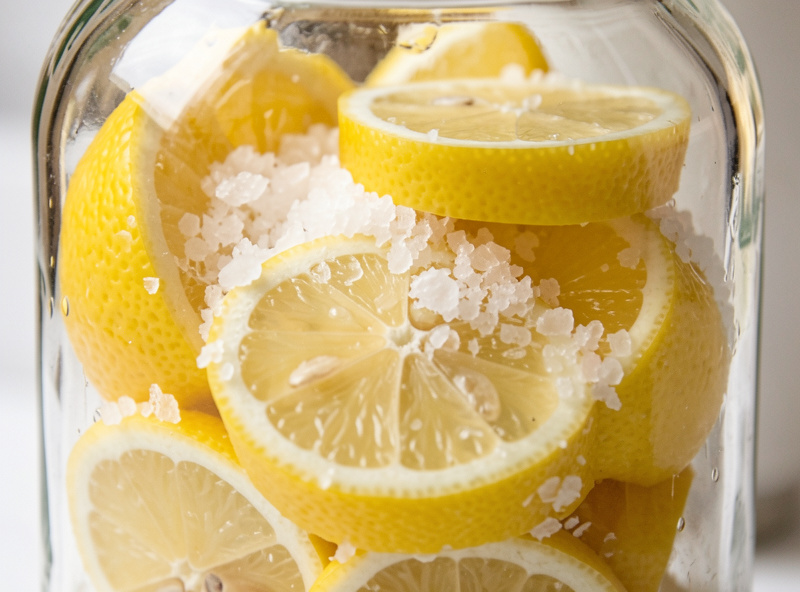
To make preserved lemons: scrub organic lemons, quarter them from the top but leave the base attached, pack the cut faces with coarse salt at 15–20% of the fruit weight, cram them into a sterile jar pressing hard to release juice, top with more salt and extra lemon juice until fully submerged, and cure at room temperature for three to four weeks, turning the jar every few days.
That’s the whole thing — there is genuinely no special equipment beyond a clean jar, salt, and a scale. The first week the fruit is stiff and the brine is thin; by week three the rinds have softened to the texture of a soft leather, the brine has gone syrupy, and the harsh raw-lemon smell has mellowed into something floral and savory. I use Meyer lemons when I can get them for the thinner pith, but standard Eureka lemons work fine. The complete step-by-step, including exactly how I pack the jar and the twelve ways I actually cook with the finished peel, is the flagship spoke of this cluster: how to make preserved lemons and how to use them.
The one place beginners panic is when the jar turns cloudy or the lemons go soft — both of which are supposed to happen. I get more questions about that than anything else, so it has its own troubleshooting piece linked below.
Can You Salt-Preserve Garlic and Herbs?
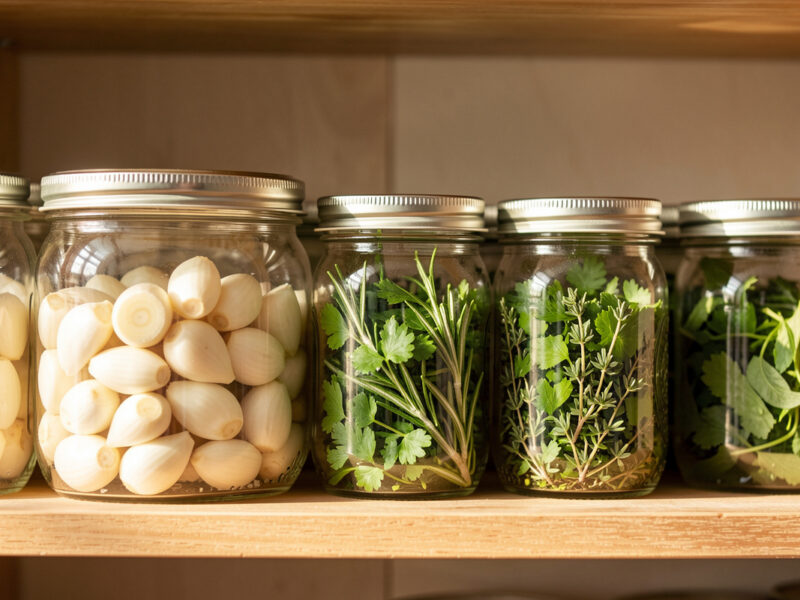
Yes — garlic and herbs are two of the best salt-cure candidates in the whole pantry. Garlic cloves go into a saturated brine or a 20% salt pack and stay firm and usable for six months or more without sprouting; soft herbs like parsley, cilantro, and dill get layered with salt at about 25% of their weight, which draws out their water and locks in a concentrated green flavor you can spoon straight into a dish.
The herb cure is my favorite low-effort preservation trick. A jar of salt-cured herbs is essentially a homemade seasoning base — the salt and the herb become one ingredient, and you account for the saltiness when you cook. Rosemary and thyme, being woody and aromatic, keep almost indefinitely. I walk through both the garlic brine and the layered-herb method, plus how much to reduce the salt elsewhere in a recipe when you’re cooking with them, in the salt-preserved garlic and herbs guide. One safety note I’ll flag here and expand there: raw garlic in oil is a botulism risk, but garlic in a high-salt brine is not the same thing — the salt is the safeguard.
What About Limes, Oranges, and Other Citrus?
Every citrus fruit can be salt-preserved, and each brings something different. Limes cure darker and more intense than lemons and are the backbone of certain South Asian pickles; oranges and their peel turn into a sweet-savory preserve that’s incredible with duck or in a marinade; bergamot, kumquats, and bitter Seville oranges each have their own uses. The method is identical to lemons — the salt level and timeline just shift slightly with the fruit’s thickness and water content.
I keep at least three citrus cures going at once in different jars, and comparing them side by side is half the fun. Preserved kumquats, whole and tiny, are a revelation you can pop straight from the jar. The full rundown of which citrus to cure, how the salt ratios change, and what each one is good for is in preserved limes, oranges, and other citrus variations. If you’ve mastered the basic preserved lemon, this is where the method opens up.
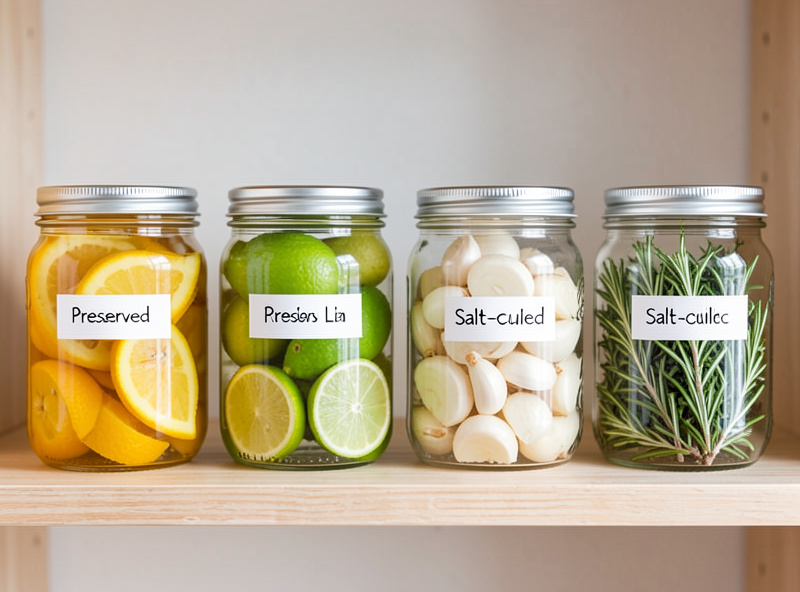
Are Salt-Preserved Foods Supposed to Look Cloudy or Soft?
Yes — cloudiness and softening are normal and expected in salt-preserved produce. The cloudy brine is dissolved pectin, fruit sugars, and cell material pulled out by osmosis; the softening is the salt breaking down the rind’s cell walls. Neither is spoilage. Real spoilage in a salt cure is rare and looks specific: fuzzy, colored, raised mold above the brine line, or an off smell like rot rather than sharp salt-and-citrus.
This is where the measurement mindset pays off. A properly submerged, properly salted jar is a hostile place for pathogens, so the failures almost always come from the same two mistakes: not enough salt, or produce poking above the brine into the air. A white film on the surface is usually kahm yeast — harmless, skim it — the same way it shows up on my lacto pickles. Fuzzy green or black growth is real mold and means toss the batch. I put the full photo-by-photo “is this normal?” checklist in are preserved lemons supposed to get soft and cloudy? — the single most-visited troubleshooting question I get.
How Long Does Salt-Preserved Produce Keep?
Properly salted and fully submerged, salt-preserved citrus keeps six to twelve months at room temperature and often longer in the fridge; salt-cured garlic and herbs keep six months or more. The salt doesn’t expire and the low water activity doesn’t drift, so these preserves fail from contamination or exposure to air, not from age. Keep everything under the brine and use a clean utensil every time.
I’ve eaten preserved lemons well past a year old that were perfect — if anything they improve, the flavor deepening and the peel getting silkier. The failure modes are all mechanical: a lemon that floated above the brine and dried out, a jar contaminated by a dirty spoon, or a lid that let too much liquid evaporate. Refrigeration isn’t required for a correctly made cure but it slows everything down and buys extra insurance. The complete storage playbook — jar choice, topping up the brine, fridge vs pantry, and the exact signs a jar has finally turned — is in how long do preserved lemons keep and how to store them.
What Gear Do You Actually Need?
Almost nothing — that’s the beauty of salt curing. You need a clean glass jar with a non-reactive lid, a 0.1 gram kitchen scale to weigh salt accurately, and coarse non-iodized salt. That’s the entire required list. Everything else is optional refinement.
The scale is the one thing I’d insist on. Salt curing lives or dies on the salt fraction, and volume measurements of salt are wildly unreliable across salt types. My 0.1 gram scale does every calculation in this cluster. Beyond that: wide-mouth Mason jars in quart and half-gallon sizes are my default vessels because I can pack them by hand and get a lid on tight; a small glass fermentation weight helps keep floaty citrus submerged; and non-iodized salt matters because iodine and anti-caking agents can cloud a brine or leave an off taste. I use plain coarse sea salt or kosher salt. You do not need an airlock — salt cures aren’t producing the CO2 that a lacto ferment does, so a normal lid is fine, just burped occasionally if any activity builds.
If you’re buying jars or a scale to start, a quick search does the job. As an Amazon Associate I earn from qualifying purchases. You can compare wide-mouth Mason jars and a 0.1 gram digital scale to get set up, but honestly you may already own everything you need.
The Mistakes I Made So You Don’t Have To
My worst early failure was a jar of preserved lemons that grew a raised, fuzzy grey patch on the top two lemons — because I’d packed them proud of the brine and never pushed them back down. The salt level in the liquid was fine; the exposed rind above the surface was not. I lost the whole jar, and the lesson stuck: in a salt cure, the brine line is the safety line. Anything above it is exposed to air and can grow what the brine would have stopped.
The second mistake was salting by volume in my first year — a “half cup of salt” that turned out to be a very different mass depending on whether I’d grabbed the fine table salt or the flaky sea salt. One batch came out under-salted and soft in a way that worried me enough to toss it. Since then, everything goes on the 0.1 gram scale, produce weight first, then salt as a percentage. Weigh, don’t guess. That single habit is the difference between salt curing feeling risky and feeling like the safest, most forgiving preservation method in the kitchen.
What I’d do starting today: pick lemons, buy nothing but salt and a jar, weigh both, pack tight, keep everything under the brine, and check it in three weeks. Then read the spoke that matches whatever question comes up — and something always comes up, which is exactly why I linked every one of them above.
For the garden side of this — growing the cabbage and chilies that feed the rest of my fermentation shelf — my crossover notes live over at cityrooted, and the parallel between a salt cure and whole-muscle charcuterie (same salt-and-time logic, different scale) is something I get into at curingchamber.
Frequently Asked Questions
Is salt-preserved produce the same as fermentation?
No. Fermentation like sauerkraut uses low salt (2 to 3 percent) to let Lactobacillus produce acid and drop the pH below 4.6. Salt curing uses high salt (15 to 25 percent) to lower water activity and suppress nearly all microbes, including the lactobacilli. Different organisms, different preservation mechanism.
How much salt do I need to safely preserve produce?
For a dry salt cure, use salt at 15 to 20 percent of the produce weight. For a covering brine, use a near-saturated solution of roughly 20 to 25 percent salt by weight of water. Always weigh salt on a scale rather than measuring by volume, since salt types differ hugely by volume.
Is it normal for the brine to turn cloudy?
Yes. Cloudiness is dissolved pectin, sugars, and cell material pulled out of the produce by osmosis. It is expected and not a sign of spoilage. Real spoilage looks like fuzzy, colored, raised mold above the brine line or smells of rot rather than sharp salt and citrus.
How long does salt-preserved produce last?
Properly salted and fully submerged, salt-preserved citrus keeps six to twelve months at room temperature and often longer refrigerated. Salt-cured garlic and herbs keep six months or more. These preserves fail from air exposure or contamination, not from age, so keep everything under the brine and use a clean utensil.
Do I need an airlock for salt curing?
No. Unlike lacto-fermentation, salt curing produces little to no CO2, so a normal tight lid is fine. Just burp the jar occasionally in the first weeks if any pressure builds. The key requirement is keeping all produce fully submerged below the brine line.
Can I reduce the salt to make it healthier?
Not below the safe floor. In a true salt cure the salt is the only thing preventing dangerous microbial growth, so cutting it turns a safe preserve into a risky one. If you want a lower-salt result, choose lacto-fermentation instead, which preserves through acid at 2 to 3 percent salt.
Keep Building
- How to Make Preserved Lemons and How to Use Them
- Salt-Preserved Garlic and Herbs for the Pantry
- Salt-Cured vs Lacto-Fermented: Two Different Preservation Paths
- Are Preserved Lemons Supposed to Get Soft and Cloudy?
- Preserved Limes, Oranges, and Other Citrus Variations
- How Long Do Preserved Lemons Keep and How to Store Them
Every technique here leans on the same safety references I keep coming back to: the National Center for Home Food Preservation for salting and curing fundamentals, and the FDA Food Code for the water-activity thresholds that make a salt cure genuinely shelf-stable.

About Kenny Nyhus Fadil
A home fermenter documenting brines, bubbles, and the occasional moldy tragedy.
Keep Bubbling
Salt-Preserved Garlic and Herbs for the Pantry
Quick Pickling vs Lacto Fermentation: The Difference