How to Calculate a Salt Brine Percentage by Weight With a Scale

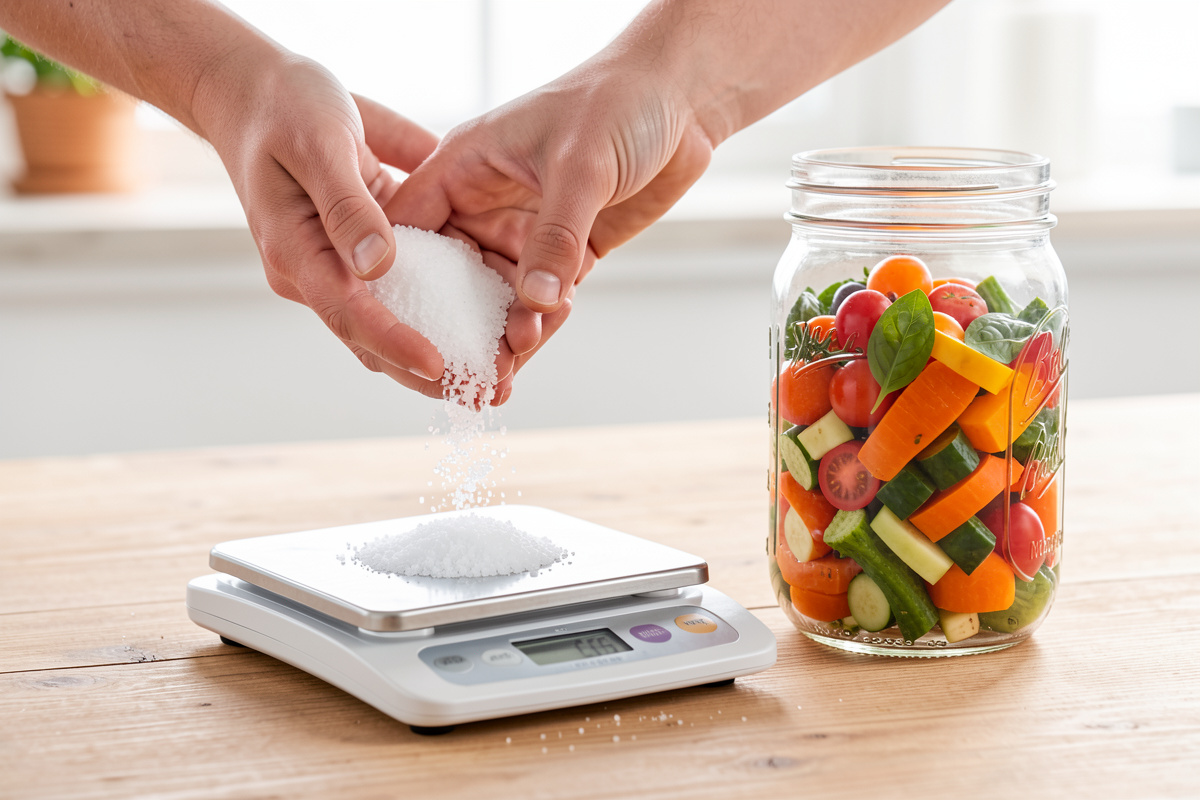
To calculate a salt brine percentage by weight, weigh everything that goes in the jar — vegetables plus water — then multiply that total in grams by your target percentage as a decimal. For a 2.5% brine on 1,500 g of contents, that is 1,500 × 0.025 = 37.5 g of salt. A 0.1 g scale turns the whole thing into one line of arithmetic.
That is the entire skill, and once it clicks you never reach for a measuring spoon again. Every batch in my kitchen — kraut, kimchi, lacto pickles, hot-sauce mash — starts on the scale, because weight is the only salt measurement that is actually repeatable. This guide walks the calculation slowly, with the two real-world variations that trip people up: dry-salting a packed jar of produce, and building a separate brine to pour over whole vegetables. Both use the same formula; they just define “total weight” a little differently. For the wider context of why these numbers matter, the salt and brine math hub maps every ferment’s safe band.
The Formula, Once and For All
Salt in grams equals total weight in grams times the percentage as a decimal. Write it as salt = total × (% ÷ 100). A 2% brine is × 0.02, a 3.5% brine is × 0.035, a 5% brine is × 0.05. That is it. There is no separate conversion for different salts, no fudge factor for jar size — the percentage already scales to whatever total weight you put in.
The reason this beats volume measuring is crystal density. A level tablespoon of fine table salt weighs roughly 18 g, while the same spoon of flaky kosher salt weighs closer to 10 g. Follow a “1 tablespoon per quart” recipe with the wrong salt and your brine can swing from 2% to nearly 4% — the difference between a fast crunchy ferment and an over-salted one. Weighing erases that entirely. On my bench the scale stays on the counter the whole time I am packing jars.
Method 1: Dry-Salting Shredded Produce
For sauerkraut, kimchi base, or anything you shred and massage, the “total weight” is the weight of the prepared vegetables alone — because the brine forms from the water the salt pulls out of the cells. You are not adding water, so you do not weigh any. Weigh the shredded cabbage, multiply by your percentage, and massage that much salt in.
Worked example: 1,200 g of shredded cabbage at 2.25% needs 1,200 × 0.0225 = 27 g of salt. Massage it in, pack it down, and within an hour or two osmosis builds enough brine to submerge the kraut under its own liquid. This is the cleanest version of the calculation because there is only one number to weigh. The dry salting versus brining guide covers which vegetables suit this approach, and the sauerkraut salt percentage test shows what 2% versus 3% actually tastes and behaves like.
Method 2: Building a Brine to Pour Over Vegetables
For cucumbers, beans, carrots, or whole garlic — produce that holds its shape and will not give up enough water on its own — you submerge it in a pre-mixed brine. Here “total weight” is the water plus the vegetables together, because the salt has to season both. The cleaner shortcut most fermenters use is to weigh the water and salt the water to a slightly higher percentage to account for the produce diluting it as it equalizes.
My practical method: pack the jar with vegetables, fill with water to cover, then pour that water into a measuring jug and weigh it. Say it comes to 600 g of water. For pickles I want a strong brine, so I salt that water at 4%: 600 × 0.04 = 24 g of salt. Stir until dissolved, pour back over the vegetables, weight them down. As the produce releases some water the salinity settles toward the mid-3% range across the whole jar, which is exactly where a crunchy lacto pickle wants to be.
Total-Weight vs Brine-Only: Don’t Mix Them Up
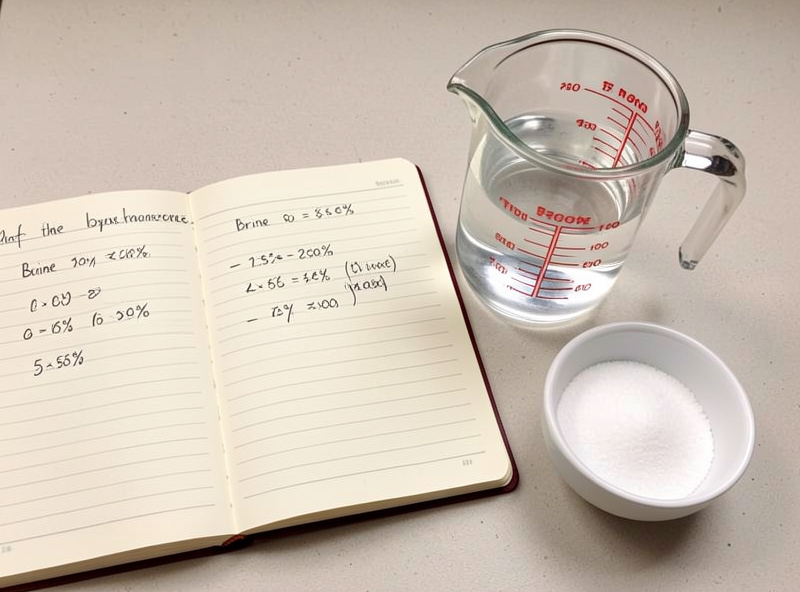
The single most common calculation error is confusing the two ways of expressing percentage. Total-weight percentage counts salt against everything in the jar. Brine-only percentage counts salt against just the water and ignores the vegetable mass. The same jar can read 2% one way and 3.5% the other, so a recipe that does not say which it means is genuinely ambiguous.
I default to total weight for dry-salted ferments and water-weight for poured brines, and I never average the two. If you adopt one convention and stay with it, your results become repeatable batch to batch — which is the whole point of weighing in the first place.
| Method | What you weigh | Example | Salt |
|---|---|---|---|
| Dry-salt (kraut, kimchi) | Shredded vegetables only | 1,200 g cabbage at 2.25% | 27 g |
| Poured brine (pickles) | Water that covers the jar | 600 g water at 4% | 24 g |
| Full total-weight (mash) | Produce + water together | 1,000 g total at 3.5% | 35 g |
A Faster Trick: Tare and Top
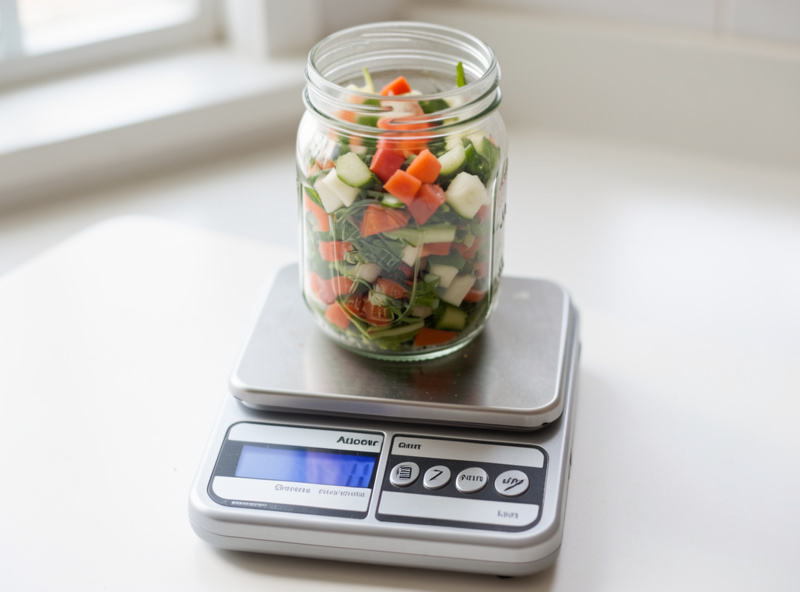
When I run several jars at once I skip the jug entirely. Put the empty jar on the scale, press tare to zero it, pack in the vegetables and add water to cover, and read the total weight straight off the display. Multiply that number by your percentage and add that much salt right into the jar. One weighing, one multiplication, no extra dishes. The 0.1 g resolution matters here because on a small batch the difference between 20 g and 24 g of salt is a real swing in strength.
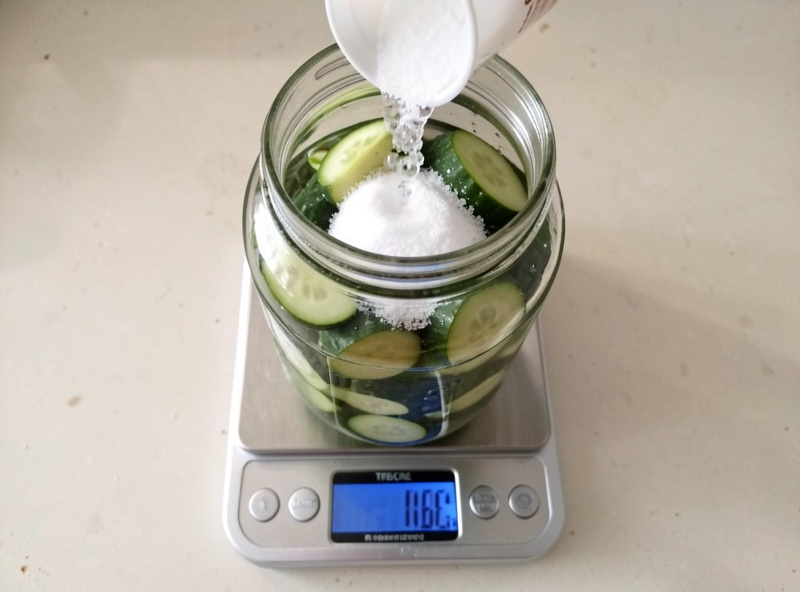
Whichever method you use, dissolve the salt fully and keep the produce submerged with a fermentation weight so the top layer does not dry out and grow film. If you ever need to confirm the strength of a brine you did not build yourself, a salinity refractometer reads it directly — but for anything you weighed, the math already told you the answer. Those target percentages are not arbitrary: the National Center for Home Food Preservation grounds safe vegetable fermentation in hitting the correct salt concentration, so getting this one multiplication right is the line between a safe jar and a guess. As an Amazon Associate I earn from qualifying purchases. A reliable 0.1 g digital kitchen scale is the one tool I would never ferment without.
Frequently Asked Questions
What is the formula for fermentation brine percentage?
Salt in grams equals total weight in grams multiplied by the percentage as a decimal. For a 2.5% brine on 1,500 g of contents, that is 1,500 times 0.025, which equals 37.5 g of salt. The percentage scales automatically to any batch size.
Do I weigh the vegetables or just the water?
For dry-salted ferments like sauerkraut, weigh the shredded vegetables only, since the brine forms from their own water. For poured brines over whole produce like cucumbers, weigh the water you use to cover and salt that water, typically at 3.5 to 5%.
How much salt is 2% for a quart jar?
It depends on the contents weight, not the jar size. A quart of shredded cabbage weighing about 800 g needs roughly 16 g of salt at 2%. Always weigh the actual contents rather than assuming a fixed amount per jar.
Can I calculate brine percentage without a scale?
You can approximate with volume, but it is unreliable because salt crystal density varies. A tablespoon of fine salt weighs nearly double a tablespoon of flaky kosher salt. For repeatable, safe results, a 0.1 g scale is strongly recommended over measuring spoons.
What percentage should I use for pickles versus kraut?
Sauerkraut runs 2 to 2.5% by weight of cabbage. Submerged lacto pickles such as cucumbers, beans, and carrots run 3.5 to 5% in the brine water, because they have no osmotic pre-draw and need a stronger solution to stay safe and crunchy.
Why do my batches come out inconsistent?
The usual cause is measuring salt by volume or switching salt types between batches. Weigh the salt in grams every time and pick one convention, total weight or water weight, and stick to it. Consistency in measurement gives consistency in results.
Related Articles
- Salt and Brine Math: The Complete Fermentation Salinity Guide
- How Much Water and Salt for a Quart Jar: A Brine Cheat Sheet
- Dry Salting vs Brining Vegetables: When to Use Each Method
- Best Salt for Sauerkraut: Sea vs Kosher vs Pickling vs Iodized
- Lacto-Fermentation for Vegetables: The Complete Home Guide

About Kenny Nyhus Fadil
A home fermenter documenting brines, bubbles, and the occasional moldy tragedy.
Keep Bubbling
Spring, Filtered, or Distilled: Which Water for Water Kefir
Fermenting Hydroponic Greens: Why Hydroponic Lettuce and Kale Need a Different Salt Ratio