Fermented Fizzy Drinks: Water Kefir, Kvass, Switchel, and Tepache

Pop the swing-top on a bottle of home-brewed kvass and the fizz hits before the flavor does — a sharp, bready prickle that a can of soda water can’t fake, because the CO2 came from live yeast working sugar in a sealed bottle, not a carbonation tank. That’s the throughline across the four drinks in this piece: water kefir, kvass, switchel, and tepache all get their fizz, their tartness, and a good chunk of their mineral character from the same fermentation chemistry that runs my sauerkraut crock and my kombucha jars, just pointed at something you drink instead of something you eat with a fork.
None of these four are kombucha, and I’m not trying to make them kombucha. Kombucha needs a SCOBY and weeks of patience. These four are the fast, low-fuss end of the fermented-drink shelf — the ones I reach for when I want something fizzy and interesting in two to four days without babysitting a culture. I run all four in rotation through the summer, mostly because the flavor range between a tart water kefir, a bready kvass, a ginger-hot switchel, and a fruity tepache covers almost every mood a cold glass needs to hit.
Why These Drinks Fizz and Taste the Way They Do
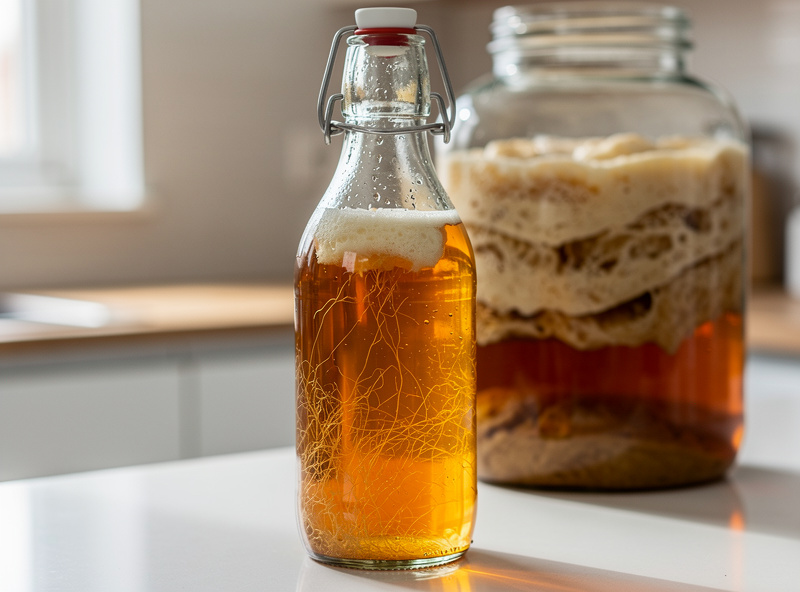
The fizz in all four drinks comes from the same place: yeast metabolizing sugar in a sealed or partly sealed container, producing CO2 with nowhere to go but into solution. Water kefir grains and the wild yeast on a pineapple rind or in a chunk of rye bread do the same basic job as the yeast in a bottle of Champagne — they just do it at kitchen temperature over days instead of in a controlled cellar over months. The tartness underneath the fizz comes from the bacteria working alongside the yeast: lactic acid from water kefir’s bacterial side, acetic acid if a ferment runs long enough to tip toward vinegar, and in switchel’s case, acetic acid added directly as cider vinegar rather than produced in the vessel.
Salt shows up in a couple of these drinks, and it’s worth being straight about why: it’s a flavor tool, not a wellness additive. A pinch of sea salt in kvass or tepache rounds off the sour edge and adds a mineral, faintly savory note — the same reason a gose beer is brewed with salt and coriander, or a michelada gets a salted rim. It changes how the drink sits on the tongue. That’s the whole claim. Any specific number on what a fermented drink can or can’t do for your body belongs in a different kind of article than this one; here it’s brewing and flavor, full stop.
Food safety is the one place I don’t get loose with numbers. Any open ferment — these four included — needs to drop its pH below 4.6 to sit outside the range where Clostridium botulinum can grow, a threshold the food-safety literature is unambiguous about: as UGA Extension’s rundown on pH and food safety puts it, spores of C. botulinum simply will not grow at a pH under 4.6, which is why that number is the line commercial acidified-food rules are built around. All four drinks here get there fast — a day or two of active fermentation is enough acid production to clear that floor — and a ferment that smells clean, sour, and yeasty rather than putrid or off is doing exactly what it should.
Four Home-Brewed Fizzy Ferments
If you want the short version before the details: water kefir is the most forgiving and the one I’d hand a first-timer, kvass is the one that uses up bread I’d otherwise throw out, switchel is the fastest and barely needs fermentation at all, and tepache is the one that surprises people because it needs no starter culture whatsoever — just a pineapple.
| Drink | Base | Ferment Time | Flavor Profile | Natural Fizz |
|---|---|---|---|---|
| Water kefir | Kefir grains + sugar water | 24–48h primary, 24–48h F2 | Clean, mildly tart, neutral canvas for fruit | Moderate–high (F2 dependent) |
| Kvass | Stale rye bread + water | 1–3 days | Bready, mildly sour, faint malt sweetness | Light–moderate |
| Switchel | Molasses + cider vinegar + ginger | Same day, or 1–2 days if kicked with a live vinegar splash | Sharp ginger heat, dark molasses tang | Low unless actively fermented |
| Tepache | Pineapple rind + piloncillo + spice | 2–3 days | Fruity, warm-spiced, faintly winey | Moderate–high |
Water Kefir — the Everyday Crock
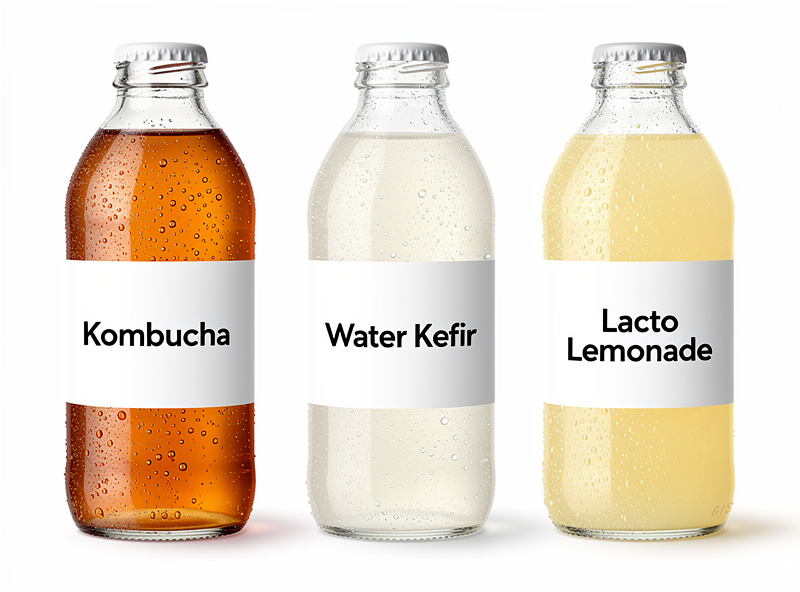
Water kefir is the one I keep going year-round because the grains ask so little. A quart jar, roughly 60 g of cane sugar dissolved into 900 mL of dechlorinated water, a tablespoon of active grains, and 24 to 48 hours at room temperature is the whole primary ferment — I go by taste more than the clock, since a warm Swedish kitchen in July runs faster than the same jar in a cool March. The grains come out, the sweet-tart base liquid goes into a swing-top bottle with a spoonful of crushed ginger or a splash of tart cherry juice, and a second 24- to 48-hour ferment at room temperature builds the fizz — I burp the bottle daily until it hisses back convincingly, then it goes in the fridge to stop.
The flavor is the reason I keep a batch running even in the weeks I’m deep in a kombucha cycle. Where kombucha carries tea tannin and vinegar bite, water kefir is a clean, almost neutral base that takes on whatever fruit or herb you second-ferment it with — it’s the closest thing in my fermentation lineup to a blank canvas, and it’s the drink that converts people who think they don’t like “fermented” flavors.
Kvass — What a Swedish Kitchen Does With Stale Rye
Rye bread turns stale fast in my kitchen, which makes kvass close to a zero-waste habit rather than a project. I toast roughly 300 g of stale rye bread cubes until dark and dry, dunk them in 2 liters of hot water for a few hours to pull out the starch and flavor, strain the liquid off the bread, stir in 100 g sugar and a small handful of raisins, and let the wild yeast already living on the bread crust take it from there — a day or two at room temperature is enough for the raisins to float and the liquid to turn faintly hazy and lightly sparkling. Kvass brewed this way is a genuinely low-alcohol drink; traditional versions typically land under roughly 1.5% ABV, which the drink’s long documented history bears out — the historical record on kvass traces it back to at least 988 CE, when it’s recorded alongside mead as part of Prince Vladimir’s celebrations in Kiev, and centuries of home brewers since have used the same rye-and-water base I’m running in a Mason jar on my counter.
I strain out the bread and raisins, bottle the liquid, and give it one more day sealed to build carbonation before it goes cold. A pinch of salt in the glass at serving time — not in the ferment — takes the edge off the tang the same way it does in a good sourdough crust.
Switchel — the Two-Ingredient Fizz That Barely Needs a Ferment
Switchel is the outlier on this list because the classic version isn’t really a live ferment at all — it’s a mix-and-drink of water, molasses or honey, apple cider vinegar, and grated ginger, and it’s been served that way since it turns up in New England as haymaker’s punch, the drink field workers reached for between rounds of cutting hay. The Old Farmer’s Almanac’s history of the drink traces switchel back through 19th-century hayfields to a Caribbean and colonial-American origin, and the base recipe — molasses, water, sometimes vinegar and ginger — hasn’t changed much since.
What I do differently is give it a short active ferment: a splash from my live vinegar mother instead of bottled cider vinegar, mixed with the molasses, ginger, and water and left loosely covered for a day or two at room temperature before straining and refrigerating. The mother’s live acetic-acid bacteria and a little wild yeast off the unpeeled ginger root pick up right where a plain mix-and-drink switchel leaves off, and the result gets a faint natural prickle that a same-day switchel doesn’t have. It’s still the fastest drink on this list either way — even the un-fermented version is ready to drink in minutes, which is why it’s the one I make when I want something ginger-forward and don’t want to wait.
Tepache — Three Days, One Pineapple, No Starter Culture
Tepache is the drink on this list that most surprises people who’ve only ever fermented with a maintained culture, because it needs none. The wild yeast living on a pineapple’s skin is enough to carry the whole ferment — the background on tepache confirms what most home brewers of it already know: it’s built from the rind and core of a pineapple, sweetened with piloncillo or dark brown sugar and warmed with cinnamon, and the fermentation typically runs a couple of days to a bit longer depending on how warm the kitchen is and how much fizz and tang you want.
I cut the rind and core off one pineapple, pack it into a half-gallon jar with 150 g piloncillo (or dark brown sugar if that’s what’s in the cupboard), a cinnamon stick, and enough water to cover, and leave it loosely lidded at room temperature for two to three days, stirring once a day and tasting from day two onward. It’s ready when it’s fragrant, faintly fizzy, and pleasantly tart rather than sharply sour — leave it much past three or four days at a warm room temperature and it drifts further toward alcoholic and vinegary, which some people want and some don’t. I strain it, bottle it cold, and it’s gone within a week because everyone in the house drinks it faster than I can brew the next batch.

What I Actually Stock and Brew Across All Four
The water kefir grains live in the same rotation as my milk kefir grains, fed in a quart Mason jar with a Pickle-Pipe waterless airlock so I don’t have to burp a primary ferment. Kvass and tepache both run in wide-mouth half-gallon jars from the same shelf that holds my sauerkraut jars when the crock is full — no dedicated gear needed beyond what a fermentation kitchen already has on hand. Switchel gets a splash from the same vinegar mother jar that’s been feeding my home vinegar for months, which is the one piece of “borrowed” culture in the lineup. For bottling anything with active carbonation, I only use glass rated for pressure — proper swing-top (Grolsch-style) bottles or heavy Belgian-beer bottles — never a screw-cap jam jar repurposed as a soda bottle.
That last point isn’t a minor detail. I test every new carbonated batch in a plastic soda bottle first, squeezing it daily — when it goes rock-hard and won’t dent under thumb pressure, that’s my signal the glass bottles are close to ready and it’s time to move everything to the fridge. I learned that the hard way with an early batch of kvass I bottled and forgot about for four days on a warm counter: one bottle let go on its own overnight, and I found rye-scented glass shards across half the kitchen floor the next morning. Nobody was hurt, but it’s the reason I never skip the plastic-bottle pressure test now, and it’s the reason every fizzy ferment in my kitchen gets checked daily until it’s safely cold.
What I’d Reach for on a Hot Day
After a few summers running all four side by side, the one I keep coming back to on a hot afternoon is tepache — it takes the least equipment, uses a pineapple that would otherwise go in the compost, and the flavor is the most immediately likeable to anyone who’s never had a fermented drink before. Water kefir is the one I trust to convert a skeptic because it’s the mildest, kvass is the one that makes the best use of bread that would otherwise be wasted, and switchel is what I reach for when I want something ready in minutes rather than days. All four live in the same rotation as the rest of the crock and jar lineup in this kitchen — different vessels, same basic chemistry, four very different glasses at the end of it.
Frequently Asked Questions
What makes a fermented drink fizzy without added carbonation?
Live yeast metabolizing sugar in a sealed or partly sealed container produces carbon dioxide with nowhere to escape, so it dissolves into the liquid. Water kefir grains, wild yeast on a pineapple rind, and wild yeast on rye bread crust all do this job at room temperature over one to three days, the same basic process that carbonates Champagne over a much longer, cooler timeline.
Is it safe to add salt directly to kvass or tepache?
Yes, in the small amounts used for flavor. A pinch of sea salt (well under 1 percent by weight) added at serving time rounds off sourness and adds a mineral note without affecting the fermentation, since it’s added after the ferment is done rather than into the active brew. It’s a flavor choice, the same logic behind a salted gose beer or a rimmed michelada, not a food-safety requirement.
How long should tepache ferment before it’s ready to drink?
Two to three days at room temperature is the typical window, depending on kitchen warmth. It’s ready when it smells fragrant and faintly winey and tastes tart with a light natural fizz. Left much longer in a warm kitchen it keeps fermenting toward more alcohol and more vinegar-like sourness, which some brewers want and some don’t — taste daily from day two onward and refrigerate once it’s where you like it.
Can I use bread other than rye for kvass?
Rye is traditional and gives the characteristic malty, faintly sour flavor, but pumpernickel or other dark, dense breads work using the same method. Lighter white breads produce a thinner, blander kvass because they lack the dense crumb and crust flora that carry most of the flavor and the wild yeast that starts the ferment.
What’s the easiest fermented fizzy drink for a first-time brewer?
Water kefir. The grains do most of the work, the primary ferment is forgiving of a few extra hours either direction, and there’s no risk of an under-ripe batch tasting unpleasant the way an early-stopped ferment sometimes can elsewhere. Tepache is a close second since it needs no maintained culture at all — just a pineapple and patience.
Related Articles
- Kombucha Brewing: The Complete Home Guide from SCOBY to Bottle
- Lacto-Fermentation for Vegetables: The Complete Home Guide
- Home Vinegar Making: The Complete Guide from Mother to Bottle
- Fermentation Equipment: The Complete Home Brewer Toolkit
- Fermented Hot Sauce: The Complete Home Brewer Guide

About Kenny Nyhus Fadil
A home fermenter documenting brines, bubbles, and the occasional moldy tragedy.
Keep Bubbling
Clean a Stoneware Fermentation Crock Without Soap Residue
Spring, Filtered, or Distilled: Which Water for Water Kefir