Sauerkraut Mold vs Kahm Yeast: How to Tell the Difference (Photos)

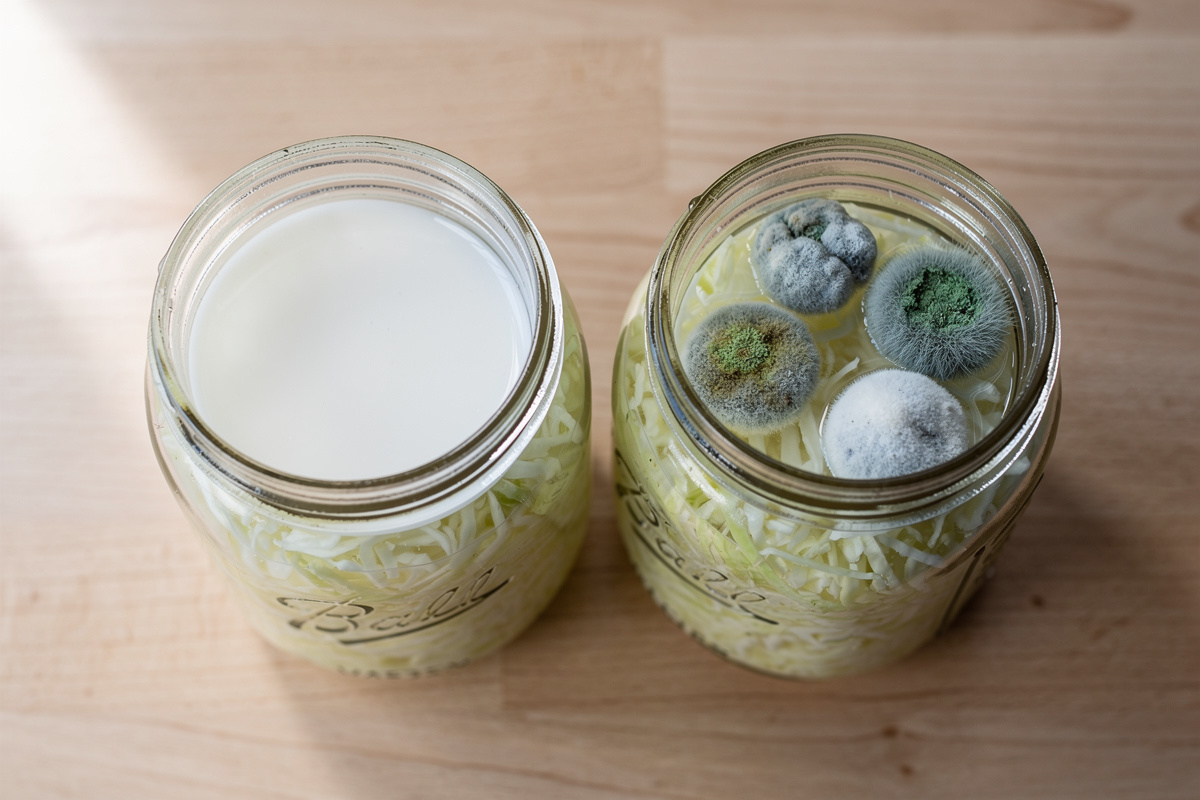
Kahm yeast is a thin flat white film on the brine surface — completely safe, just skim it off and the sauerkraut continues fermenting normally. Mold is fuzzy, three-dimensional, and almost always colored (green, blue, black, or pink) — it means the ferment is contaminated, and confirmed mold means the entire jar gets tossed, no matter how small the spot.
Surface ID is one of five variables that decide sauerkraut success; cabbage variety, salt, temperature, and storage are the others — full system in my homemade sauerkraut guide.
The visual difference is unmistakable once you’ve seen both: kahm looks like wax paper, mold looks like fur. I threw away my first two jars of sauerkraut because I couldn’t tell the difference — scraped what turned out to be kahm yeast off the surface with a fork, panicked at the sight of anything white, and dumped both batches. A neighbor who’d been fermenting for 15 years looked at my third jar and said “that’s just kahm, skim it off.” The cabbage underneath was crisp and perfect. I had wasted two weeks of fermentation and two heads of cabbage on nothing but inexperience.
Most home fermenters mistake their first kahm yeast appearance for mold and toss perfectly good ferments. It’s one of the most common issues beginners run into in the first couple of weeks, almost always traced back to incomplete brine submersion — it’s a sign that surface oxygen exposure happened, not that the fermentation failed. This guide covers visual identification, the simple skim-and-continue rescue, and the four common causes that make kahm appear in the first place.
Visual ID: Kahm Yeast vs Mold
Kahm yeast (Pichia, Candida, or related yeasts) appears as a thin white-to-pale-cream film floating on the brine surface. Texture is flat, slightly wrinkled, and looks like a thin layer of wax paper or skim milk. The film typically covers most or all of the brine surface uniformly rather than appearing in patches. It can be lifted off in one continuous sheet with a spoon.
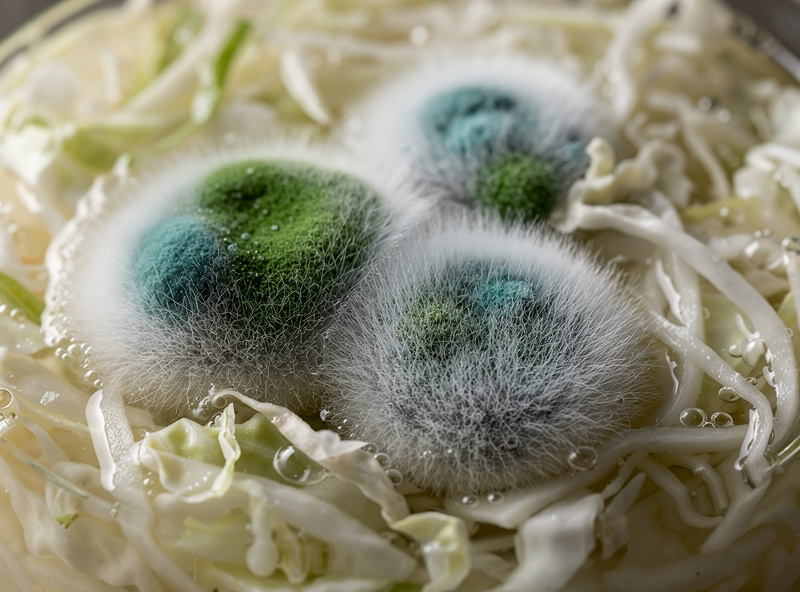
Mold appears as raised three-dimensional fuzzy growth in distinct patches. Color is the giveaway: green (Penicillium expansum or Aspergillus), blue-green (Penicillium chrysogenum), black (Aspergillus niger), pink-red (Fusarium), or fuzzy white that’s clearly raised rather than flat. Mold colonies have visible structure — you can see the individual fungal threads if you look closely.
The flat-vs-fuzzy test is the fastest field check. Press a clean toothpick gently into the surface growth. Kahm yeast collapses immediately and feels slick. Mold resists the toothpick and feels firm or springy. The difference is unmistakable.
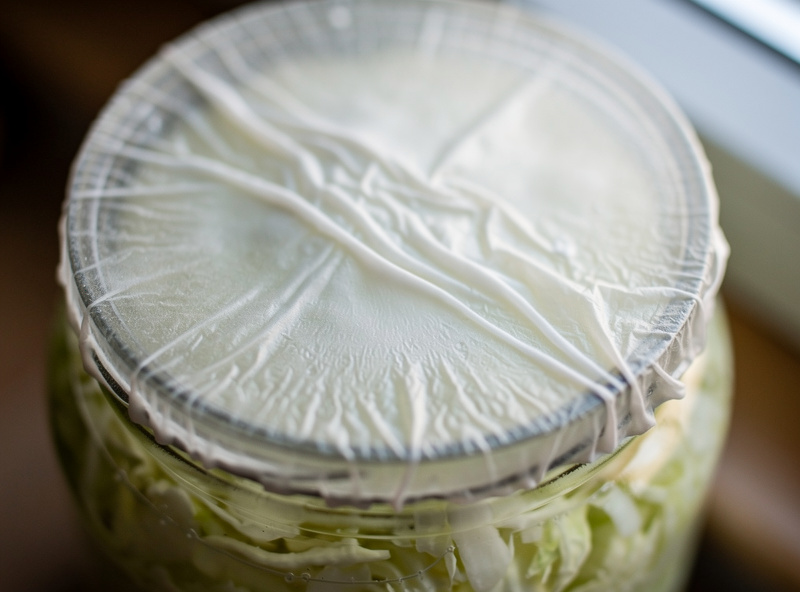
Why Kahm Yeast Appears (And Why It’s Not Dangerous)
Kahm yeasts are aerobic — they need oxygen to grow. They establish on the brine surface where oxygen is present and the lactic acid bacteria (LAB) doing the actual fermentation can’t compete. The LAB are anaerobic and dominate in the brine below the surface; kahm fills the surface niche.
Kahm yeast doesn’t produce toxins, doesn’t damage the LAB fermentation, and doesn’t make the food unsafe. Some traditional ferments (Russian solyanka, certain Eastern European pickles) actively encourage a thin kahm yeast film as part of the desired flavor profile. The “throw it away because something white grew on top” instinct is American sanitation culture, not actual food safety.
The downside of kahm: it produces volatile off-flavors (sometimes described as “musty” or “yeasty”) that can transfer into the ferment if left in place for 5+ days (more on why kahm forms across all ferments in our complete kahm yeast guide). Skimming kahm off within 48 to 72 hours of appearance prevents the off-flavor transfer and the sauerkraut tastes normal.
The Four Causes of Kahm Yeast
Cause 1 (most common): Cabbage not fully submerged below brine. Pieces of cabbage poking above the brine surface contact air directly, give kahm yeast a stable substrate, and the film spreads from there. Use a fermentation weight (glass disc, ceramic weight, or a small zip bag of brine) to hold the cabbage submerged.
Cause 2: Salt percentage too low. Below 1.5% salt by weight, the LAB activity is sluggish and kahm yeasts have time to establish before the brine pH drops. Standard sauerkraut salt percentage is 2 to 2.5% — never go below 1.5% even for “low-salt” recipes.
Cause 3: Fermentation temperature too high. Above 75°F, surface evaporation accelerates and the brine concentrates at the surface, creating a salt-poor zone where kahm yeast thrives. Keep sauerkraut fermentation at 60 to 70°F for the first 7 to 10 days.
Cause 4: Open or poorly-sealed jar. Standard mason jar lids let oxygen exchange happen, which kahm needs. Use an airlock lid (silicone valve, fermentation lid, or a 2-piece mason jar lid loosened slightly) to limit oxygen exchange while still letting CO2 escape during active fermentation.
I learned the submersion lesson the expensive way during my second summer of fermenting. I was using a small ceramic ramekin as a fermentation weight — it fit the jar opening but left a 1 cm gap on one side where cabbage shreds kept sneaking past. Three days later, the entire brine surface was covered in kahm yeast because those few floating pieces gave it a foothold. I switched to glass fermentation weights sized to my jars and the kahm problem disappeared permanently. The lesson: a weight that doesn’t fully cover the cabbage is worse than no weight at all — it creates false confidence while still letting surface exposure happen.
The Skim-and-Continue Rescue (Kahm Yeast)
Step 1: Skim the kahm yeast film off with a clean spoon. The film usually lifts off in one or two pieces — try to remove all of it in one pass to avoid disturbing the cabbage below. Discard the skimmed film.
Step 2: Inspect the cabbage just below the skimmed surface. If the top layer of cabbage has visible kahm yeast clinging to it, scrape off the affected pieces with the spoon. Discard them. The cabbage 1 to 2 cm below should look and smell normal — fresh fermenting cabbage smell, not musty.
Step 3: Re-cover the cabbage with brine. If the brine level is low (which is often what caused the kahm in the first place), top up with a 2% brine solution made fresh: dissolve 20 g salt in 1 liter water. Don’t use plain water — that dilutes the brine and creates conditions for kahm to return.
Step 4: Press a fermentation weight onto the cabbage to hold it fully submerged. The weight should keep all cabbage at least 5 mm below the brine surface. Re-seal with an airlock lid if available.
Step 5: Continue fermenting normally. Check daily for the next 3 days to confirm kahm doesn’t return. If it returns within 48 hours, the underlying cause (insufficient submersion, low salt, temperature, oxygen) hasn’t been addressed.
The Toss Decision (Mold)
If you see actual mold — raised, fuzzy, three-dimensional growth in any color — the food-safety guidance is conservative, and it isn’t a judgment call on coverage. The University of California Davis fermentation troubleshooting guide is blunt about it: if you confirm mold growth on any part of a ferment, it should be discarded immediately — no exception for a small spot. I’ve known fermenters who scraped off a dime-sized patch and kept going without incident, but that’s not what the guidance supports, and mold’s visible edge doesn’t tell you how far its mycelium has actually spread into the brine below. I don’t scrape-and-rescue a mold jar anymore. Small or large, one spot or the whole surface, confirmed mold means the jar goes in the compost.
Mycotoxins from common mold genera including Aspergillus and Penicillium can migrate into brine that still looks visually clear around the visible colony — there’s no reliable way to tell by sight whether a specific mold has already spread its toxins through the batch. That’s exactly why “just cut around it,” which works on a hard cheese rind, doesn’t hold up on a fermented vegetable. The $4 cabbage isn’t worth the food poisoning risk.
For pink, red, or orange mold (Fusarium): toss immediately regardless of coverage. These species produce serious mycotoxins (trichothecenes) that can’t be reliably trimmed away. Don’t try to rescue any ferment with pink/red mold growth.
Kahm vs Mold Quick Decision Table
| What You See | Identification | Action | Underlying Fix |
|---|---|---|---|
| Thin flat white film | Kahm yeast (safe) | Skim off, continue ferment | Better submersion, airlock |
| Slightly wrinkled white film, no fur | Kahm yeast (safe) | Skim off, continue | Increase salt to 2-2.5% |
| Fuzzy white raised colonies | White mold (contamination) | Toss the batch, any amount | Lower temp, better seal |
| Green or blue-green spots | Penicillium mold | Toss the batch, any amount | Sterilize jar, clean re-start |
| Black powdery patches | Aspergillus niger | Toss; rare in ferments | Check storage temperature |
| Pink, red, or orange | Fusarium (toxic) | Toss immediately, no rescue | Deep clean all equipment |
| Cobweb-like gray fuzz | Mucor (uncertain) | Toss to be safe | Lower humidity, fresh start |
The Smell Test Confirms Kahm vs Mold
Fresh sauerkraut with kahm yeast smells like fresh fermenting cabbage with a slight musty note (the kahm contribution). Skim the kahm off and the musty note disappears within 24 hours as fresh fermentation continues. The underlying cabbage smell is positive — sour-tangy, slightly sulfurous, “alive.”
Mold-contaminated sauerkraut smells noticeably wrong: rotten, sour-rotten, alcoholic, or pungent in a way distinct from healthy fermentation. The smell often arrives before visible mold or alongside it. If your nose says “this isn’t right,” trust it — visible mold or not, dispose of the jar.
Healthy fermentation smell vs spoilage smell is a skill that develops over a few months of practice. After fermenting 5 to 10 batches, you’ll know exactly what fresh sauerkraut should smell like and the off-smell of any contamination becomes immediately obvious. The sauerkraut cluster covers smell evaluation across the full ferment timeline.
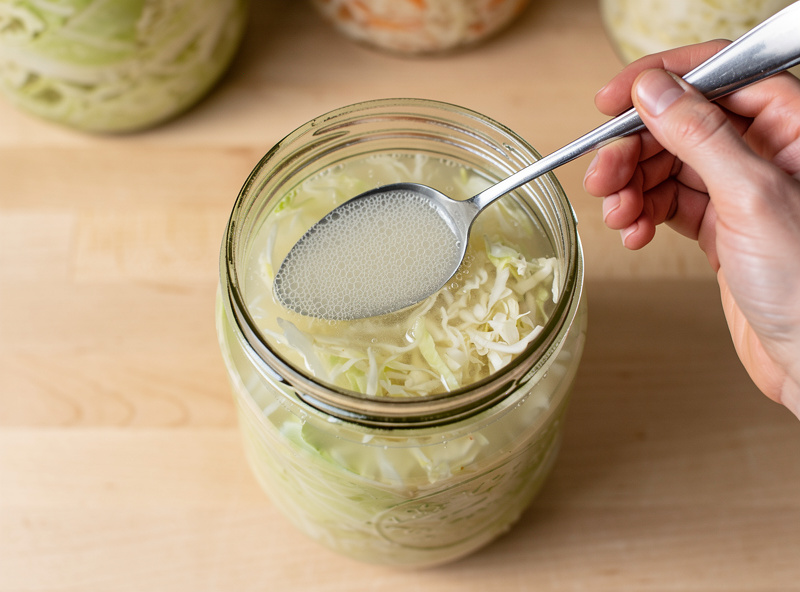
Preventing Kahm From Appearing in the First Place
Submersion is the single most effective prevention. Use a fermentation weight (glass disc, ceramic weight, or a small zip bag filled with 2% brine) on top of the shredded cabbage. I run a set of glass fermentation weights sized to my jars — they fit standard wide-mouth mason jars perfectly and don’t trap air bubbles the way some ceramic rings do. Press the weight down so all cabbage sits at least 5 mm below the brine surface. Skip this and kahm shows up far more often — inconsistent submersion is the single biggest driver I see in my own batches.
Salt at 2 to 2.5% by total weight (cabbage + any added water). For a 1 kg cabbage with 200 ml added water (1200 g total), use 24 to 30 g salt. Weigh the salt with a digital scale; volume measurements vary too much based on salt crystal size. Inconsistent salt levels are also the top cause of mushy sauerkraut — getting salt right prevents both kahm and texture problems.
Temperature 60 to 70°F for the first 7 to 10 days. Above 75°F kahm appears more reliably; below 55°F fermentation slows so much that kahm has time to establish before LAB pH drop. Most home kitchens at 65 to 72°F are in the sweet spot.
Airlock lid optional but helpful. Simple silicone waterless-airlock lids limit oxygen exchange while letting CO2 escape during active fermentation, and they’re inexpensive enough to put on every jar I run. A loosened mason jar 2-piece lid works as a poor-man’s substitute. The fermentation equipment cluster covers airlock options.
If I were teaching a friend to make sauerkraut tomorrow, I’d tell them to focus on three things: keep the cabbage submerged with a weight that actually fits the jar, use a digital scale for salt at 2.5% by weight, and learn to recognize the flat white film of kahm yeast so you don’t throw away perfectly good ferments. Mold is rare in properly managed sauerkraut — I have seen it only twice in over 40 batches, both times when I left town for a week and the airlock dried out. Kahm yeast, on the other hand, shows up occasionally even in experienced hands, and knowing how to skim it while telling it apart from mold is the single skill that saves more fermenters from needlessly dumping their jars.
Frequently Asked Questions
Is kahm yeast on sauerkraut dangerous?
No — kahm yeast (Pichia, Candida species) is a thin white film on the brine surface that is completely safe. It does not produce toxins and does not make the food unsafe. Skim it off with a clean spoon and the sauerkraut continues fermenting normally. The only downside is musty off-flavors if left in place for 5+ days.
How can I tell kahm yeast from mold on sauerkraut?
Kahm yeast is flat, white, and looks like wax paper or skim milk on the brine surface. Mold is fuzzy, raised, and almost always colored (green, blue, black, pink). Press a clean toothpick gently into the growth — kahm collapses; mold resists. Color is the giveaway: pure-white-flat is kahm; any color or fuzzy texture is mold.
What causes kahm yeast on fermenting sauerkraut?
Four causes in order of frequency: cabbage not fully submerged below the brine (most common), salt percentage below 1.5 percent, fermentation temperature above 75 degrees F, and open or poorly-sealed jar allowing oxygen exchange. Fix the underlying cause to prevent kahm returning.
Can I eat sauerkraut if it had kahm yeast?
Yes — once you have skimmed the film off and discarded any visibly affected cabbage on the surface, the sauerkraut below is safe to eat. Some flavor transfer (musty note) may have happened if the kahm was present for several days; this is unpleasant but not unsafe.
What does dangerous mold on sauerkraut look like?
Fuzzy raised growth in distinct colors: green (Penicillium), blue-green (Penicillium chrysogenum), black (Aspergillus), or pink/red (Fusarium). University extension guidance on fermented vegetables is conservative here: any confirmed mold, any color, any amount, means discard the whole jar immediately — don’t scrape and continue. Pink/red (Fusarium) is especially dangerous due to trichothecene mycotoxins.
How do I prevent kahm yeast from coming back?
Use a fermentation weight to keep all cabbage at least 5 mm below the brine surface, salt at 2 to 2.5 percent of total weight, ferment at 60 to 70 degrees F, and use an airlock lid. Address all four together — fixing only one usually means kahm returns.
Related Articles
- Why Did My Sauerkraut Turn Mushy? 7 Fixes That Actually Work
- Best Cabbage for Sauerkraut: 7 Varieties Tested
- Kahm Yeast: What It Is, How to Prevent It, When It Is Safe
- Fermentation Weights: Glass vs Ceramic vs Ziplock Bag Compared
- Easy Napa Cabbage Kimchi Recipe for Beginners (Step-by-Step)
- Sauerkraut Juice Benefits: What the Brine Actually Does

About Kenny Nyhus Fadil
A home fermenter documenting brines, bubbles, and the occasional moldy tragedy.