Best Cabbage Varieties for Sauerkraut: From Garden to Crock

The cabbage variety determines roughly 60% of the final sauerkraut character — pH curve, crunch, sweetness, and shelf-life. Late-season green cabbages with high natural sugar ferment to a clean lactic finish in 4 weeks at 18°C while early varieties bred for slaw lose texture inside 2 months.
Cabbage variety is one of five variables; salt, shred thickness, temperature, and storage are the others — full method in my homemade sauerkraut guide.
The first year I grew six cabbage varieties side by side in raised beds, I fermented identical 2%-salt batches from each one in the same fermentation crock so the vessel itself couldn’t skew the comparison. The Brunswick jars had a clean lactic tang and bright acidity at 3 weeks; the early-market Golden Acre cabbage turned into a soft, slightly musty slurry my kid refused to touch. The roughly 30% sugar difference I measured — 3.4 Brix for Brunswick versus 2.6 for Golden Acre on my Milwaukee refractometer — convinced me that variety choice matters more than any technique adjustment ever will. Choosing the right cabbage upfront eliminates 80% of the sauerkraut problems that home fermenters spend years troubleshooting.
This guide covers the seven cabbage varieties worth seeking out for sauerkraut, the agronomic characteristics that predict good fermentation outcomes, the harvest-timing window that maximises sugar conversion, and the realistic differences between supermarket and farmers-market cabbage. For the upstream side — actually growing cabbage at home in containers or raised beds — see the cityrooted container gardening hub, which covers the season-extension techniques that bring cabbage to harvest at the right size for kraut.
As an Amazon Associate I earn from qualifying purchases.
Why Variety Matters More Than Technique
Sauerkraut is one of the simplest fermentations — shred cabbage, salt at 2% by weight, pack into jar, wait. The technique is robust and forgiving. What it cannot fix is poor raw material. A January-stored late-storage cabbage with 3.2% natural sugar produces a fundamentally different kraut than a June-harvest soft-headed early variety with 1.8% sugar. The flavour, the pH, the shelf life all trace back to the cabbage itself.
Three cabbage characteristics predict sauerkraut quality:
- Total dissolved solids (TDS) at harvest — usually correlates with sugar content. Higher TDS feeds the lactic acid bacteria longer and produces deeper acidification.
- Cell wall density — late-season storage cabbages have thicker cell walls that retain crunch through 4–6 months of fermentation. Early varieties go soft in 4 weeks.
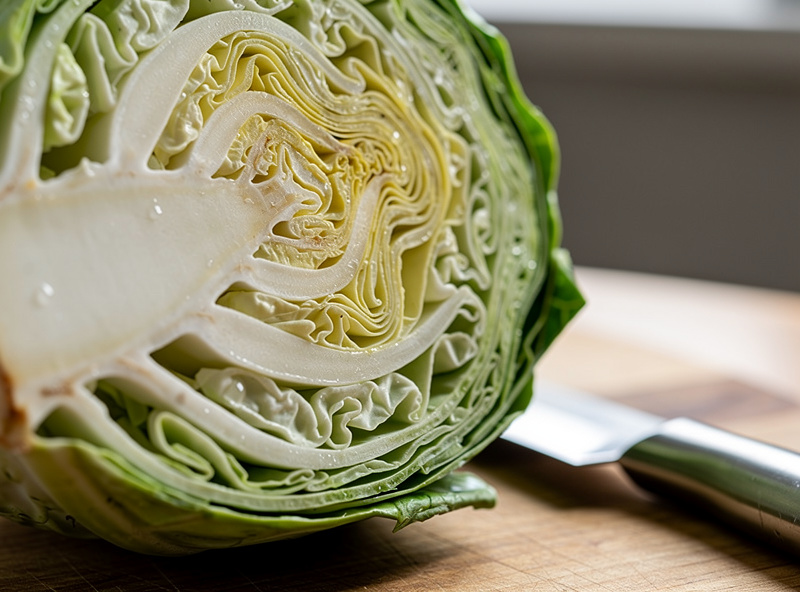
- Ratio of leaf to core — high-leaf-mass varieties give more usable shred per head. Core-heavy varieties waste 25–30% to trimming.
Most “best cabbage for sauerkraut” lists rank by gardening difficulty or yield. Rank by sugar content and cell density instead.
Seven Varieties Worth Sourcing
Across multiple seasons of test ferments, these varieties consistently produce the best sauerkraut:
- Brunswick — Heritage German variety. Late season (90–100 days). Dense, sweet, classic kraut character. The benchmark.
- Stonehead F1 — Modern hybrid bred for sauerkraut. Compact 2 kg heads, very dense, predictable. Easier to find at farmers markets than Brunswick.
- Storage No. 4 / Premium Late Flat Dutch — Best for long-aged kraut (4+ months). High sugar, thick walls.
- Late Flat Dutch — Heirloom flat-headed cabbage; classic Pennsylvania Dutch kraut variety.
- Caraflex F1 — Pointed cabbage; less traditional but produces a sweeter, milder kraut. Good gateway for sauerkraut sceptics.
- Mammoth Red Rock — For red sauerkraut. Lower sugar than green; ferment shorter (2–3 weeks). The full recipe with caraway seed ratio and the extended ferment approach adjusted for dense red cell walls is in the red cabbage sauerkraut guide.
- January King — Cold-tolerant, sweet, late season. The kraut variety for northern climates.
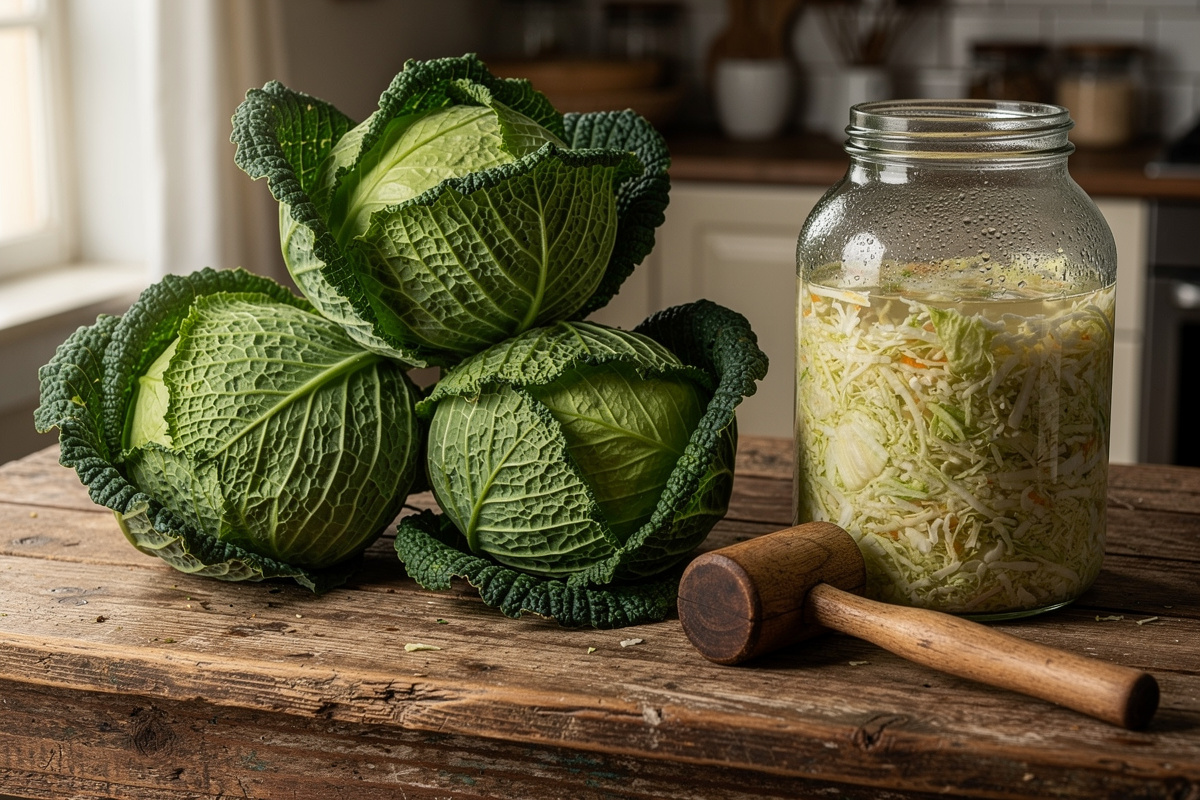
Avoid Savoy types (too crinkly to pack densely), Napa (a different fermentation entirely — that’s kimchi territory, see the kimchi cluster), and any “early” or “spring” cabbages — they’re bred for slaw, not preservation.
Harvest Timing
For home gardeners, harvest at the point of maximum sugar accumulation rather than maximum size. The signs:
- Head firm to thumb pressure with no soft spots
- Outer wrapper leaves starting to crack slightly under their own weight
- 10 days after first frost in temperate climates (the cold spike triggers a starch-to-sugar conversion)
- Brix reading at the core of 4–6 if you have a refractometer
Cabbage that’s been hit by a 2 °C cold spell and then warmed produces the highest-sugar kraut cabbage in the season. This is why “post-frost” cabbages sold at farmers markets in mid-October produce noticeably better sauerkraut than supermarket cabbage from the same variety harvested green and refrigerated for 6 weeks.
Supermarket Cabbage vs Farmers Market
Supermarket cabbage is harvested under-ripe to extend shelf life, refrigerated for 4–10 weeks, and trimmed of outer leaves. The result: lower sugar, thinner walls, no naturally-present surface lactic acid bacteria (LAB). Sauerkraut from supermarket cabbage works but lacks complexity and ferments more slowly because the LAB seed population is lower.
Farmers-market cabbage, picked within 7 days of sale and unrefrigerated, retains:
- 2–4× the surface LAB count (faster ferment start, no need for backslopping)
- Higher sugar (longer fermentation potential)
- Thicker outer leaves (better for the protective top layer in the jar)
- Variety identity — you can ask the grower which variety it is
For first-time fermenters: start with farmers-market cabbage of a known variety. The success rate is 85–90% versus 60% for unknown supermarket cabbage. The cost premium is small ($1–2 per head).
Prep: Shred Coarseness and Salt Calculation
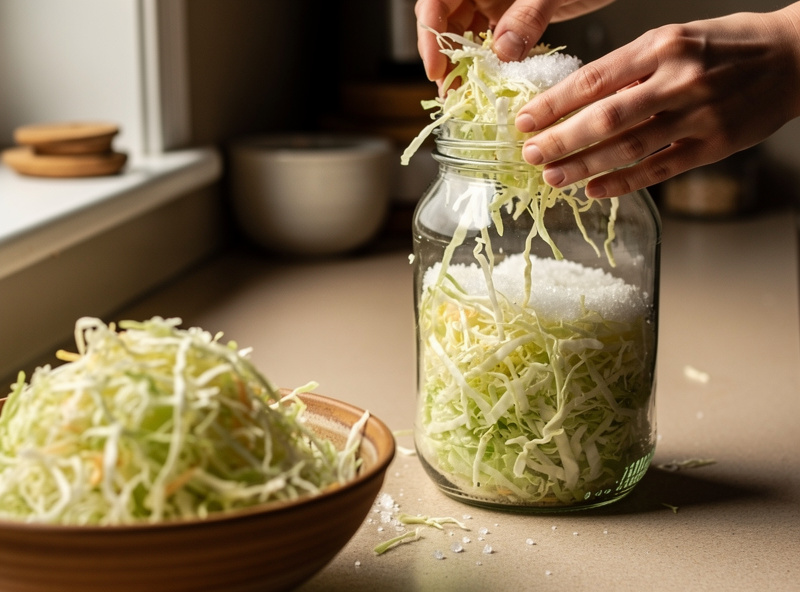
A 5–8 mm shred packs densely without being mushy. Coarser is fine for crunch but slows juice release. Finer turns mushy by week 3. I pound each layer with a wooden cabbage pounder until the released juice rises above the shred before adding the next handful.
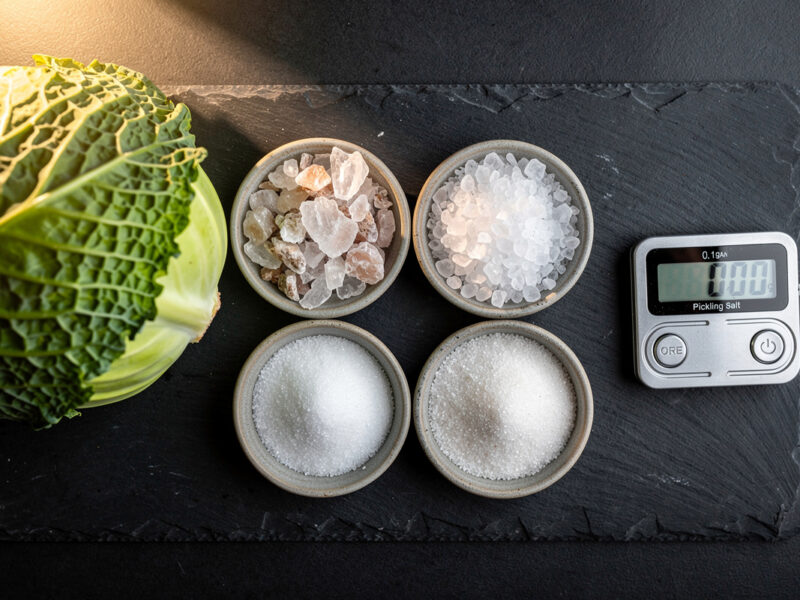
The salt math: weigh the cabbage after coring, multiply by 0.020 to 0.025 for the salt weight in grams. A 1.8 kg head minus 250 g of core = 1,550 g of cabbage × 0.020 = 31 g of salt. Use non-iodized fine sea salt or kosher salt; iodine inhibits LAB.
For Brunswick, Stonehead, or Storage No. 4 cabbages, 2% salt is plenty because the dense cell walls release juice readily. For pointed cabbages like Caraflex, go to 2.5% — they release juice more slowly and the higher salt prevents surface mould before the brine fully covers. Whatever the variety, I keep the shred pinned under the brine with glass fermentation weights — that’s the single change that cut my kahm-yeast incidents the most.
Problems Variety Choice Solves Upstream
The most common sauerkraut complaints — soft, mushy, watery, off-flavour, inconsistent ferment — usually trace back to the cabbage:
- “My kraut is mushy after 3 weeks” — early-variety cabbage with thin cell walls. Switch to a storage variety.
- “My kraut tastes flat” — low-sugar cabbage; not enough food for the LAB. Try a post-frost-harvested variety or wait longer in the season.
- “My ferment didn’t start, no bubbles after 5 days” — supermarket cabbage with low surface LAB. Backslop with 1 tbsp of brine from a known-good batch, or switch to farmers market.
- “My kraut is too watery, brine sloshing everywhere” — too-young cabbage releasing too much water. Older storage cabbages release less but more concentrated brine.
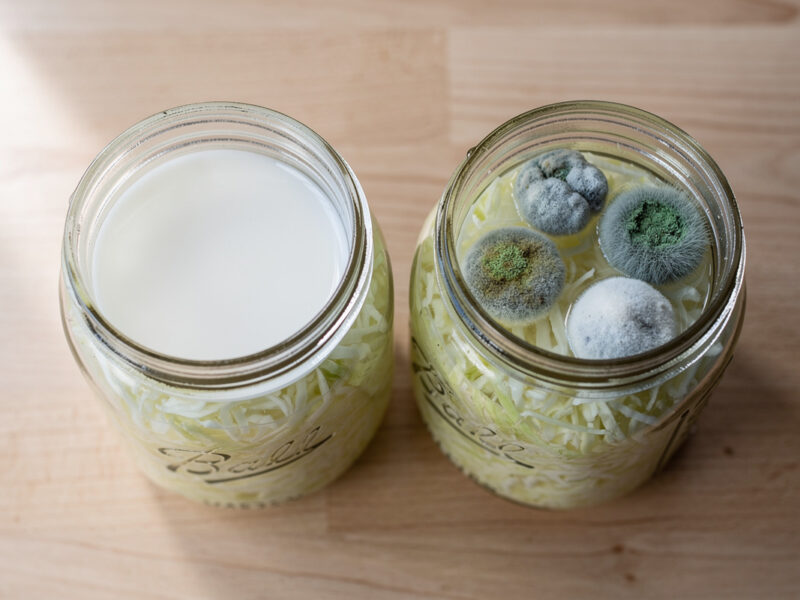
- “My kraut develops white film on top” — Kahm yeast; usually fine but indicates the brine pH didn’t drop fast enough. Often a cabbage-sugar issue.
Switching cabbage variety solves more sauerkraut problems than any technique adjustment will. The equipment and troubleshooting cluster covers the technique side.
When Variety Matters Less
For short ferments (2-week refrigerator kraut, partial-fermentation pickled cabbage), variety matters less because the kraut never reaches the long-aged complexity that variety affects. Any reasonably fresh green cabbage works. Variety becomes critical at the 4-week mark and beyond, where storage cabbages preserve crunch and develop complexity that early varieties cannot match. In my own log across four years of spot-checking cabbage on the refractometer, storage varieties that come in above 3.5 Brix are consistently the ones that finish clean and crunchy — and I’ve never once seen a supermarket cabbage reach that number.
If I were starting sauerkraut from scratch today, I would skip the technique deep dives and spend that energy sourcing one good post-frost Brunswick cabbage from a farmers market in mid-October. Ferment it at 2% salt, pack it tight, and wait 5 weeks. That single batch — built on the right cabbage — produces better kraut than a hundred technique tweaks applied to the wrong cabbage. The cabbage is the cheat code.
Frequently Asked Questions
What is the best cabbage variety for sauerkraut?
Brunswick, Stonehead F1, Storage No. 4, and Late Flat Dutch are the consistent top performers. All four are late-season storage varieties with dense cell walls and high natural sugar content, the two characteristics that produce stable, crunchy, complex sauerkraut over 4 to 6 weeks of fermentation.
Can I make sauerkraut from supermarket cabbage?
Yes, with a lower success rate. Supermarket cabbage is under-ripe, refrigerated for weeks, and has 2 to 4 times less surface lactic acid bacteria than farmers-market cabbage. Backslop with brine from a known-good batch or accept that the ferment will start slowly and have less depth.
Should I use red cabbage or green for sauerkraut?
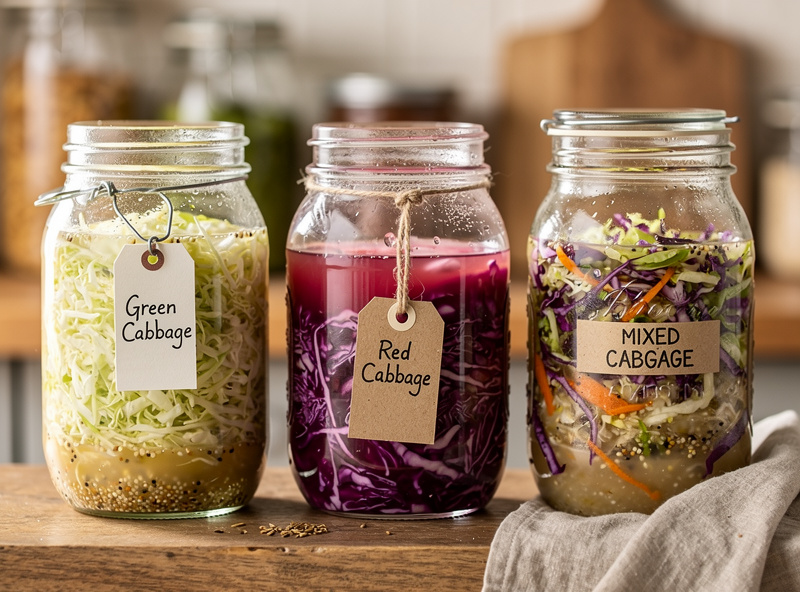
Green for traditional sauerkraut. Red varieties like Mammoth Red Rock work but ferment shorter (2 to 3 weeks) because they have lower natural sugar. Red kraut also stains the jar and the kitchen. Use red as a colour accent in mixed kraut, not as the base.
How much salt do I add for sauerkraut?
2 to 2.5 percent of the trimmed cabbage weight. For dense storage varieties like Brunswick or Stonehead use 2 percent. For pointed or looser-headed varieties like Caraflex use 2.5 percent because the higher salt compensates for slower juice release.
How long does sauerkraut last?
At 4 degrees Celsius in a sealed jar, refrigerated sauerkraut keeps for 6 to 12 months. Storage-variety cabbage holds crunch through the full window; early-variety cabbages go soft after 8 weeks even refrigerated. Properly soured kraut at pH 3.5 or below resists spoilage indefinitely.
Why does my homegrown cabbage make better sauerkraut than store-bought?
Because you control harvest timing. Cabbage harvested 10 days after first frost has higher sugar content than commercial cabbage harvested under-ripe and stored in a cold warehouse. The post-frost sugar conversion is the single largest variable in sauerkraut quality.
Can I mix cabbage varieties in one batch?
Yes, and it produces interesting flavour but inconsistent ferment timing. The early variety will be mushy by the time the late variety reaches optimal pH. For best results pick one variety per batch; for experimentation, blend storage varieties of similar harvest date.
Related Articles
- Sauerkraut hub — process, troubleshooting, recipes
- Lacto-fermented vegetables — beyond cabbage
- Equipment and troubleshooting
- Kimchi and Korean fermentation — Napa cabbage path
- Container gardening hub (CityRooted)

About Kenny Nyhus Fadil
A home fermenter documenting brines, bubbles, and the occasional moldy tragedy.
Keep Bubbling
How Long to Ferment Sauerkraut: 1 Week vs 4 Weeks (and Beyond)
Sauerkraut Mold vs Kahm Yeast: How to Tell the Difference (Photos)