Kombucha pH Guide: Safe Levels, Timeline, and Fixes

Finished kombucha sits between pH 2.5 and 3.5, with most drinkers happiest around 3.0 to 3.3. The number that actually matters for safety is the end-of-fermentation floor: by the time you bottle, the brew should be at or below pH 4.2. That acidity is the single dial that keeps kombucha safe, and it is worth measuring rather than guessing.
Of all the things I measure across my ferments, pH is the one I would not give up on kombucha. It is not fussiness — it is the difference between a brew that is preserving itself and one that is sitting in the danger zone. The good news is that healthy kombucha drops its own pH fast and reliably, so most of the time the meter just confirms what a working culture is already doing. But knowing the actual numbers, what they mean, and when a reading is telling you something is wrong turns kombucha from folklore into a controlled process. Here is the full picture: the safe ranges, the timeline, how to measure it properly, and how to fix a brew that is reading too high or too low.
Why pH Is the Safety Dial
Kombucha is safe because it is acidic. A low pH — specifically below about 4.6 — stops Clostridium botulinum and virtually all foodborne pathogens from growing. Kombucha’s own working target is more conservative still, at or below pH 4.2 by the end of the first fermentation, a margin the brew clears easily when the culture is healthy.
This is the chemistry behind every “is my kombucha safe” question. The acids the bacteria produce — mostly acetic and gluconic — pull the pH down into territory where spoilage organisms and pathogens simply cannot establish. The widely recognised line for botulism is pH 4.6; nothing dangerous grows below it. Kombucha brewers aim lower, at 4.2, because it builds in a safety buffer and because a brew that has reached 4.2 has clearly fermented properly rather than stalling. A healthy batch finishes far below even that, down around 3.0, so in practice you are never close to the edge — provided the culture actually did its job, which is exactly what measuring confirms.
The Kombucha pH Reference Ranges
There are three numbers worth knowing: the safe finishing floor (≤4.2), the pleasant drinking window (2.8–3.5), and the strong-starter zone (2.5–2.8). Anything reading above 4.2 at the end of F1 has not fermented enough; anything below 2.5 has gone past drinking into vinegar territory.
| pH reading | Stage / meaning | Safe? | What to do |
|---|---|---|---|
| 4.5–5.0 | Fresh sweet tea, no starter yet | Not yet acidic | Add 10–20% mature starter before fermenting |
| 4.0–4.5 | Day 0–2 with starter added | Borderline — still dropping | Keep fermenting, recheck in days |
| 3.5–4.2 | Mid fermentation | Safe and on track | Taste; bottle when balanced |
| 2.8–3.5 | Finished, ready to drink | Safe | Bottle for F2 or refrigerate |
| 2.5–2.8 | Strong, tart, great starter | Safe | Use as starter liquid or dilute |
| Below 2.5 | Over-fermented, vinegary | Safe but sharp | Use as starter, vinegar, or back-sweeten |
Disclosure: FermentFoundry is reader-supported. As an Amazon Associate I earn from qualifying purchases made through links in this article, at no extra cost to you. I only point to gear I actually use or would buy for my own kitchen.
How pH Changes Through Fermentation
Sweet tea starts around pH 4.5–5. The moment you add mature starter liquid, the pH drops to roughly 4.0–4.5, which is the whole point of starter. Over the next five to ten days the culture pulls it down past 3.5 and on toward 3.0, with the steepest drop in the first few days.
This curve is why the starter step is non-negotiable. You never ferment plain sweet tea on its own — you add ten to twenty percent mature, acidic kombucha (or strong liquid from your SCOBY hotel) so the batch begins already below the pathogen-friendly zone. That acidic head start locks out mold and stray bacteria during the vulnerable opening days before the new culture has built up its own acid. From there the drop is predictable: a warm, healthy brew loses most of its pH in the first three to four days, then tapers as it approaches its floor. On my meter a typical batch reads about 4.2 on day one, around 3.4 by day five, and settles near 3.0 by day eight to ten. If yours is not following roughly that path, the pH is telling you something — usually that the culture is cold, weak, or under-started.
How to Measure Kombucha pH
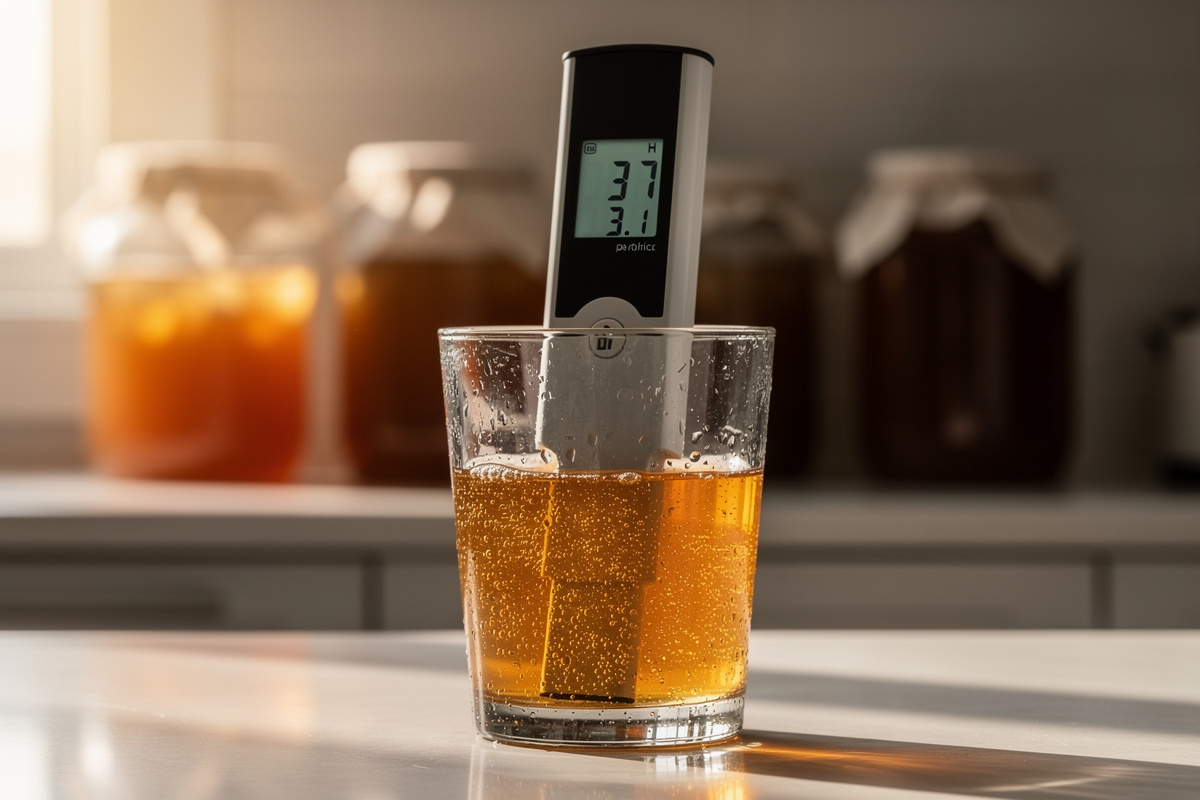
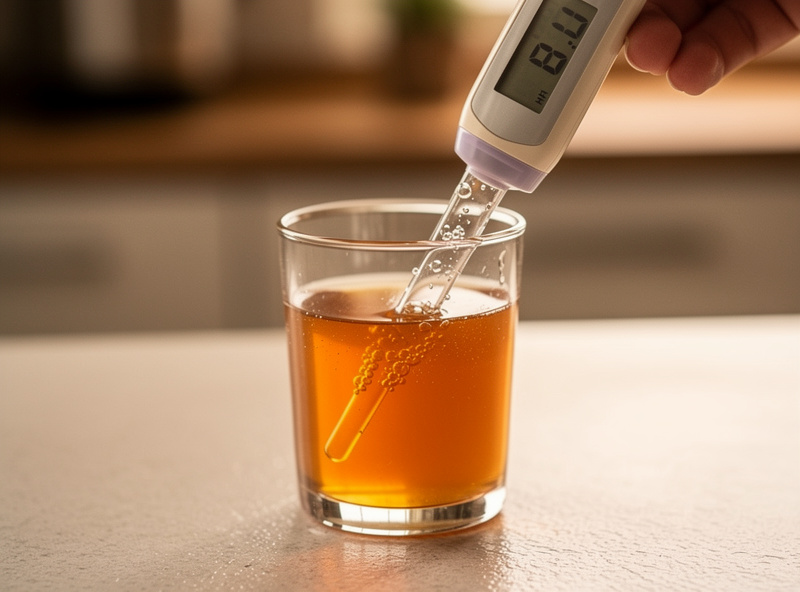
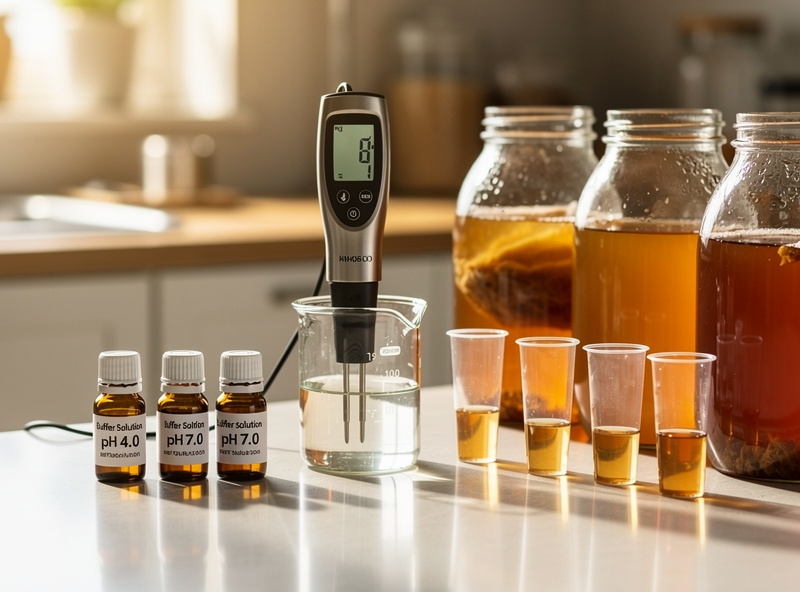
A calibrated digital pH meter is the accurate tool — it reads to a tenth of a pH unit, which matters in this range. pH test strips work as a rough backup but are hard to read precisely between 2.5 and 4.0, where the colour changes are subtle. For a one-time safety check strips are fine; for dialling in your brew, use a meter.
The catch with a meter is calibration: an uncalibrated pH meter can drift half a unit or more, which is the entire margin you care about, so it is worse than useless if you trust a bad reading. I calibrate mine against buffer solutions before any reading I am going to act on. A reliable digital pH meter plus a bottle of calibration buffer solution is a small investment that pays for itself the first time it catches a stalled batch. If you would rather not own a meter, a tub of narrow-range pH strips will at least tell you whether you are safely under 4.2 — just buy strips made for the acidic 2–4 range, not the wide 1–14 ones, which cannot resolve the differences that matter here. Pull your sample at room temperature, since temperature shifts the reading slightly, and never dip the probe straight into your main vessel — take a sample out to test.
If Your pH Is Too High (Above 4.2)
A pH stuck above 4.2 after several days means the brew is not acidifying properly, and it is the one reading you should act on. The usual causes are too little starter liquid, a weak or cold culture, or chlorinated water suppressing the bacteria. Do not bottle a high-pH batch — fix the ferment first.
Run through the causes in order. Did you add enough mature starter — a real ten to twenty percent by volume? Is the brew warm enough; below about 20°C kombucha crawls. Is your culture healthy and thick, or thin and struggling? And critically, is your water dechlorinated — chloramine in tap water is a classic stall, because it suppresses the very bacteria that make the acid. The fix in every case is to get the conditions right and give it more time, ideally after stirring in an extra slug of strong starter to drop the pH manually and re-establish the acidic environment. A batch that simply needs more time is normal; a batch that is still above 4.2 after two weeks with good conditions has a culture problem worth solving before you brew again. If you also suspect temperature swings are behind a sluggish ferment, a monitored fermentation chamber takes the guesswork out of holding a steady warmth.
If Your pH Is Too Low (Below 2.5)
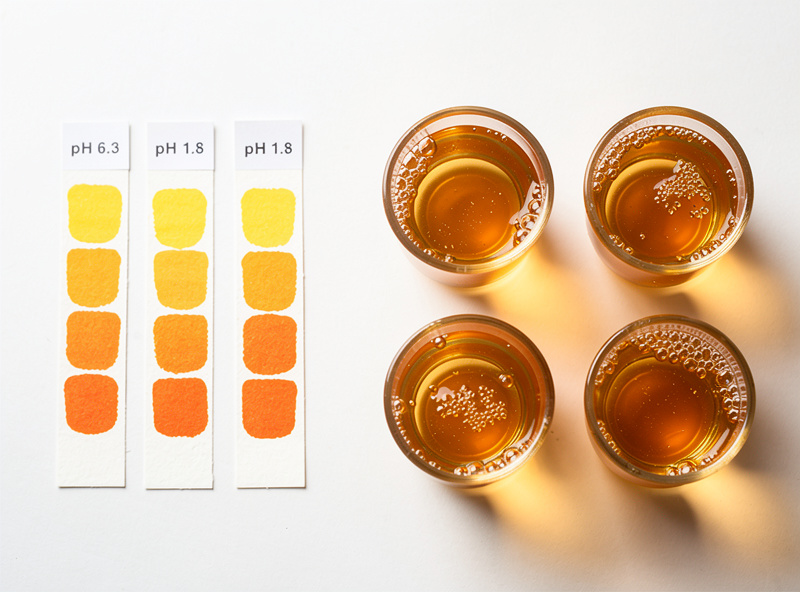
A pH below 2.5 is not a safety problem — it is over-fermentation. The brew is perfectly safe, just sharp and vinegary. Use it as powerful starter liquid for your next batch, treat it as a kombucha vinegar for dressings, or dilute and back-sweeten it to drink.
This is the happy failure mode. Over-acidic kombucha has done everything right and simply gone further than your palate wants, which happens fast in warm weather or if you forget a batch. Nothing is wasted: the strongest starter I keep is exactly this over-fermented liquid, because its low pH gives the next batch the best possible head start. It also makes a genuinely good drinking vinegar — the same acetic-acid chemistry, just taken to completion. And if you still want to drink it as kombucha, cut it with fresh sweet tea or juice to soften the bite. The only real lesson a sub-2.5 reading teaches is to taste and bottle a little earlier next time, or to move bottles to the fridge sooner, since cold slows the acid production to a near stop.
Frequently Asked Questions
What pH should finished kombucha be?
Finished kombucha should read between pH 2.5 and 3.5, with most drinkers preferring around 3.0 to 3.3. For safety, it must be at or below pH 4.2 by the end of the first fermentation, a level a healthy culture clears easily.
Is kombucha safe at pH 4.0?
Yes. Nothing dangerous, including botulism, grows below pH 4.6, and kombucha’s conservative target is 4.2. A reading of 4.0 is safe, though a finished brew usually drops further to around 3.0 once fully fermented.
Do I need a pH meter to brew kombucha?
Not strictly, but it helps. A calibrated digital meter reads to a tenth of a unit, which matters in kombucha’s range. pH strips are a rough backup. Many brewers go by taste, but a meter confirms safety and catches a stalled batch.
Why is my kombucha pH too high?
A pH stuck above 4.2 usually means too little starter liquid, a cold or weak culture, or chlorinated water suppressing the bacteria. Add more mature starter, warm the brew, use dechlorinated water, and give it more time before bottling.
Can kombucha pH be too low?
It can read below 2.5, which is over-fermentation, not a danger. The brew is safe but sharply vinegary. Use it as strong starter, as a kombucha vinegar, or dilute and back-sweeten it. Bottle a little earlier next time.
How do I lower my kombucha pH faster?
Stir in more mature starter liquid, keep the brew warm at 22 to 28 degrees Celsius, ensure the culture is healthy and the water dechlorinated. A strong starter slug drops the starting pH immediately and speeds the whole ferment.
Related Articles
- Kombucha Brewing: The Complete Home Guide from SCOBY to Bottle
- SCOBY Hotel: How to Store, Feed, and Revive Kombucha Cultures
- Best Tea for Kombucha: Black, Green, Oolong, and White
- Home Vinegar Making: The Complete Guide from Mother to Bottle
- Why Is My Kombucha Not Fizzy? 6 Fixes for Flat Second Fermentation

About Kenny Nyhus Fadil
A home fermenter documenting brines, bubbles, and the occasional moldy tragedy.