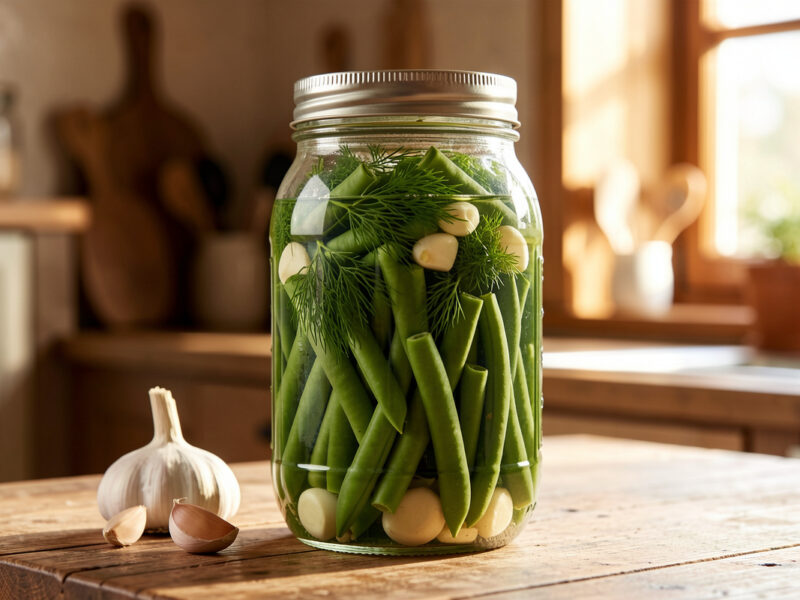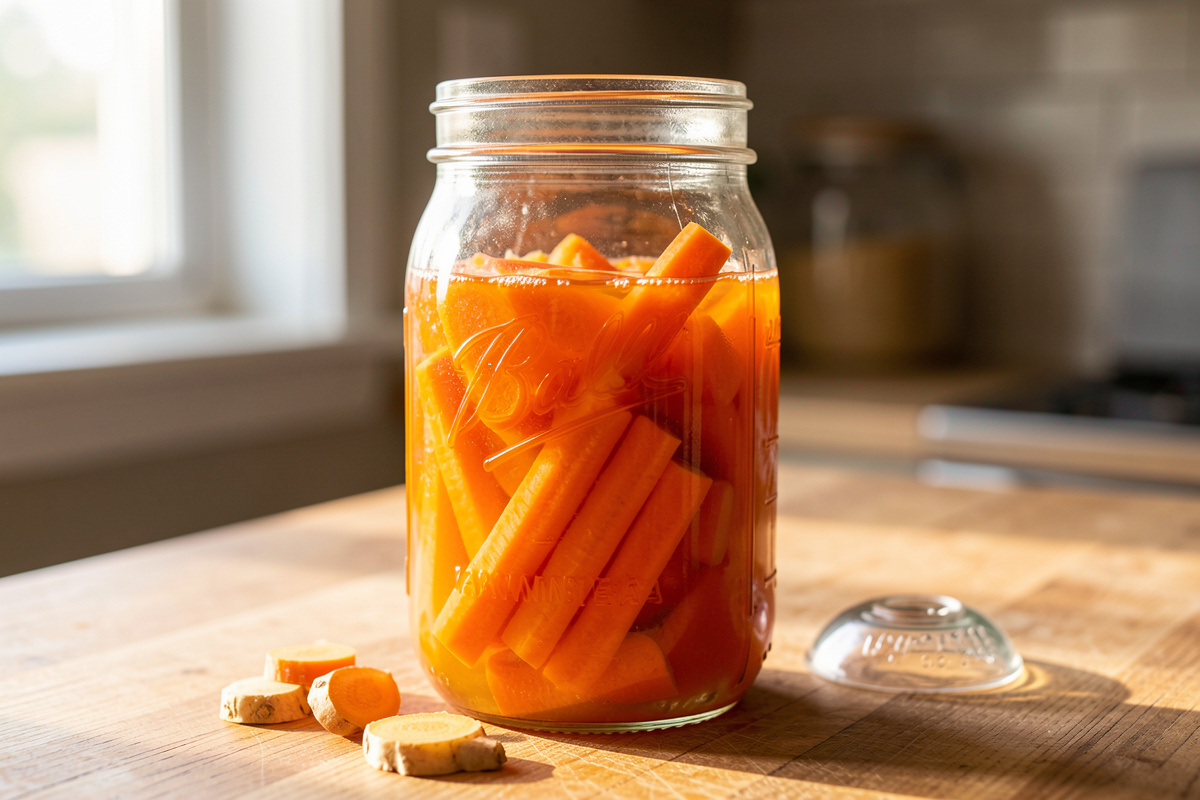
Fermented Carrots Recipe with Ginger (Crunchy + Tangy)

Fermented carrots with ginger are ready in 5 to 7 days at room temperature in a 2.5% to 3% salt brine, finishing tangy, lightly fizzy, and still snappy. I keep a half-gallon jar going almost year-round, and on my meter the brine drops past pH 4.0 within the first week, which is exactly where lacto-fermented vegetables become both safe and crave-able.
This is the ferment I hand to people who think they do not like fermented food. The carrots stay bright orange, the ginger throws a warm bite that builds over the weeks, and the texture is closer to a fresh snap than a soggy pickle. Below is the brine math I actually use, the timing windows, and the few places this batch goes wrong.
What Salt Ratio Do You Use for Fermented Carrots?
Use a 2.5% to 3% brine by weight for fermented carrots: dissolve 25 to 30 grams of non-iodized salt per 1,000 grams (1 liter) of water. Carrots are dense and sugary, so I run the upper end at 3% to keep the ferment firm and slow the souring in a warm Swedish summer kitchen.
I weigh everything on a 0.1-gram scale rather than measuring by spoon, because salt brands vary wildly in crystal size. A tablespoon of fine sea salt and a tablespoon of flaky kosher are not the same mass, and brine percentage is the one number that decides whether Lactobacillus wins or spoilage bacteria do. For the full breakdown of how brine concentration changes the result, I lean on the same logic I use across every veg ferment in my tested salt percentage guide.
One practical note: weigh the water and account for the carrots displacing brine. I pack the jar with carrot batons first, then top with brine to cover, and I mix enough brine for the full jar volume at 3% so the final concentration lands where I want it even after the vegetables go in.
How Do You Cut Carrots So They Stay Crunchy?
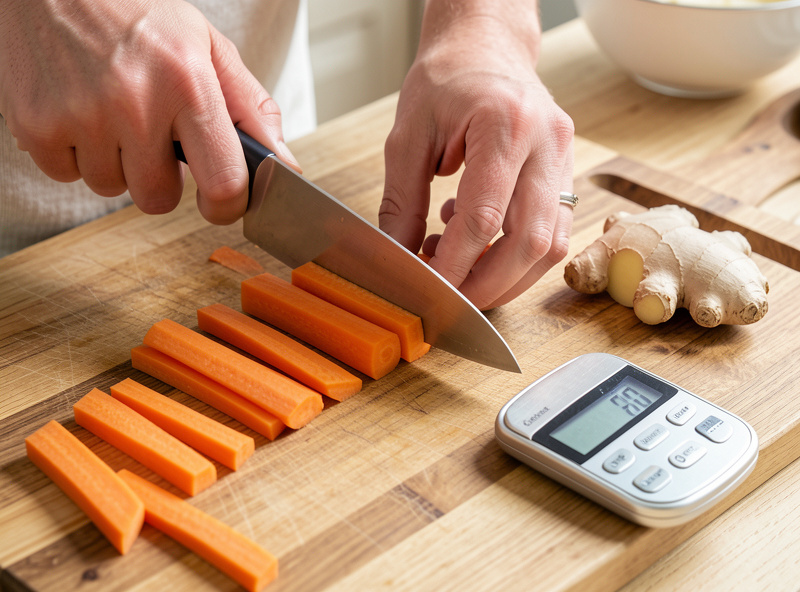
Cut carrots into uniform batons or thick coins roughly 6 to 8 mm thick, leaving them as large as practical. Thicker pieces hold their snap far longer because there is more intact cell structure for the brine to pickle slowly rather than turn to mush in days.
I peel only if the carrots are old or waxy; the skin holds flavor and helps the texture. The thing that actually wrecks crunch is not the cut, it is the temperature and the lack of tannin. Carrots have less natural pectin protection than cucumbers, so a couple of fresh grape leaves, a black tea bag, or a piece of oak leaf tucked into the jar genuinely firms the batch. The cold-tannin trick is the same one that keeps brined cucumber pickles snappy, covered in my guide on lacto-fermented pickles that stay crunchy.
Ginger goes in as thin coins or matchsticks, about 30 to 40 grams per liter of brine for a clear but not overpowering heat. Slice it; do not grate it, or it clouds the brine and you lose the clean look that makes this jar sit proudly on a shelf.
How Long Do Fermented Carrots Take?
Fermented carrots take 5 to 7 days at 20 to 22°C for a bright, lightly sour result, or 10 to 14 days for a deeper, fizzier tang. Cooler rooms slow everything down: at 16°C I expect closer to two weeks before the brine clouds and the first bubbles climb the glass.
I taste a baton from day 4 onward. The moment the sourness reads pleasant and the carrot still snaps, I move the jar to the fridge, which drops the activity to a crawl and locks the texture. Left on the counter too long, carrots over-soften and the ginger turns medicinal rather than warm.
| Ferment time (20-22°C) | Flavor | Texture | Best use |
|---|---|---|---|
| 3-4 days | Barely sour, fresh | Full crunch | Snacking, salads |
| 5-7 days | Bright tang, light fizz | Snappy | Everyday jar (my default) |
| 10-14 days | Deep sour, fizzy | Firm, slightly yielding | Tacos, grain bowls |
| 3+ weeks | Sharp, funky | Softening | Blended into dressings |
Do You Need an Airlock for Fermented Carrots?
You do not strictly need an airlock, but you do need the carrots submerged and a way to release CO2. I run a glass weight to hold the batons under brine and either a silicone waterless lid or a jar lid I burp once a day. Exposed carrot tips above the brine line are where kahm yeast and mold start.
The first time I left a jar with the lid screwed down tight and no burping, it built enough pressure to weep brine across the counter overnight. Carrots and ginger are sugary and ferment vigorously, so they outgas more than a slow kraut. A weight plus a daily burp, or a one-way airlock, solves it cleanly.
If you see a thin white film on the surface, that is almost always kahm yeast, not mold. It is harmless: skim it, make sure everything is submerged, and continue. Fuzzy, raised, colored growth (blue, green, black, pink) is mold, and that batch goes in the bin.
How Do You Know Fermented Carrots Are Safe?
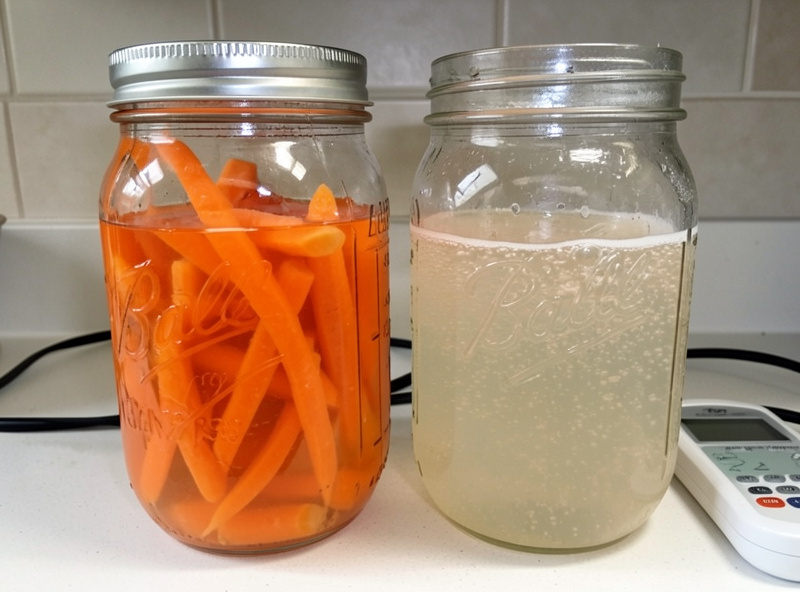
Fermented carrots are safe once the brine acidifies below pH 4.6, the recognized botulism floor, and a healthy lacto ferment drives well past it to pH 3.5 to 4.0 within a week. The brine turning cloudy, smelling pleasantly sour, and bubbling are all signs the acid-producing bacteria are doing their job.
I cross-check with a calibrated pH meter on batches I am unsure about, but you do not need one to ferment safely: keeping the carrots submerged in a correct 2.5 to 3% brine, at room temperature, away from direct sun, gets you there reliably. The danger zone is under-salting and letting vegetables float into air, not the fermentation itself. Trust your nose: a clean sour-and-gingery smell is good; anything rotten, slimy, or sharp-chemical means toss it.
What Do You Eat Fermented Carrots With?
Fermented carrots and ginger go on almost anything that wants a bright acidic crunch: tacos, rice and grain bowls, ramen, cheese boards, and straight from the jar as a snack. The ginger makes them a natural partner for Asian-leaning meals, and the brine itself becomes a salad dressing base.
In my kitchen this jar gets raided faster than the kraut crock, especially in summer when the carrots come from the same lacto-fermentation rhythm as the rest of the garden harvest. I have also started a batch with fermented garlic cloves dropped in, which builds on the brine-versus-honey methods I cover in how to lacto-ferment garlic. Do not toss the leftover brine; it is a living, gingery liquid that lifts a vinaigrette or quick-pickles the next batch.
Recommended Gear for Fermented Carrots
You can ferment carrots in any clean wide-mouth jar, but two tools make it consistent. A set of glass fermentation weights keeps the batons under brine so nothing oxidizes at the surface, and a 0.1-gram digital kitchen scale is what turns “some salt” into a repeatable 3% brine. If you want hands-off burping, a pack of silicone waterless airlock lids vents CO2 without you babysitting the jar.
Disclosure: the product links above are Amazon affiliate links. If you buy through them I may earn a small commission at no extra cost to you. I only link gear I actually use in my own fermentation kitchen.
Frequently Asked Questions
Why are my fermented carrots soft?
Soft carrots usually mean the brine was too weak, the room too warm, or the ferment ran too long. Use a 3% brine, ferment at 20 to 22C, refrigerate once the snap is still good, and add a tannin source like a black tea bag or grape leaf.
Can you ferment carrots without ginger?
Yes. Ginger is a flavoring, not a requirement. Plain salt-brined carrots ferment exactly the same way. Swap the ginger for garlic, dill, chili, or turmeric, keeping the 2.5 to 3% brine ratio unchanged.
How long do fermented carrots last in the fridge?
Once fully fermented and refrigerated, fermented carrots keep their quality for 4 to 6 months. They stay safe well beyond that because the acidity is low, but the texture slowly softens and the flavor sharpens over time.
Is the white film on my fermented carrots mold?
A thin, flat white film is almost always kahm yeast, which is harmless. Skim it, push everything back under the brine, and continue. Fuzzy, raised, or colored growth such as green, blue, black, or pink is mold and means you discard the batch.
Do fermented carrots need to be peeled?
No. Peeling is optional and only worth it for old or waxy carrots. The skin holds flavor and helps the texture. Just scrub them well, since the surface microbes help kick-start the ferment.
Can I reuse the carrot fermentation brine?
Yes. Leftover brine is a living, acidic liquid. Use it to season salad dressings, jump-start a new vegetable ferment, or as a quick-pickle bath. Keep it refrigerated and use it within a couple of weeks.
Related Guides
- Lacto-Fermentation for Vegetables: The Complete Home Guide
- Sauerkraut Salt Percentage: 2% vs 2.5% vs 3% Brine, Tested
- How to Lacto-Ferment Garlic: Honey vs Brine Methods
- Lacto-Fermented Pickles That Stay Crunchy: The Tannin Trick
- Fermented Pickle Brining and Curing-Chamber Aging

About Kenny Nyhus Fadil
A home fermenter documenting brines, bubbles, and the occasional moldy tragedy.
Keep Bubbling
Dry Salting vs Brining Vegetables: When to Use Each Method
The Garden-to-Ferment Calendar: What to Plant When for a Year-Round Fermentation Harvest