Fermented Grains & Legumes: The Complete Guide

Fermenting grains and legumes is mostly wild lacto-fermentation — soaked rice, teff, oats, maize, or pulses left warm for 8 to 48 hours while native Lactobacillus and yeast sour the batter and drop the pH toward 3.8–4.2. Unlike a salt-brined kraut crock, almost everything here gets cooked after fermenting, which changes where the food-safety risk actually lives.
I keep a maintained sourdough starter, a koji rotation, and a kombucha SCOBY hotel running in my Sweden kitchen, and the grain-and-legume ferments sit in exactly the same chemical neighborhood: a culture eating carbohydrate, acid building up, pH falling. The difference is that I am not preserving these for months in a crock — I am building flavor and lightness over hours or days, then steaming, griddling, baking, or boiling the result. This guide is the map I wish I had when I started running idli batter next to my kraut: what is fermenting, which dial controls it, and where the genuine hazards are versus the ones people invent.
What “fermenting grains and legumes” actually means
Most cultured grain and legume ferments are spontaneous lacto-fermentations: you soak the grain or pulse, sometimes grind it to a batter, and hold it warm so the Lactobacillus and wild yeast already on the seed coat take over. No added salt brine in most cases, no commercial culture — the same microbe family that runs my sauerkraut, just feeding on starch instead of cabbage sugars.
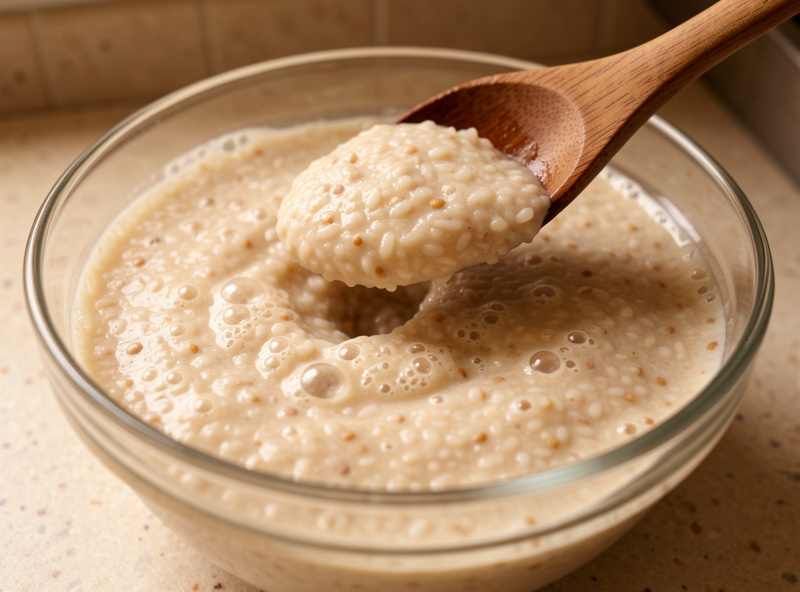
What is actually happening inside a fermenting batter is a microbial relay race. In the first hours, gas-forming bacteria like Leuconostoc mesenteroides dominate, throwing off carbon dioxide that aerates the batter and starts the rise. As they acidify the environment, more acid-tolerant Lactobacillus strains take over and drive the pH down hard, locking out spoilage organisms and building the clean sour flavor. Wild yeasts ride along the whole way, adding their own lift and aroma. You do not need to manage this succession — you just need to give it warmth and time, and it runs itself in the same orderly way a sourdough starter does.
There are really three structural families here, and sorting any ferment into one of them tells you how to run it:
- Batter ferments — grain (and often a pulse) is ground wet and the slurry ferments and rises like a thin sourdough. Idli and dosa, injera, and ogi all live here. The leavening is biological gas plus acid; you cook the batter to set it.
- Sprout-and-ferment — whole legumes are sprouted first, then either soured in a light brine or ground into a batter. Sprouting wakes the seed up, predigests some of its starch, and shortens the ferment.
- Salt-and-koji paste ferments — the high-salt outlier. Miso, doenjang, and other fermented bean pastes use salt at 5–13% and a koji mold (Aspergillus oryzae) to break the beans down over months. This is preservation, not a quick warm rise.
The reason this matters: a batter ferment that goes warm and sour in 12 hours is safe because you cook it and the pH is low. A miso is safe because the salt and the months-long acid drop hold pathogens off. They reach the same endpoint — a stable, sour, flavorful food — by completely different routes, and confusing the two is how people get the salt wrong.
A short world tour of cultured grains and legumes
Almost every grain-growing culture independently arrived at the same trick: soak the grain, let the wild flora sour it, then cook. The names change, the grain changes, but the chemistry is one chemistry. Seeing the spread makes the framework click — these are not six unrelated recipes, they are one process wearing different regional clothes.
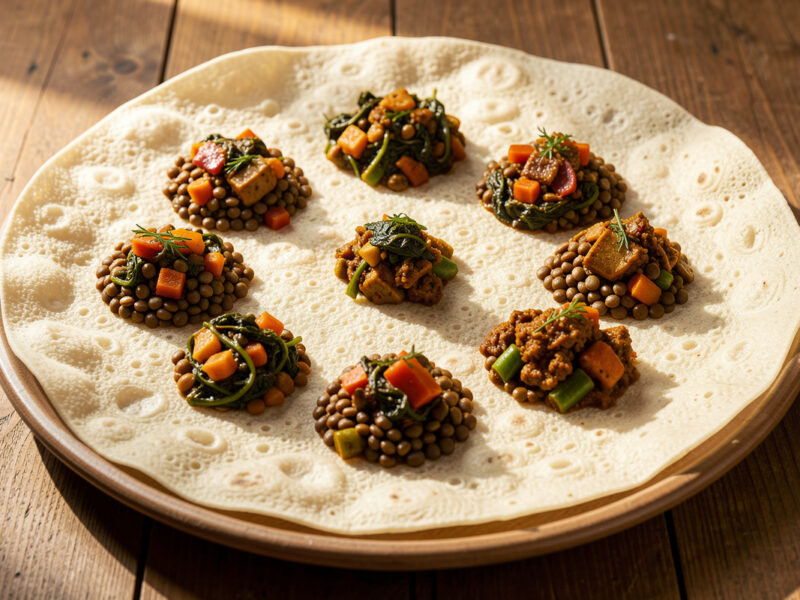
In South India, idli and dosa pair rice with urad dal so the legume’s protein and the grain’s starch ferment together into a leavened batter. Across the Horn of Africa, injera sours teff — a grain so small it is milled whole, bran and all — into a tangy, spongy flatbread baked on a clay mitad. In West Africa, ogi (called akamu or pap regionally) steeps and sours maize, sorghum, or millet into a smooth porridge. Sudan ferments sorghum into kisra; the British Isles soured oats into porridge and sowans long before refrigeration. And across East Asia, soybeans plus koji become miso, doenjang, and the whole family of savory pastes that anchor their cuisines.
What unites them is the absence of a single proprietary culture. The wild Lactobacillus on a teff grain in Ethiopia does the same job as the one on rice in Tamil Nadu. That is why I can run any of these from my Swedish kitchen with no special starter — the microbes come free on the grain, and my job is only to give them the conditions to win.
The framework: the same four dials on every batch
Whatever I am fermenting, I am watching four things: pH, temperature, hydration, and time. Get those right and the named recipe almost stops mattering — idli, injera, and ogi are the same process tuned to different grains. This is the measurement lens that runs everything on this site, and it is the reason I trust a batter that smells right but looks unfamiliar.
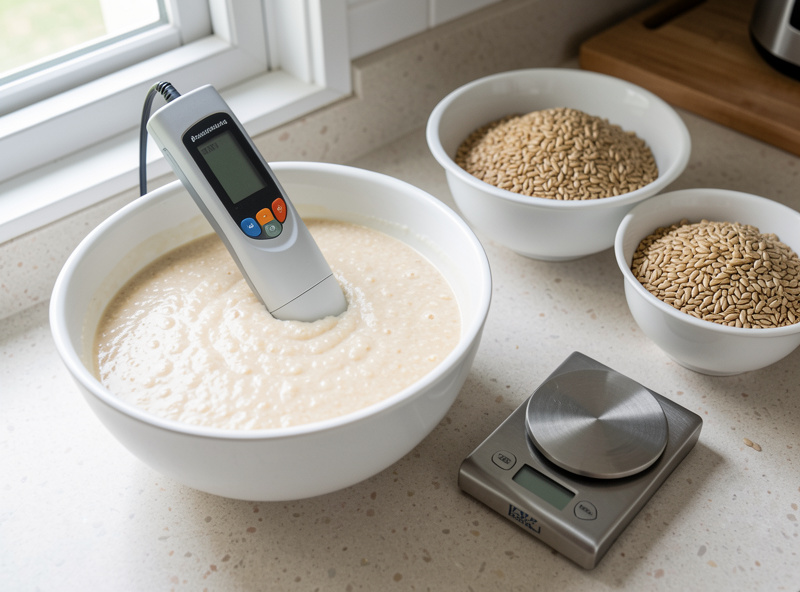
pH is the safety and flavor master dial. A finished grain batter should land near 3.8–4.5; my pH meter reads idli batter around 4.3 when it is ready and ogi slurry closer to 3.6. Once a ferment is below 4.6, the botulism vector is closed — that single number is why acid-forward ferments are forgiving. I do not test every batter, but when something looks or smells off, the meter ends the debate in ten seconds.
Temperature sets speed. The wild LAB in these batters want warmth: 28–32°C gives idli a clean 8–12 hour rise; my Sweden kitchen at 19°C drags the same batter to 18–24 hours and skews it more sour than sweet, because the slower the rise, the more the acid-formers get to work relative to the gas-formers. I park stubborn batters on a seedling heat mat, the same one I use to hold koji, and the difference in lift is dramatic.
Hydration decides texture and how freely the batter rises. A loose, high-hydration batter (dosa) ferments and pours thin; a stiffer one (idli) traps gas and steams into a sponge. It is exactly the hydration logic I run on sourdough, moved from a dough to a batter — more water means a faster, looser, more sour ferment; less water means a slower, denser, more controlled one.
Time is the dial you read off the other three. Warm and well-hydrated means short; cool and stiff means long. I never ferment by the clock alone — I ferment to a doubling and a smell, then confirm with pH if I am unsure. A recipe that says “ferment 8 hours” is really saying “ferment 8 hours at this writer’s kitchen temperature,” which is rarely yours.
The major grain and legume ferments, compared
Here is how the core ferments in this cluster line up on the dials that matter. The salt column is the quick tell for which family you are in: zero salt means a quick warm batter you will cook; high salt means a koji paste you will age. Brine-fermented sprouts sit in the middle.
| Ferment | Main grain/legume | Salt | Time | Temp | Finished pH | Cooked after? |
|---|---|---|---|---|---|---|
| Idli / dosa batter | Rice + urad dal | None (until cooking) | 8–16 h | 28–32°C | ~4.2–4.5 | Yes (steam/griddle) |
| Injera | Teff | None | 1–3 days | 20–24°C | ~3.5–4.0 | Yes (baked) |
| Ogi / pap | Maize, sorghum, millet | None | 2–3 days | 25–30°C | ~3.5–3.8 | Yes (boiled) |
| Fermented oats | Rolled/steel-cut oats | None | 12–24 h | 20–28°C | ~4.0–4.5 | Yes (cooked) |
| Sprouted-fermented legumes | Lentil, mung, chickpea | 0% or 2–3% brine | 1–3 days | 22–28°C | ~4.0–4.4 | Usually yes |
| Bean paste (miso/doenjang) | Soybean + koji | 5–13% | Months–years | Cellar/ambient | ~4.8–5.5 | No (condiment) |
Notice miso sits at a higher finished pH than the batters — it does not rely on a steep acid drop, it relies on salt. That is the whole point of the table: never borrow a batter’s “no salt needed” logic for a paste, or a paste’s “salt does the work” logic for a batter.
Where the real food-safety risk lives
The genuine hazards in this category are narrow and specific, and none of them is “the batter smells sour.” The sour smell is the safety mechanism working. Two real edges deserve respect: raw legume toxins and under-acidified low-salt holds.
Raw legume toxins. Some legumes — kidney beans most notoriously — carry phytohaemagglutinin, a lectin that sprouting and fermenting do not reliably destroy. The fix is heat: properly boiled beans are safe. This is why I sprout and ferment legumes like lentil, mung, and chickpea (low-lectin, traditionally eaten this way) and always cook the result. I do not eat raw-sprouted kidney or fava beans, fermented or not. Sprouting also raises a hygiene point worth naming: warm, wet seeds are exactly the conditions any organism likes, so clean rinsing every few hours and good water matter as much as they do for any sprout.
Under-acidified low-salt holds. A batter is safe because it acidifies fast and gets cooked within a day or two. The danger zone is a thick, unsalted legume mash held warm and anaerobic for a long time without reaching low pH — that is a botulism setup. The rule that closes it: get below pH 4.6, or add salt, or keep it short and cold. Pick one; never run a long warm anaerobic hold on none of them. This is the same reasoning that governs every safe ferment in my kitchen — risk is a thing you measure and close, not a thing you fear.
For the koji-and-salt pastes the logic flips: salt at 5% and up plus the slow acid and the koji enzymes is what makes a months-long ambient hold safe. Drop the salt to “taste better” and you have removed the preservation. The same calm-but-exact respect I bring to a kraut salt percentage applies double here.
Kahm yeast versus mold, on a batter
On a fermenting batter you will sometimes see a flat, white, slightly wrinkled film. That is almost always kahm yeast — harmless, a sign of air exposure and a slightly slow ferment. Skim it, stir, carry on. Mold is different and unmistakable once you have seen it: fuzzy, raised, and colored — green, blue, black, pink. Fuzzy and colored means the batch goes in the bin.
The distinction is identical to the one I make on a kraut crock or a kombucha pellicle: flat-and-white is the wild flora doing its job at the surface; raised-and-fuzzy is a colonizer that has no business there. Keeping the batter slightly submerged or covered, warm, and on a short timeline keeps kahm rare and mold rarer. The single biggest mold-prevention move is simply not letting a batter idle warm for days past when it is ready — a finished ferment that sits is an invitation.
Equipment that actually earns its place
You do not need a fermentation room for this. A bowl, a warm spot, and patience cover most of it. But a few tools turn guessing into knowing, and those are the ones I would not give up.
A 0.1 g scale matters the moment you make a bean paste, because miso salt is calculated as a percentage of the soybean-plus-koji weight and eyeballing it is how people make an unsafe or a wildly oversalted batch. A pH meter (or strips as a cross-check) settles every “is this done / is this safe” question in ten seconds. A wet grinder or a strong blender is the one real splurge for batter work — a smooth, aerated urad-dal grind is most of what makes idli rise. Beyond that, a warm spot is the whole game: an oven with the light on, a seedling heat mat, or the top of the fridge. For the paste ferments, vessel choice follows the same crock-versus-jar logic I use everywhere — non-reactive, the right headspace, and a way to keep the surface protected. A stainless idli steamer stand is the only single-purpose tool I would add, and only if you make idli often.
As an Amazon Associate I earn from qualifying purchases.
The six ferments in this cluster
Each of these has its own full guide. Read them as variations on the framework above — same dials, different grain and tradition.
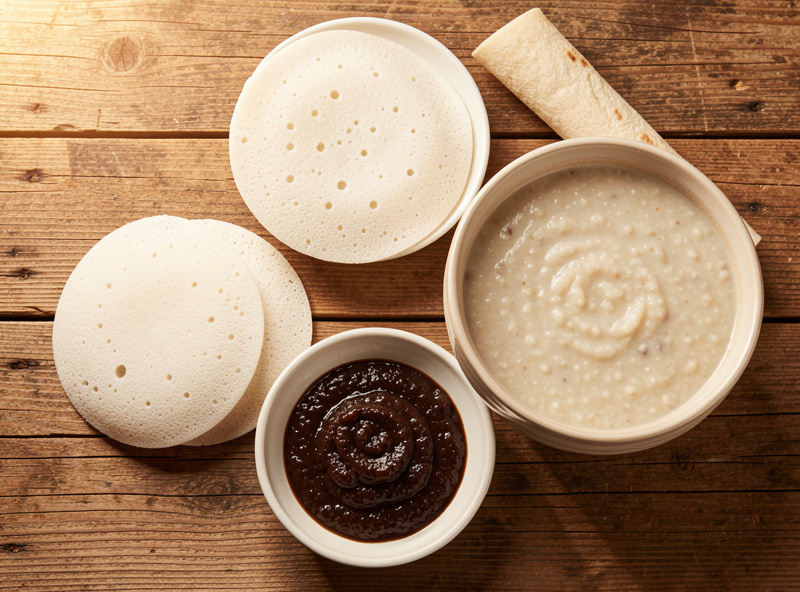
- Idli and dosa fermentation — the rice-and-urad-dal batter, the rice-to-dal ratio that controls rise, and how to ferment it warm even in a cold kitchen.
- Injera and teff fermentation — the ersho back-slop, the long sour, and why teff’s tiny grain ferments differently from rice.
- Fermented oats, overnight method — the simplest entry point: a warm, soured porridge base that breaks down phytate and cooks up tangy.
- Fermented bean paste — miso, doenjang, and the salt-and-koji route, where this category meets my koji bench.
- Sprouting and fermenting legumes — how to sprout first, which legumes are safe to do it with, and the brine option.
- Ogi fermented porridge — the West African steeped-and-soured maize/millet pap, decanted and cooked.
Starting your first batch
If you have never fermented a grain, start with the lowest-stakes one: fermented oats. Stir rolled oats with roughly equal water and a spoonful of something live — a little plain yogurt, sauerkraut brine, or a scrape of sourdough starter — cover loosely, and leave it on the counter overnight. By morning it smells tangy and cooks into a brighter, lighter porridge than plain oats ever make. That single batch teaches the whole framework: you will see the warmth-speeds-it-up effect, smell the clean sour, and learn what “ready” looks like with nothing on the line.
From there, idli batter is the natural next step because it adds the rise and the cook, and bean paste is the long game once you have a koji habit. Build in that order and each project teaches the dials for the next. The same patience that watches a starter rise watches a salami lose weight watches a hydroponic plant root in — fermentation is the meta-skill that quietly threads through half the hobbies I run. If you already keep a sourdough starter on a feeding schedule, you have most of the instincts these batters need; you are just pointing them at a new grain.
Common problems and what they mean
Most failures in grain and legume ferments are one of four things, and all four read off the four dials. A batter that will not rise is almost always too cold or under-ground — warm it up and grind smoother next time; the gas comes from yeast that needs both warmth and an aerated, broken-down batter. A batter that goes sour but flat fermented too long or too warm for its yeast, so the LAB outran the leavening; shorten the time or cool it slightly.
A slimy or ropey texture in a grain ferment usually means a particular strain bloomed (often in too-warm, too-sweet conditions) — it is generally not dangerous in a cooked grain batter, but I treat ropiness as a sign to reset the timing and temperature. And anything fuzzy and colored is mold — no rescue, start over. None of these are mysterious once you stop fermenting by recipe and start fermenting by the dials.
Why fermented grains taste and bake better
The reason traditional cultures bothered to ferment their staples is not mystical — it is chemistry you can taste. As the Lactobacillus drops the pH, it does three useful things at once. It develops flavor: lactic and acetic acids give that clean tang, and the wild yeasts throw off aromatic compounds a plain batter never has. It changes texture: enzymes and acid loosen the starch and protein network so an idli steams airy instead of dense, and a soured porridge turns silkier. And it breaks down phytic acid, the storage compound in grain and legume hulls, which is partly why a fermented batter feels lighter to cook with and tastes less raw and chalky than an unfermented one.
That last point is food chemistry, not a health claim — I am talking about how the batter behaves on the griddle and on the tongue, not what it does in anybody’s body. But it is the practical payoff that makes the overnight wait worth it: you are not just preserving the grain, you are pre-digesting it into something that cooks better and tastes more alive. Once you have eaten a properly fermented dosa next to a quick chemical-leavened one, the difference is impossible to unsee.
Frequently Asked Questions
Do you add salt when fermenting grains and legumes?
Usually no. Batter ferments like idli, injera, oats, and ogi use no salt during fermentation and rely on a fast acid drop plus cooking for safety. The exception is bean pastes like miso and doenjang, which need 5 to 13 percent salt because they age for months at ambient temperature.
How do I ferment grain batter in a cold kitchen?
Give it a warm spot and more time. Wild LAB and yeast want 28 to 32 degrees C for a fast 8 to 12 hour rise. In a 19 degree kitchen the same batter takes 18 to 24 hours. An oven with the light on, the top of the fridge, or a seedling heat mat all work well.
Is it safe to eat fermented legumes raw?
Not as a rule. Some legumes such as kidney and fava beans contain lectins that sprouting and fermenting do not reliably destroy, so they must be boiled. Stick to lentil, mung, and chickpea for sprouting and fermenting, and cook the result before eating.
What pH should a finished grain ferment reach?
Most grain batters land between 3.8 and 4.5 when ready. Ogi can reach 3.6 and idli around 4.3 on my meter. Below pH 4.6 the botulism risk is closed, which is why these acid-forward ferments are forgiving as long as you also cook them.
What is the white film on my fermenting batter?
A flat, white, slightly wrinkled film is kahm yeast, which is harmless. Skim it, stir, and continue. Mold is different: fuzzy, raised, and colored green, blue, black, or pink. Flat and white is fine; fuzzy and colored means discard the whole batch.
Why ferment grains and legumes at all?
Fermentation makes them lighter, tangier, and easier to cook with. The acid and enzymes break down starches and phytic acid, which is why a fermented idli batter steams into an airy sponge and a soured oat porridge tastes brighter than a plain one. It is a flavor and texture practice, not a health regimen.
Related Guides
- Idli and Dosa Fermentation: A Complete Guide
- Injera and Teff Fermentation
- Fermented Oats: The Overnight Method
- Fermented Bean Paste: Miso, Doenjang and Beyond
- Sprouting and Fermenting Legumes
- Ogi: Fermented Maize and Millet Porridge
- Koji Fermentation: Miso, Tempeh and Shio Koji

About Kenny Nyhus Fadil
A home fermenter documenting brines, bubbles, and the occasional moldy tragedy.