Vegetable Fermentation Troubleshooting: The Complete Fix Guide

Most vegetable ferments that look “wrong” are actually fine: a hazy brine, a sour-funky smell, and no visible bubbles are three of the most common panic triggers, and all three are usually normal. The genuinely dangerous failures are rarer and specific — fuzzy raised mold, a soft slimy mush that never acidified, a batch that never dropped below pH 4.6. This guide sorts the harmless from the hazardous the way I do it on my own bench: by measurement, not by vibes.
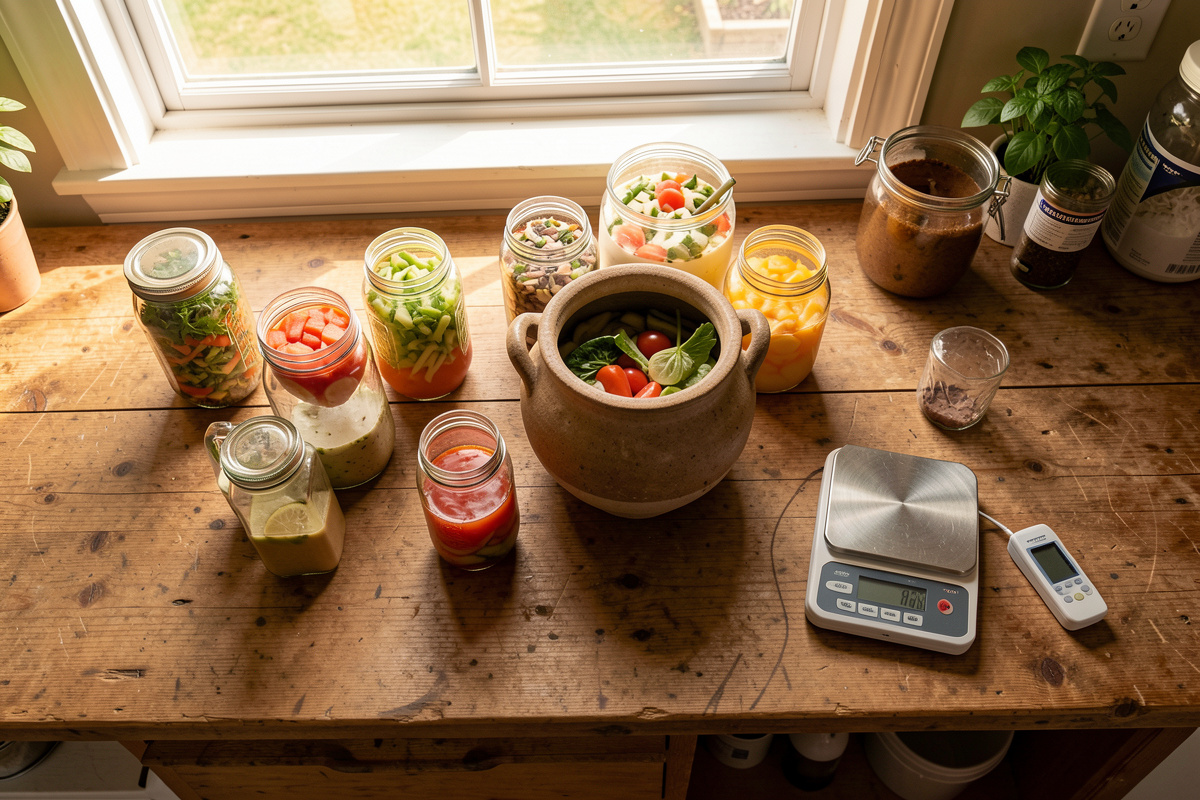
I’ve run sauerkraut, kimchi, lacto pickles, and chili mashes side by side for years — in a German-style water-sealed stoneware crock, in wide-mouth Mason jars, and in food-grade buckets for big cabbage runs — and I’ve grown every kind of film, cloud, and off-color you’re about to read about. The single thing that separates a fermenter who tosses good food from one who eats it safely is a pH meter and a scale. Numbers turn “is this okay?” into a yes or a no.
Here’s the mental model to hold before we get into specifics. Lacto-fermentation is a race. You salt vegetables so that Lactobacillus — which tolerates salt — outcompetes the spoilage bacteria and molds that don’t. As the lactos eat sugars, they pour out lactic acid, the pH falls, and by the time you’re under 4.6 the batch is hostile to pathogens, including the botulism-causing Clostridium botulinum. Almost every problem below is either “the race is running normally and just looks ugly” or “something stalled the race.” Diagnose which, and you know whether to skim, wait, or toss.
What Does a Healthy Vegetable Ferment Actually Look Like?
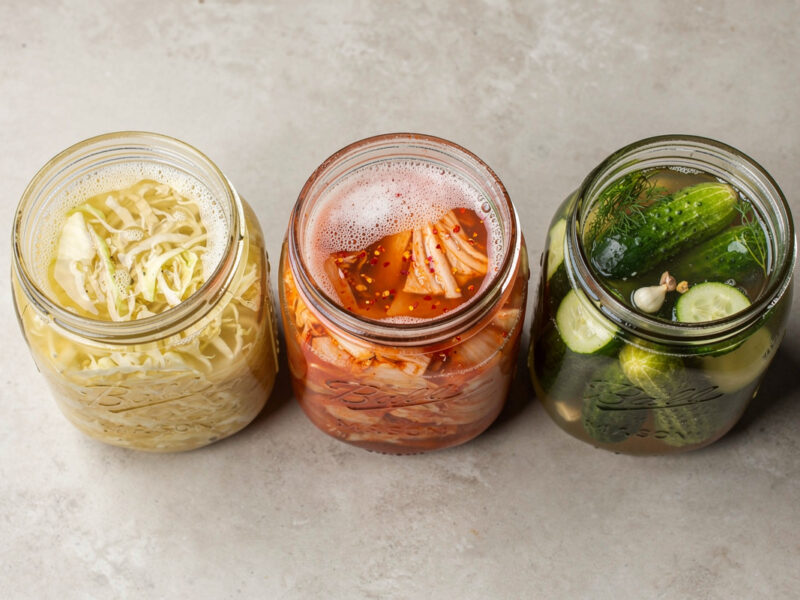
A healthy young vegetable ferment is cloudy, tangy-smelling, and often quiet. Expect the brine to turn milky within 3–5 days at room temperature (18–22°C), a clean sour-lactic aroma, small bubbles that may or may not be visible, and a pH heading toward 3.2–3.7 by the two-week mark. Cloudiness is Lactobacillus doing its job, not contamination.
The first time I fermented, I nearly threw out a perfect batch of dilly beans because the brine had gone the color of skim milk and smelled sharp enough to make my eyes water when I lifted the lid. That’s textbook. Lactic-acid bacteria are microscopic but they multiply into the billions, and en masse they cloud the liquid and settle as a pale sediment at the bottom of the jar. On my pH meter that “scary” batch read 3.4 — deeply, safely acidic. I ate it for a month.
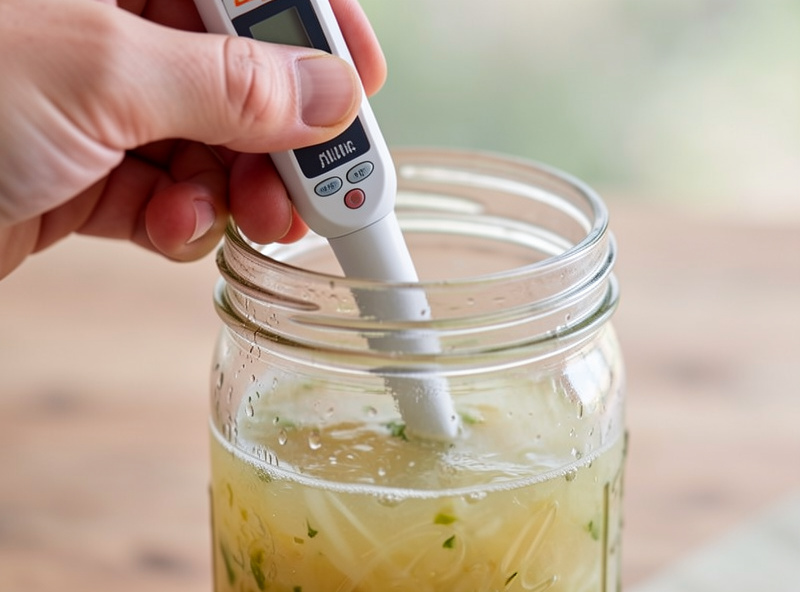
What you’re checking for, positively, is four things: the brine went cloudy and then partly cleared with sediment; the smell is sour and vegetal, not putrid; the vegetables stayed submerged (or you fixed it fast if they didn’t); and the pH dropped. If you don’t own a meter yet, the right pH meter for fermentation is the single highest-value tool on the bench — it’s the difference between guessing and knowing. For the full walk-through of the process these symptoms sit inside, my complete lacto-fermentation guide is the parent reference.
The Vegetable Ferment Symptom-to-Cause Table
Use this table as a triage map: match the symptom, read the most likely cause, and jump to the linked deep-dive. The rightmost column is the only one that matters for safety — whether the batch is a skim-and-continue or a toss-it. When a symptom is genuinely ambiguous, the pH reading breaks the tie: under 4.0 and acidic-smelling is almost always fine.
| Symptom | Most likely cause | Common fix | Skim or toss? |
|---|---|---|---|
| Cloudy brine, sour smell, no fuzz | Normal Lactobacillus bloom | Nothing — this is success | Keep |
| White wrinkly film on top | Kahm yeast (harmless) | Skim, keep submerged, cool it | Skim |
| Fuzzy raised spots (green/black/pink) | Mold | None reliable in soft veg | Toss |
| No bubbles at all | Cool temp, sealed vessel, or late start | Warm it, check pH, wait | Keep |
| Rotten/sulfur/putrid smell | Under-salted or warm spoilage | Check pH; if not acidic, toss | Depends |
| Soft or hollow pickles | Enzymes, warmth, low salt | Prevent next time; safe to eat if sour | Keep (usually) |
| Vegetables floating above brine | Gas lift, no weight | Re-submerge, add weight | Depends on exposure |
| Brine turned pink/grey/brown | Salt, oxidation, or yeast | Diagnose by ferment type | Depends |
| Too salty or lifeless-sour | Salt math off or over-fermented | Rinse, dilute, or repurpose | Keep |
| Fruit flies swarming the lid | Exposed brine, warm kitchen | Seal the vessel, trap the flies | Keep |
Notice how many rows land on “Keep.” That’s the real lesson of troubleshooting vegetable ferments: the fear-to-danger ratio is enormously lopsided. The overwhelming majority of “help, is this ruined?” photos I get sent are healthy batches with cosmetic quirks. The next sections take each row apart.
Why Is My Vegetable Ferment Not Bubbling?
No bubbles rarely means no fermentation. Bubbling is just CO2 escaping fast enough to see, and it depends on temperature, how tightly the vessel is sealed, and how far along you are. A cool 16°C kitchen, a jar with a loose lid that lets gas leak silently, or a batch that’s simply past its vigorous phase can all ferment perfectly with zero visible fizz.
The mistake I made early on was “fixing” a quiet jar by adding more starter brine and warming it aggressively — I turned a fine slow ferment into a soft, over-warm one. The correct move is to confirm with your senses and your meter: is the brine clouding, does it taste sour, is the pH falling? If yes, it’s working. Carbon dioxide production also front-loads — you’ll see the most bubbling on days 2–5, then it tapers even though acidification continues for weeks. I walk through every cause and the confirmation checks in the full spoke on no bubbles in your ferment. If your jar is sealed tight with no airlock, understand that a truly gas-tight jar builds pressure and can crack — the weights and lids you choose change whether you ever see bubbles at all.
What Does It Mean When My Ferment Smells Bad?
A vegetable ferment is supposed to smell strong — sour, sharp, sulfurous with cabbage and brassicas, funky with garlic and kimchi. That funk is normal. The specific smells that signal trouble are putrid, rotting, or genuinely nauseating in a way that reads as “decay” rather than “sour,” and they almost always come paired with a pH that never dropped and vegetables that went to mush.
Brassicas are the champions of alarming-but-safe aromas. My first big cabbage crock threw off a rotten-egg, low-tide smell around day four that had me convinced I’d poisoned the whole batch. It was hydrogen sulfide — a normal, transient byproduct of cabbage fermentation that blows off as the batch matures. By week two it smelled cleanly sour. The reliable tell for real spoilage is the combination: bad smell plus slimy texture plus a pH above 4.6 means the lactos never won the race. Bad smell with a sour taste and a pH of 3.5 is just fermentation being fermentation. I break down every category — the normal funks and the genuine red flags — in normal funk vs genuinely spoiled.
Why Did My Pickles Go Soft, Mushy, or Hollow?
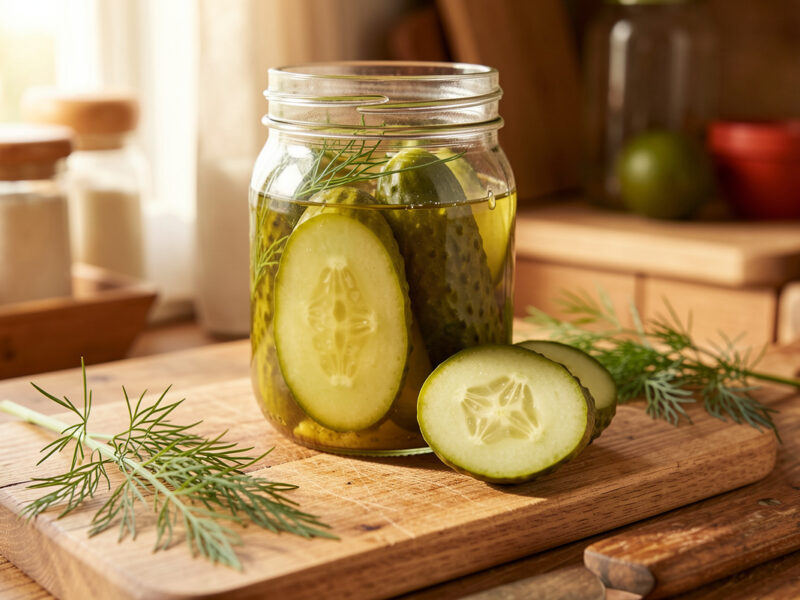
Soft and hollow pickles are texture failures, not usually safety failures. Softness comes from enzymes (pectinases, often carried in on blossoms and blossom ends), fermentation that ran too warm, or salt that was too low to keep the cell walls firm. Hollow cucumbers are frequently hollow before they ever hit the brine — a growing problem, not a fermenting one.
The fix is prevention. I trim the blossom end off every cucumber now — a hard lesson after a jar of gorgeous garden pickles turned to paste — and I ferment pickles cooler and saltier than kraut, at 3.5–5% brine by weight. Tannins help too: a grape leaf, oak leaf, or a pinch of black tea in the jar donates tannins that inhibit the softening enzymes. A soft pickle that fermented properly and tastes clean and sour is safe to eat; it’s just disappointing. The full mechanism, including why some cucumbers are hollow at harvest, is in why pickles go hollow or soft, and my broader texture playbook lives in keeping fermented vegetables crunchy. Kraut has its own softening story in why sauerkraut turns mushy.
My Vegetables Floated Above the Brine — Is That Dangerous?
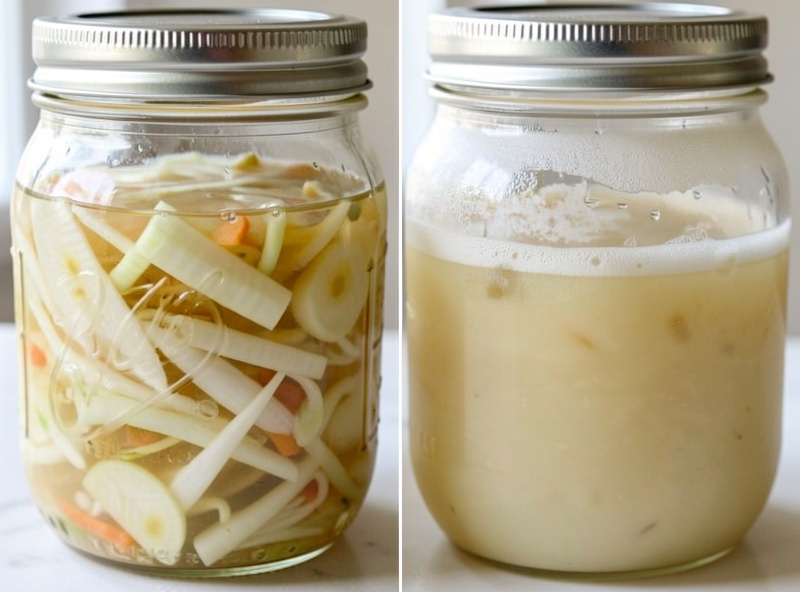
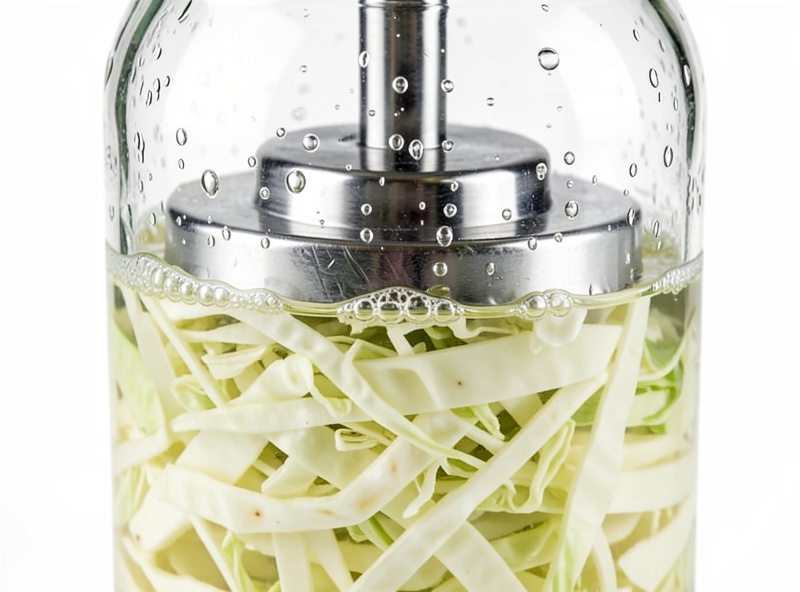
Floating vegetables are the number-one cause of mold in home ferments, and they’re entirely preventable. Anything above the brine is exposed to oxygen, which is exactly what molds and kahm yeast need and Lactobacillus doesn’t. Gas production during the vigorous phase physically lifts vegetables up; without a weight holding them down, they surface and start collecting fuzz.
The rule on my bench is absolute: everything stays submerged, always. I use glass fermentation weights and ceramic crock stones, and for jars a follower plate or even a brine-filled zip bag as a water weight that conforms to the surface. If a few shreds float briefly and you push them back under within a day, no harm done. If cabbage sat exposed and grew a fuzzy colony, that’s a different problem — you’re now in mold territory. Exactly how much exposure is recoverable, and how to weight different vessels, is the whole point of vegetables floating above the brine. My head-to-head on holding things down is fermentation weights compared.
My Ferment Turned Pink, Grey, or Brown — What Does That Mean?
Color changes split into three buckets: harmless oxidation, harmless pigment chemistry, and a genuine warning. Grey or brown at the surface of kraut or exposed vegetables is usually oxidation — air discoloring the top layer — and it’s cosmetic. Pink in kimchi or radish is often just the pigment doing normal things. Pink kraut, specifically, can signal a salt problem worth investigating.
The one I take seriously is a slimy, spreading pink in sauerkraut, which is associated with the wrong yeasts taking hold — frequently a sign the salt was uneven or too high, letting salt-tolerant pink yeasts bloom instead of the lactos. Brown-black at a dry, exposed spot is usually just oxidation you can scrape. The diagnostic that ties it together is, again, the pH and the texture: acidic and firm with surface discoloration is a scrape-and-eat; sour-smelling normal color throughout is perfect. I sort every color by ferment type — kraut, kimchi, pickle, mash — in pink, grey, or brown ferments explained. Note that colored fuzzy raised growth is not a color change, it’s mold — see the toss line below.
Can I Rescue a Ferment That’s Too Salty or Too Sour?
Yes to both, and neither is a safety problem — they’re flavor problems, which means you have options. Too salty almost always traces to salt math done by volume instead of weight, or salt that didn’t fully dissolve before you tasted. Too sour means the batch simply fermented longer or warmer than you wanted; the acid climbed past your preference.
For an over-salted batch, I’ll dilute the brine with measured fresh water to bring the salinity back into range, or lean into it and use that ferment as a seasoning — a spoonful of aggressively salty kraut brine is a fantastic addition to soups and dressings. For over-sour, cold storage is the brake: moving a jar to the fermentation fridge slows Lactobacillus to a crawl and holds the flavor where it is. You can also cut sour kimchi into cooked dishes where the acidity is an asset. The full rescue toolkit, including how to recalculate salinity safely, is in rescuing an out-of-balance ferment, and the numbers behind it all live in my salt and brine math guide and the step-by-step on calculating a brine percentage by weight.
How Do I Get Rid of Fruit Flies Around My Crock?
Fruit flies are drawn to exposed, actively fermenting surfaces — the vinegary aroma is a beacon — and the fix is mechanical, not chemical: deny them access and trap the ones already in the room. A properly sealed crock or an airlocked jar is invisible to them. The problem is almost always an open bowl, a loose cloth cover, or lifting the lid too often in a warm kitchen.
They matter beyond nuisance because fruit flies carry yeasts and can lay eggs on any exposed vegetable, and a maggot in your brine ends the batch. During peak summer in my kitchen I switch open crocks to water-sealed lids or silicone waterless airlocks, and I keep an apple-cider-vinegar trap (a splash of vinegar, a drop of dish soap to break the surface tension) on the counter as insurance. The complete prevention system — vessel choices, trap recipes, and the habits that keep them away — is in fruit flies and gnats around your crock.
The Two Dials That Prevent Most Problems: pH and Salinity
Nearly every failure above is downstream of two numbers: salt concentration going in, and pH coming out. Get the salt right and you tilt the microbial race toward Lactobacillus from minute one. Watch the pH fall and you know the batch reached safety — under 4.6 is the pathogen floor, and a finished vegetable ferment should sit well below it, around 3.2–3.7.
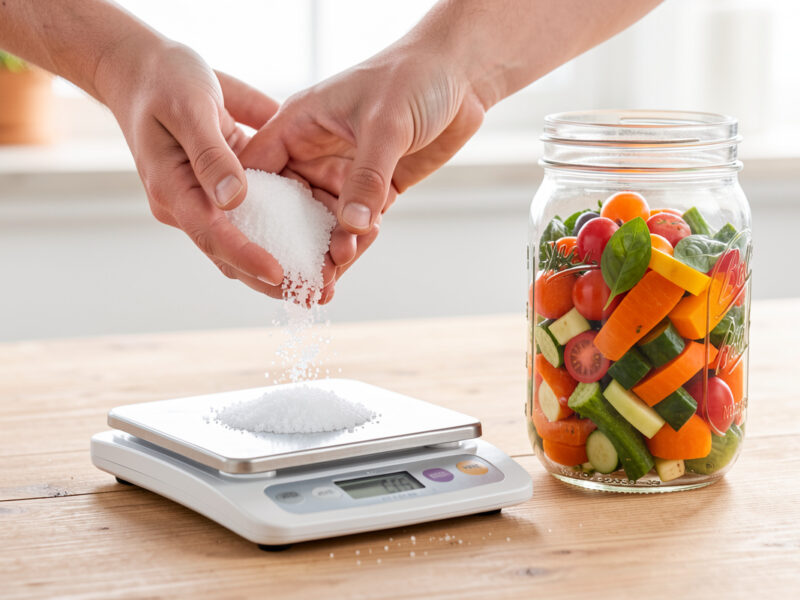
Salt targets by ferment, always measured by weight on a 0.1 g scale: sauerkraut at 2–2.5%, kimchi around 2–3%, lacto pickles and chili mashes at 3.5–5%. Those aren’t arbitrary — they’re the concentrations that suppress spoilage organisms while still letting the lactos work. Below roughly 2% you’re gambling, and the risk isn’t just softness; under-salted, anaerobic vegetables are the one genuine botulism vector in this hobby, which is why the U.S. National Center for Home Food Preservation and the CDC’s botulism guidance both anchor safety to acidity and salt. I keep backup pH strips for cross-checks and a calibrated meter as my primary. If you want to push salt down for dietary reasons, do it with your eyes open — I cover exactly how far in how low can you safely go. And if your brine looks cloudy or ropy, that’s usually salinity too, covered in why your brine went cloudy or slimy.
When to Skim, When to Toss: The Safety Line
The single distinction that keeps you safe is kahm yeast versus mold. Kahm is a flat, white or cream, sometimes wrinkly film on the brine surface — harmless, a cosmetic and flavor nuisance you skim off and move past. Mold is fuzzy, raised, and colored: green, black, blue, or fuzzy pink or white with visible texture. In soft, high-moisture fermented vegetables, mold means toss the batch.
Why the hard line on mold in soft vegetables? Because unlike hard cheese, where you can cut an inch around a spot, the mold’s root filaments (hyphae) run invisibly through waterlogged vegetables, and some molds produce mycotoxins that don’t cook out. I’ve skimmed hundreds of kahm films and eaten those batches happily; I’ve also tossed a beautiful jar of fermented carrots the moment I saw one fuzzy green dot, and I’d do it again without hesitation. The cost of a lost batch is a few dollars of vegetables. When you’re unsure which you’re looking at, my photo guides — sauerkraut mold vs kahm yeast and the kahm yeast guide — show the difference clearly. The rule I live by: skim what’s flat and pale, toss what’s fuzzy and raised, and let the pH meter settle every argument in between.
How Long Should a Healthy Vegetable Ferment Take?
Most lacto-vegetable ferments hit a safe pH within 3–5 days and reach eating quality between one and four weeks, but temperature is the throttle. At a warm 24°C a jar of kraut can be pleasantly sour in 7 days; in my cool 16°C winter kitchen the same batch needs three weeks to get there. “It’s been two days and nothing’s happening” is almost always impatience, not failure.
Timeline anxiety causes more ruined batches than any actual microbe, because it drives people to intervene when they should wait. Here’s the rhythm I watch for: days 1–2, the salt pulls water out and the brine level rises; days 2–5, the vigorous phase, most bubbling and the fastest pH drop; week one to two, souring continues and flavors round out; beyond that, slow deepening you can arrest anytime by refrigerating. If you’re at day three in a cold room with no bubbles and no souring yet, the fix is warmth and patience, not more salt or a fresh culture. A cold kitchen doesn’t kill a ferment — it just stretches the calendar, and it actually produces firmer, more complex results. Warmth speeds everything but also softens texture and can invite off-flavors, which is why summer batches need a closer eye.
Does Tap Water Stall My Vegetable Ferment?
It can. Chlorinated municipal water carries chlorine or chloramine specifically to kill bacteria — and Lactobacillus is a bacterium. A heavily chlorinated tap can slow the start of a ferment or make it sluggish and prone to being outcompeted. It rarely stops a well-salted batch outright, but it stacks the deck against you at the most vulnerable moment: the first 48 hours.
I don’t gamble on it. For any brine I mix, I use dechlorinated water — either filtered, or tap left uncovered overnight so chlorine gasses off. The catch is chloramine, which many utilities now use instead of chlorine: it does not simply evaporate, and boiling won’t remove it either. My kitchen is on a chloramine supply, so I filter. If a batch started slow and you’ve ruled out cold temperature and low salt, water is the next suspect. I unpack exactly what happens — and what doesn’t — in does chlorinated tap water kill your ferment. It’s a small, cheap variable to control, and controlling it removes one more reason a batch might disappoint you.
My Pre-Batch Checklist That Prevents Most Failures
The fastest way to stop troubleshooting is to prevent the problems at pack-out. Ninety percent of the failures in the table above trace back to five decisions you make before the lid goes on: the salt weight, the water, the submersion, the temperature, and the vessel. Nail those and most of this guide becomes theoretical for you.
Here’s the checklist I actually run, in order. One: weigh the vegetables and the salt on a 0.1 g scale and hit the target percentage for that ferment — 2–2.5% kraut, 2–3% kimchi, 3.5–5% pickles and mashes — never eyeballed, never by volume. Two: use dechlorinated water for any added brine. Three: get everything under the brine and keep it there with a real weight, because floating vegetables are the number-one mold cause. Four: pick a stable, moderate spot — cooler is safer than warmer, and a consistent temperature beats a swinging one. Five: choose the vessel for the job — a sealed jar with no airlock builds pressure and can crack, so either burp it, fit an airlock, or use a water-sealed crock. The last habit is the cheapest insurance of all: take a pH reading at pack-out and again at day three or four. Watching the number fall from a starting ~5.5 toward 4.0 tells you the race is being won long before your tongue or nose can confirm it — and it means that when something does look strange later, you already have the one data point that settles whether it’s safe.
Frequently Asked Questions
My vegetable ferment smells bad but tastes fine — is it safe?
Usually yes. Strong sour and sulfurous smells are normal, especially with cabbage and brassicas, and they fade as the batch matures. The reliable danger signal is a putrid rotting smell combined with slimy texture and a pH above 4.6. If it tastes cleanly sour and the pH is below 4.0, it fermented correctly.
Why is my ferment not bubbling?
No visible bubbles rarely means no fermentation. Bubbling depends on temperature, how tightly the vessel is sealed, and how far along the batch is. Confirm it is working by checking that the brine is clouding, the taste is turning sour, and the pH is falling. Most CO2 is produced in the first few days, then tapers while acidification continues.
Can I eat fermented vegetables that floated above the brine?
If you pushed them back under within a day and no fuzzy mold grew, yes. Anything left exposed to air can grow kahm yeast or mold. Kahm is a flat pale film you skim off. Fuzzy, raised, colored growth is mold, and in soft fermented vegetables that means discard the whole batch.
Is a cloudy brine a sign my ferment is ruined?
No. Cloudy brine is one of the clearest signs of a healthy ferment. It is the Lactobacillus population blooming into the billions and settling as pale sediment. A clear brine early on is more concerning than a cloudy one. Ropy or slimy cloudiness is a separate issue usually tied to salinity.
How do I know when to toss a ferment versus skim it?
Skim flat, pale, wrinkly films — that is harmless kahm yeast. Toss the batch if you see fuzzy, raised, colored growth, which is mold. In soft high-moisture vegetables mold filaments spread invisibly and some produce toxins, so unlike hard cheese you cannot cut it out. When unsure, a pH below 4.0 and a clean sour smell strongly favor safe.
What pH should a finished vegetable ferment reach?
A finished lacto-fermented vegetable should sit around 3.2 to 3.7. The critical safety floor is pH 4.6 — below that, pathogens including botulism cannot grow. A healthy batch drops under 4.6 within days and keeps falling. If a batch never gets below 4.6, it did not ferment safely and should be discarded.
Keep Building
Troubleshooting is easiest when you already understand the process it sits inside. Start with the complete lacto-fermentation guide, then dig into the specific symptom you’re chasing: bad smells, no bubbles, soft or hollow pickles, floating vegetables, color changes, salty or sour rescues, and fruit flies. When you’re ready to stop reacting and start preventing, dial in the two numbers that govern everything with the brine math guide and the right pH meter.

About Kenny Nyhus Fadil
A home fermenter documenting brines, bubbles, and the occasional moldy tragedy.
Keep Bubbling
How to Calculate a Salt Brine Percentage by Weight With a Scale
Why Did My Pickles Go Hollow or Soft Inside?