Home Vinegar Making: The Complete Guide from Mother to Bottle

Home vinegar costs almost nothing to make and ages into something supermarket vinegar cannot match. After four years of running concurrent vinegar mothers — one apple cider, one red wine, one rice — my pantry has settled into a steady output of about 6 litres per year of bottled vinegar at a per-litre cost under 80 cents. The flavour depth is the headline benefit; the supply security and zero packaging waste are the quiet ones.
Vinegar is the simplest fermentation you can run because the chemistry is unforgiving but the procedure is patient. Take any alcoholic liquid (wine, cider, beer, sugar-water), expose it to oxygen, give it a mother of acetic acid bacteria, and walk away for 6-12 weeks. The acetobacter does the work. The variables that matter are oxygen access, temperature, and starting alcohol percentage. Miss any of the three and the batch stalls or spoils; get all three right and the mother runs perpetually.
The Two Roads: Alcohol-Then-Vinegar versus Direct Acetic
Vinegar is acetic acid, and acetic acid bacteria (Acetobacter and Gluconobacter species) make it by oxidising ethanol. That means every vinegar starts with an alcoholic substrate. The two production roads are: ferment your own alcohol first (sugar plus yeast → alcohol → vinegar) or buy a finished alcohol and inoculate it directly with a mother. Both produce identical end product; the choice is about timeline and skill investment.
| Method | Starting Material | Time to Pourable | Cost per Litre | Difficulty | Best Use |
|---|---|---|---|---|---|
| Sugar to ACV (full process) | Apples + sugar + water + wild yeast | 3-5 months | $0.40-0.80 | Moderate | Pantry workhorse, salad dressing |
| Wine to red wine vinegar | Open bottle of red table wine + mother | 6-10 weeks | $2-4 | Easy | French cooking, vinaigrettes |
| Cider to ACV (short-cut) | Hard cider + mother | 6-10 weeks | $1-2 | Easy | Same as ACV but faster start |
| Sake to rice vinegar | Sake or makgeolli + mother | 8-12 weeks | $1.50-3 | Moderate | Asian cooking, sushi rice |
| Beer to malt vinegar | Stale ale or stout + mother | 6-10 weeks | $1-2.50 | Easy | Fish and chips, pickling |
| Honey to honey vinegar | Honey + water + yeast (mead) + mother | 4-6 months | $3-5 | Moderate | Premium dressings, glazes |
My personal split: I make apple cider vinegar from scratch (full process — apples to alcohol to vinegar) once a year as an autumn project, and I run a perpetual red wine vinegar mother on whatever opened bottle did not finish in the kitchen. The two outputs cover roughly 90 percent of household vinegar use. The full ACV-from-scratch protocol lives in how to make apple cider vinegar from scratch, and the dedicated red wine vinegar method in how to make red wine vinegar at home.
What a Mother Is and How to Get One
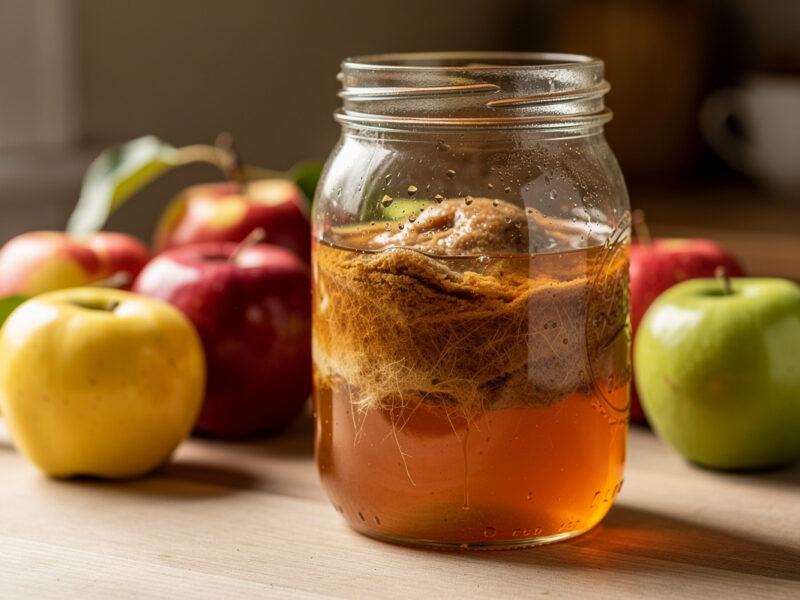
A vinegar mother is a cellulose mat formed by acetic acid bacteria, similar in structure to a kombucha SCOBY but typically thinner and more rubbery. The mother is not strictly necessary for vinegar fermentation — acetobacter exists in the air and on fruit skins — but a mother dramatically accelerates the process and reduces failure risk by giving you a known active starter culture. New batches with a mother start fermenting within days; batches without can take weeks to develop their own surface colony or never get there.
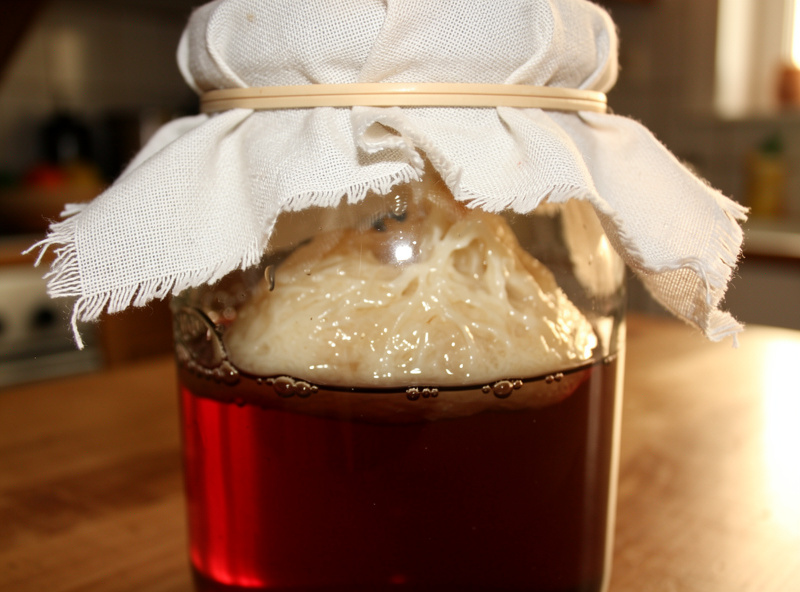
Three ways to obtain a mother. First and easiest: buy unpasteurised raw apple cider vinegar from a health food store (Bragg’s is the most widely available) and pour the cloudy stringy material at the bottom into your starting alcohol. Within 2 weeks a surface mother forms. Second: a friend who already brews vinegar — most home vinegar makers have more mother than they need. Third: spontaneous — leave an open bottle of unpasteurised wine on the counter with a cloth over the top; in 4-8 weeks a mother typically forms from airborne acetobacter, with a higher failure rate than the first two methods.
Once you have one healthy mother, you can split it indefinitely. Every 3-4 batches I pull off a strip of mother and seed a new vinegar substrate (wine, beer, cider) — within a month I have a parallel running culture for a different vinegar type. After four years I run three concurrent mothers (ACV, red wine, rice) all descended from a single Bragg’s seed. The full broader fermentation-and-curing crossover applies here too: the mother-management discipline parallels the inoculum work for sourdough (covered in sourdough starter not rising) — same logic, different organism.
Substrate Choice: Wine, Beer, Cider, Sugar-Water
Acetobacter converts ethanol to acetic acid at roughly a 1:1 ratio — every percent of alcohol in your substrate becomes about 1 percent acetic acid in the finished vinegar. The starting alcohol percentage decides the final acidity. Aim for 5-8 percent alcohol in the substrate; lower means weak vinegar (under 4 percent acidity, prone to spoilage during aging) and higher (above 12 percent) means acetobacter struggles or stalls because alcohol becomes toxic to the bacteria.
Wine substrates: most table wines are 12-14 percent alcohol, which is too high. Dilute with filtered water at roughly 1:1 ratio to land at 6-7 percent — the safe target. Red, white, and rosé all work; sweetness in the wine adds residual fruity notes to the final vinegar. Avoid wines with significant sulphite preservatives if you can; the sulphites slow but do not stop acetobacter, just extend the timeline. Box wine works fine and is the cheap-and-cheerful path for vinegar makers.
Cider, beer, and sake all start at usable alcohol percentages and need no dilution. Sugar-water requires you to ferment alcohol first with baker’s yeast or champagne yeast — typically 100 grams sugar per litre of water plus apple scraps as flavour and wild yeast vehicle, fermented under airlock for 2-3 weeks to produce roughly 6 percent ABV, then the airlock comes off and acetic fermentation begins. The full apple-scrap procedure is in apple cider vinegar from scratch.
Acetobacter Conditions: Oxygen, Temperature, Container Geometry
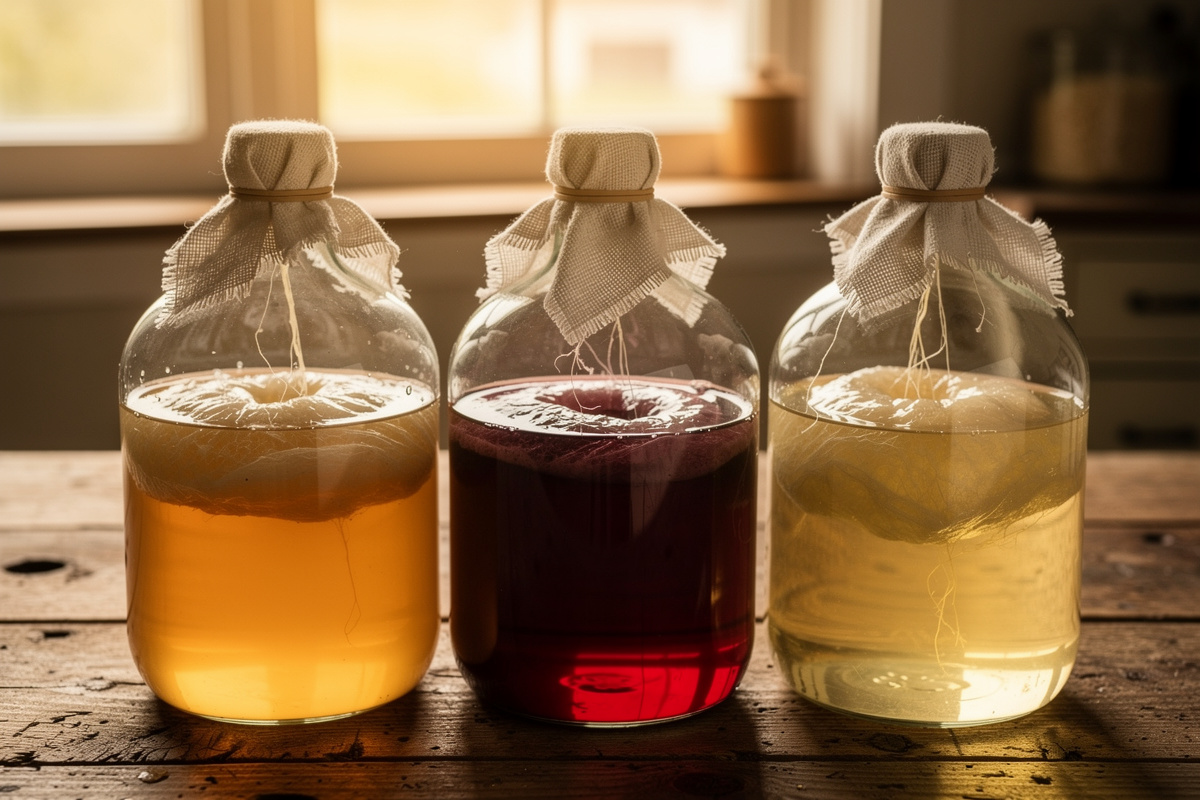
The single biggest beginner mistake is sealing the vinegar jar with an airtight lid. Acetobacter is aerobic — it needs oxygen to convert ethanol to acetic acid. Sealed vinegar substrate does not ferment; it just sits as alcohol indefinitely. The container needs a breathable cover (cotton cloth, paper coffee filter, double layer of muslin) secured with a rubber band, and the substrate-to-air surface area should be maximised by using wide-mouth vessels rather than narrow-necked ones.
My standard vessel is a 4-litre wide-mouth glass jar, 22 cm diameter at the opening, filled with 2.5 litres of substrate — leaving roughly 12 cm of head space and a generous air-substrate interface. The cloth cover keeps fruit flies and dust out while letting oxygen in. Two flies in the jar will ruin a 4-litre batch within 48 hours by introducing yeasts and bacteria that compete with acetobacter, so the cloth needs to be tight at the edge with no gaps.
Temperature window is 21-29 C, with optimum around 26 C. Below 18 C the fermentation crawls; above 32 C acetobacter activity drops and ethanol evaporation rises sharply. My summer vinegars run in 5-6 weeks at kitchen ambient (24-27 C); winter vinegars take 9-12 weeks in a 19-21 C kitchen. A small fish-tank heater or a 30-watt seedling heat mat under the jar holds 25 C reliably for under 5 dollars per month of electricity.
Timeline: From Pitch Day to Pourable Bottle
Vinegar timelines are remarkably predictable once you nail the variables. The pattern for a 5-litre wine-to-vinegar batch at 25 C: week 1 — mother lays down a thin translucent film on the surface; week 3 — film thickens to a 3-5 mm rubbery mat, vinegar smell becomes pronounced; week 5 — taste test, expect 3-4 percent acidity; week 6-8 — full conversion, taste test for finished acidity; week 8 — siphon off, bottle, and start the next batch.
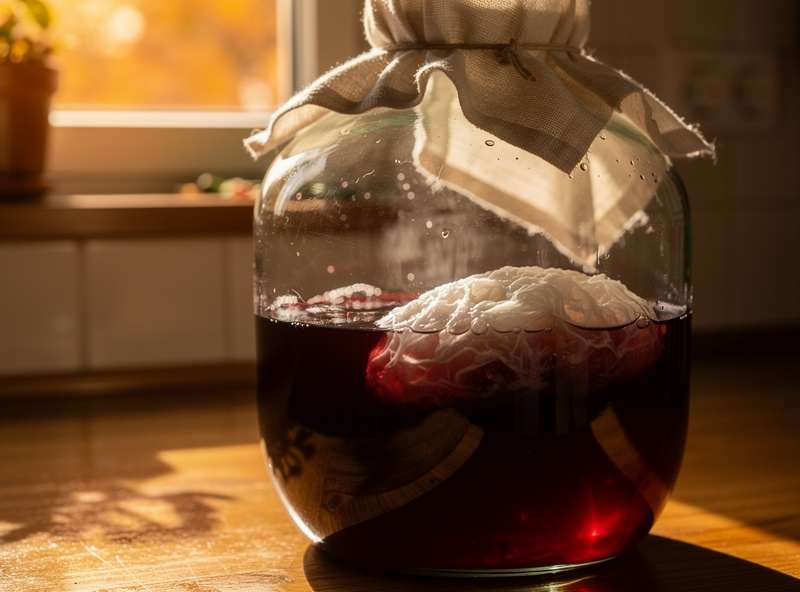
The taste test is the only reliable finish indicator. A pH meter or acid titration kit gives you a precise number, but for home use the tongue is accurate enough. Finished vinegar should taste sharp and complete — no detectable alcohol harshness, no off-notes of acetone (a sign of too-warm fermentation), and no residual sweetness. If you taste alcohol, give it 2-3 more weeks; if you taste acetone, lower the temperature and let it finish more slowly.
For ACV from scratch, the timeline is longer because you are running two ferments back to back. Week 1-3: anaerobic alcoholic fermentation (apples plus sugar plus wild yeast in a covered jar with an airlock or loose cover). Week 3: remove airlock, replace with breathable cloth, allow oxygen exposure. Week 4-12: acetic fermentation. Week 12-16: rack off the spent apple solids and continue for another 2-4 weeks until acidity stabilises. Total: 14-16 weeks for a finished bottled ACV.
Filtering, Pasteurising, and Bottling
Finished vinegar needs three decisions: filter or leave unfiltered, pasteurise or leave raw, and which bottle to use. My defaults: filter through a fine cloth for clarity, leave raw (unpasteurised) for full mother retention and flavour complexity, and bottle in dark glass with a tight cap for long-term storage. Most home vinegar makers over-process at this stage; raw unfiltered vinegar is what most commercial “artisan” vinegars are sold as at premium prices.
Pasteurisation is only needed if you want to gift the vinegar (eliminates risk of mother reforming in the recipient’s bottle and surprising them) or if you plan to use it for canning vegetables (a stable known acidity is needed for safety calculations). Pasteurise by heating to 75 C for 10 minutes, then cooling and bottling immediately. The acidity remains identical; the visual stability improves; the live mother culture is destroyed.
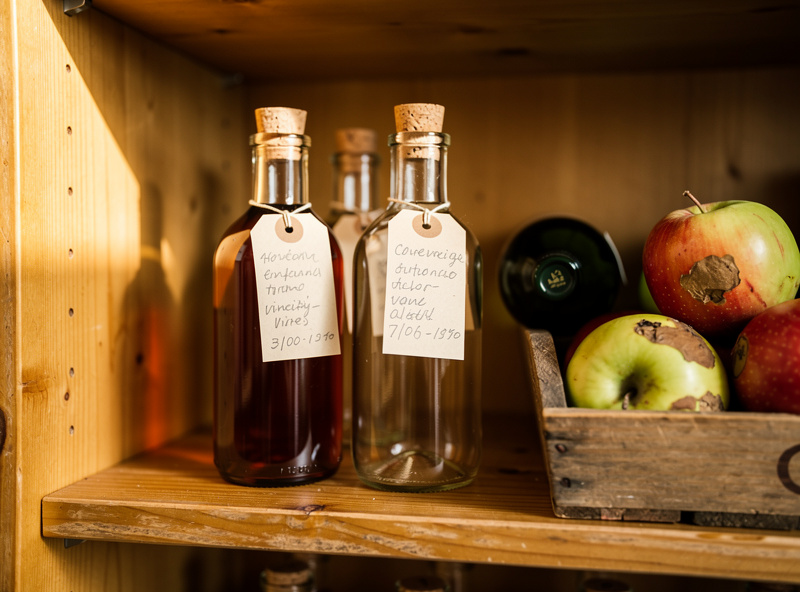
Bottle choice matters for long-term storage. Glass with a tight-sealing cap is non-negotiable — vinegar dissolves most metals over months. Avoid metal lids touching the vinegar; use plastic-lined caps or a small disc of plastic film as a barrier. Dark amber glass is preferable to clear because UV slowly degrades the flavour compounds over years of pantry storage. For finished bottles, I label with date, substrate, and acidity (percent) — the same labelling discipline I describe in detail at the sauerkraut diagnostic guide, where dated labelling is what lets you compare across batches and seasons.
Troubleshooting and Mother Health
Vinegar problems cluster into five common patterns. Mother does not form (low alcohol substrate, too cold, or oxygen-blocked container — diagnose temperature first). Vinegar tastes weak (insufficient starting alcohol; aim for 6-7 percent ABV next batch). Vinegar tastes harsh (over-acidic from too warm or too long; bottle and let it mellow for 1-2 months). Slimy or rotten substrate (contaminated by yeast competing with acetobacter — toss, sterilise vessel, restart). Fruit flies in the jar (cloth not secured properly — re-secure, in the worst case rack off the top 2 cm where flies have been and continue).
Mother health is the longest-term concern. A healthy mother is rubbery, off-white to pale tan, and laid in even sheets. A struggling mother becomes thin and patchy or develops dark spots. The two recovery moves: add a fresh “feed” of diluted alcoholic substrate to a stagnant mother (revives it within 5-7 days), or split off a healthy section to a new vessel with fresh substrate and discard the older damaged mother. Mothers can live for years with regular feeding.
The visual ID skill for distinguishing healthy mother from a contaminated mat transfers from sauerkraut surface diagnosis — see sauerkraut mold vs kahm yeast with photos and the broader kahm yeast guide. Vinegar tops sometimes grow kahm yeast on the surface above the mother; skim it the same way you would skim kahm yeast off a sauerkraut crock. The fermented-pickle crossover with charcuterie climate is covered in fermented pickle brining and curing-chamber aging, which uses the same temperature-stability lessons detailed in curing chamber humidity tech for salami. The deep brewing-side workflow that overlaps with home vinegar is detailed in the deeper home vinegar brewing guide.
My Four-Year Vinegar System
Three concurrent mothers, two production cycles per year. The ACV mother runs once a year in autumn when local apples are cheap; produces 6-8 litres of finished ACV that lasts the household until the next harvest. The red wine vinegar mother runs perpetually on whatever opened bottle did not finish in the kitchen — typically a top-up every 2-3 weeks, harvest 500 ml every 6-8 weeks. The rice vinegar mother is the most experimental; runs on whatever makgeolli or unfiltered sake I can source, slower than the others, harvest once a quarter.
Total active work: roughly 90 minutes per quarter. Total annual cost: under 35 dollars for the perpetual mothers; ACV bulk is essentially free because it uses second-quality apples from my garden and a friend’s orchard. The output replaces roughly 12-15 supermarket bottles of vinegar per year (industrial vinegar at 4 dollars a bottle), and the home-brewed versions have flavour profiles I cannot find at any price commercially.
For someone starting their first vinegar mother, my recommendation is straightforward: buy a bottle of Bragg’s unpasteurised ACV (8 dollars), open a bottle of red wine you would not regret losing, mix 1:1 with filtered water in a wide-mouth glass jar, pour in 50 millilitres of the stringy material from the bottom of the Bragg’s bottle, cover with a clean cloth, leave on the counter at 21-25 C for 6-8 weeks, taste, bottle. Total cost for a litre of finished red wine vinegar: under 4 dollars including the mother seed. The garden-to-jar pipeline for using whatever fruit your garden produces is documented in garden to jar fermenting; if you grow fruit, the seasonal pairing is what makes vinegar production self-funding.
Frequently Asked Questions
What is a vinegar mother and do I need one?
A vinegar mother is a cellulose mat formed by acetic acid bacteria (Acetobacter) on the surface of a vinegar ferment. You do not strictly need one — acetobacter exists in air — but a mother accelerates fermentation from 8-12 weeks down to 5-8 weeks and reduces the failure rate dramatically. Easiest source: pour the stringy material from the bottom of a bottle of unpasteurised raw apple cider vinegar (Bragg’s) into your starting alcohol.
What alcohol percentage should my vinegar substrate be?
Aim for 5 to 8 percent alcohol by volume. Below 4 percent yields weak vinegar that may spoil during aging; above 12 percent is toxic to acetobacter and the fermentation stalls. Wine at 12-14 percent should be diluted 1:1 with filtered water; cider, beer, and sake are typically in range without dilution; sugar-water must first be alcoholic-fermented with yeast for 2-3 weeks to produce around 6 percent ABV before vinegar fermentation can begin.
Why is my vinegar not fermenting?
Five likely causes: container is airtight (acetobacter needs oxygen — use a cloth cover); starting alcohol is too high (above 12 percent ABV stalls acetobacter — dilute with filtered water); temperature is below 18 C (move to a warmer spot or add a seedling heat mat); no active starter culture (add 50-100 ml from a known active mother); or sulphites in commercial wine slowing the bacteria (give it 3-4 more weeks).
How long does home-made vinegar take to make?
With a mother, wine-to-vinegar takes 6 to 10 weeks at room temperature. Cider and beer are similar. ACV from scratch (sugar plus apples plus wild yeast plus mother) takes 14 to 16 weeks because you run alcoholic fermentation first (3 weeks) followed by acetic fermentation (8-12 weeks). Honey vinegar (from mead) is the slowest at 4 to 6 months.
Do I need to pasteurise home vinegar before bottling?
No, for personal use. Raw unpasteurised vinegar keeps indefinitely in dark glass with a tight cap and contains the live mother and beneficial bacteria. Pasteurise (75 C for 10 minutes) only if gifting (prevents mother reformation surprising the recipient) or if using the vinegar for water-bath canning where a known stable acidity is needed for safety calculations.
Can I make vinegar without buying a mother?
Yes. Leave an open bottle of unpasteurised wine or hard cider on the counter with a cotton cloth over the mouth for 4 to 8 weeks. A mother typically forms from airborne acetobacter. Success rate is 50-70 percent versus 90-plus percent when using a known mother. The fallback if no mother forms: pour the substrate into a bowl of unpasteurised raw apple cider vinegar and restart.
Go Deeper: The Vinegar Brewing Cluster
Each stage in this guide opens into a dedicated deep-dive. If you want the full picture on any one piece, start here:
- The Mother of Vinegar, Explained — what the mat actually is, how to grow one, and how to keep it alive for years.
- Vinegar Fermentation Stages — the two-stage biochemistry, and which instrument reads each stage.
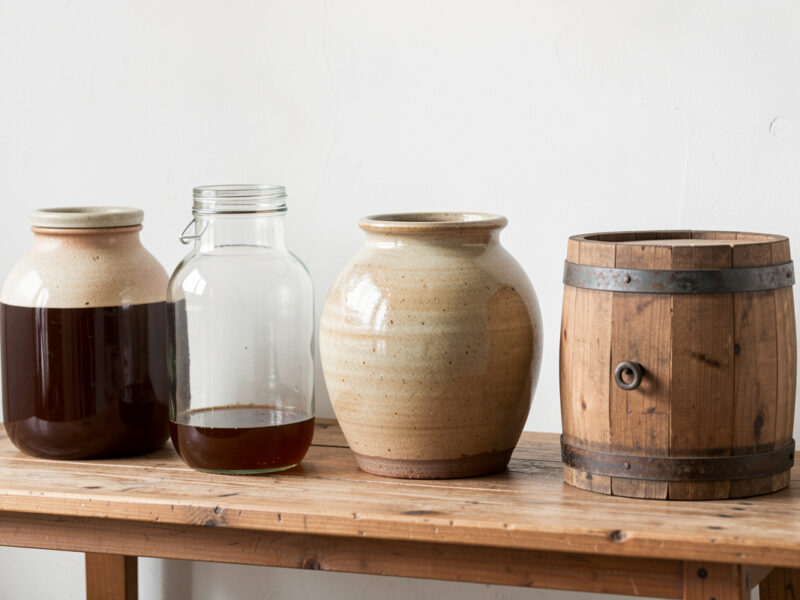
- The Best Vessels for Brewing Vinegar — why surface area beats volume, and which container to choose.
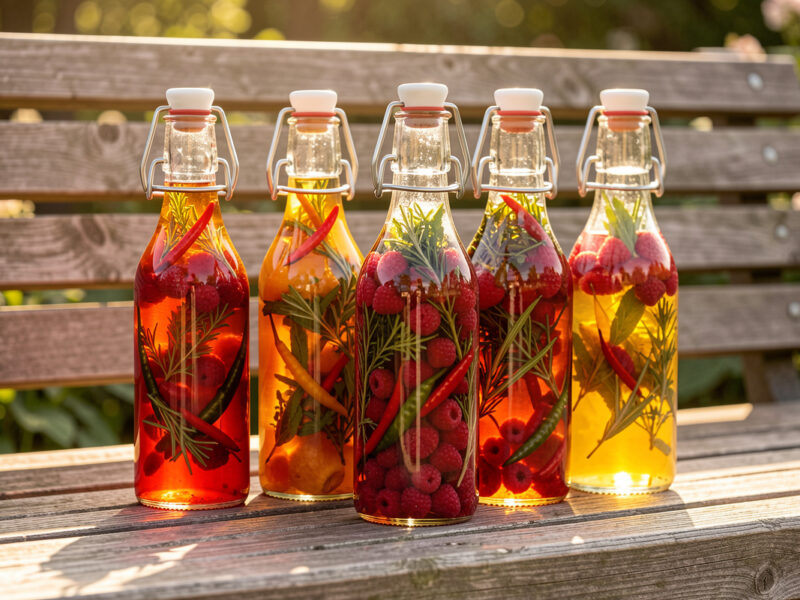
- Infused Vinegar Recipes and Methods — turning a finished batch into a shelf of flavoured vinegars, safely.
Related Guides on FermentFoundry
- How to Make Apple Cider Vinegar From Scratch (With Mother)
- How to Make Red Wine Vinegar at Home (From Bottle to Bottle)
- Vinegar Brewing at Home: Mother Cultures, Acetobacter, Curing-Brine Crossover
- Lacto-Fermentation for Vegetables: The Complete Home Guide
- Sauerkraut Mold vs Kahm Yeast: How to Tell the Difference

About Kenny Nyhus Fadil
A home fermenter documenting brines, bubbles, and the occasional moldy tragedy.